All species › Passerines › Wrens › Kalinago Wren
Kalinago Wren | Troglodytes martinicensis
Kalinagowinterkoning | Chivirín de Kalinago
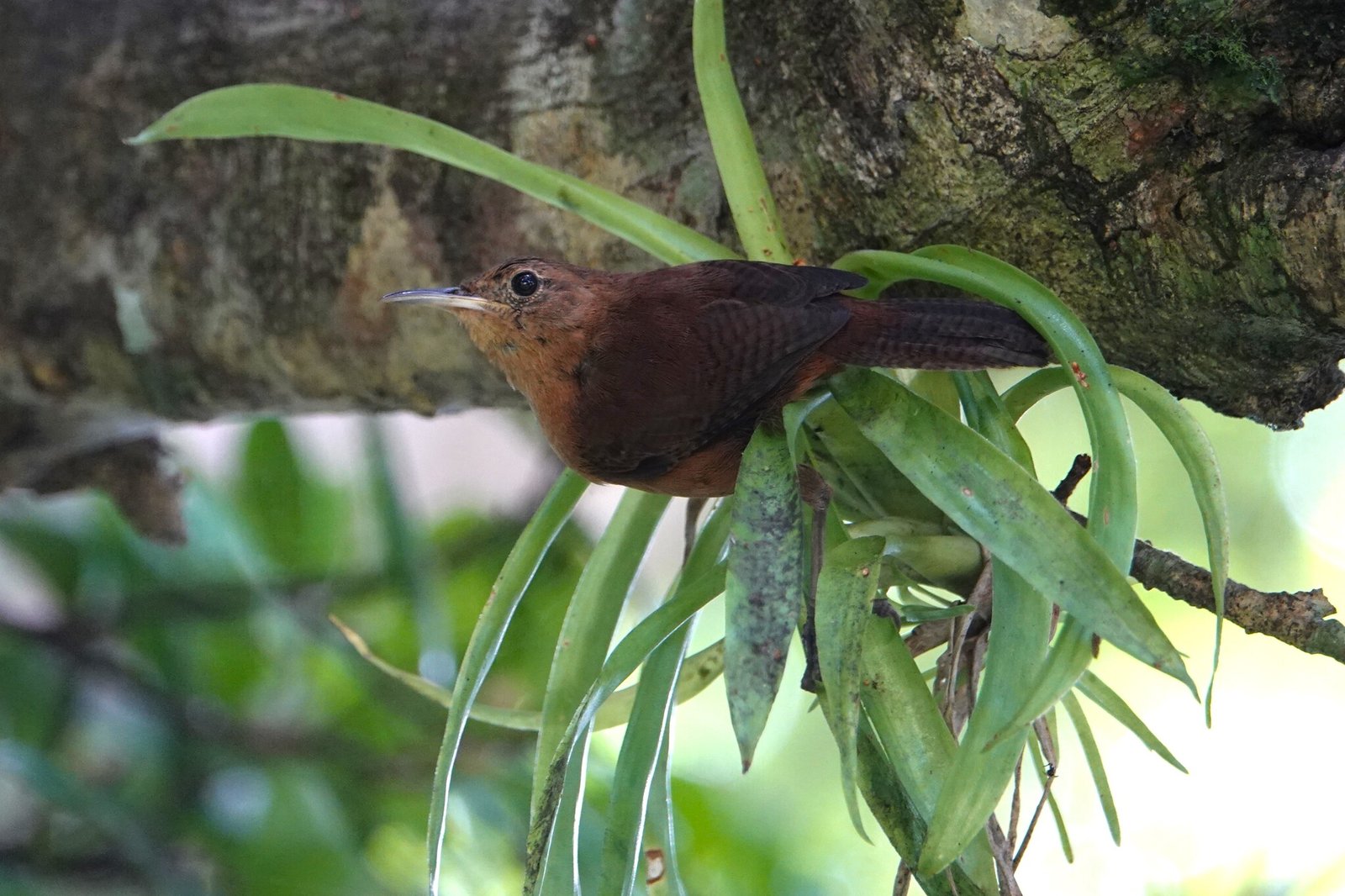
Kalinago Wren is the house wren of the northern Windward Islands, named after the Kalinago, the indigenous people of Dominica. Until 2024 it was treated as a subspecies of Northern House Wren Troglodytes aedon; on the basis of genetics, song and plumage it was then recognised, together with three other island forms, as a separate species. Of its three described forms only the Dominica one (rufescens) survives.
Voice
The song is loud and ebullient: a rapid series of clear whistles, trills and bubbling notes, clearly different from the songs of mainland house wrens. Calls are a dry, rasping chrr and a rattling chatter when alarmed.
Recording: Tate Putman — CC BY-NC 4.0 · Converted to mp3, mono, full length · iNaturalist
Identification
11–13 cm, small, with a short, often cocked tail and a fairly long, slightly curved bill with a largely yellow lower mandible. The plumage is warm rufous-brown, even more rusty on rump and tail; wings and tail finely barred dark. The underparts are also warm ochre to rusty brown, the throat slightly paler. The supercilium is faint at most. The sexes are alike.
Confusion species
The only wren on Dominica. Brown Trembler Cinclocerthia ruficauda also often cocks its tail, but is much larger, with a long, strongly curved bill and a pale eye. Female Lesser Antillean Bullfinch Loxigilla noctis is small and brown, but has a short conical bill and an unbarred tail. Northern House Wren Troglodytes aedon, which reaches the region only in the north in winter, differs in its much more rufous plumage and its long, yellow-based bill.
Habitat
Edges and clearings of moist forest and rainforest, plantations, gardens and yards, including around villages. It forages low in vegetation, among creepers, dead wood and wall crevices, for insects and spiders. It nests in cavities in trees, walls and buildings.
Where the bird is most at home, classified by the vegetation types of the Caribbean.






Range and movements
Now found only on Dominica, where it is widespread across the island. The Martinique form (martinicensis) is extinct; the Guadeloupe form (guadeloupensis) has not been reliably seen since the 1970s and is considered possibly extinct. It does not occur outside these islands.
- Resident
- dark = core range, pale = thinly spread
How and when to look
Found along forest edges and in gardens and plantations in the interior of Dominica, for example along roads through the central highlands. The loud song gives it away; it can then often be seen low in a bush or on a post.
Conservation status
Not yet assessed by IUCN (NE), as the species was only split in 2024. The loss of the Martinique and Guadeloupe populations, probably partly due to introduced predators such as the mongoose, leaves a small range: a single island. On Dominica itself the species is not considered rare.
Scientific name
Troglodytes martinicensis | (Sclater, 1866) (GBIF: Troglodytes aedon)
Sclater described the species in 1866 as Thryothorus martinicensis; because it was later moved to another genus, the author and year stand in brackets. The genus Troglodytes was introduced in 1809 by Vieillot. Troglodytes is Greek, from troglē 'hole, crevice' and dyein 'to creep into': 'cave-dweller', after the habit of disappearing into crevices and holes while foraging. martinicensis means 'of Martinique', where the type was collected. The specimen the first description was based on came from Martinique.