All species › Pelicans, herons and ibises › Herons and bitterns › Least Bittern
Least Bittern | Botaurus exilis
Amerikaans woudaapje | Avetorillo panamericano
The Least Bittern is the smallest heron in the region, barely bigger than a thrush but with a long neck. It lives hidden in dense marsh vegetation and is heard more often than seen. Long placed in the genus Ixobrychus, it is now included with the larger bitterns in Botaurus.
Voice
Mainly at dusk the male gives a soft, low, cooing coo-coo-coo; also a rapid, dry kek-kek-kek as an alarm or contact call.
Recording: José María Loaiza B. — CC BY-NC-SA 4.0 · converted to mono · xeno-canto
Identification
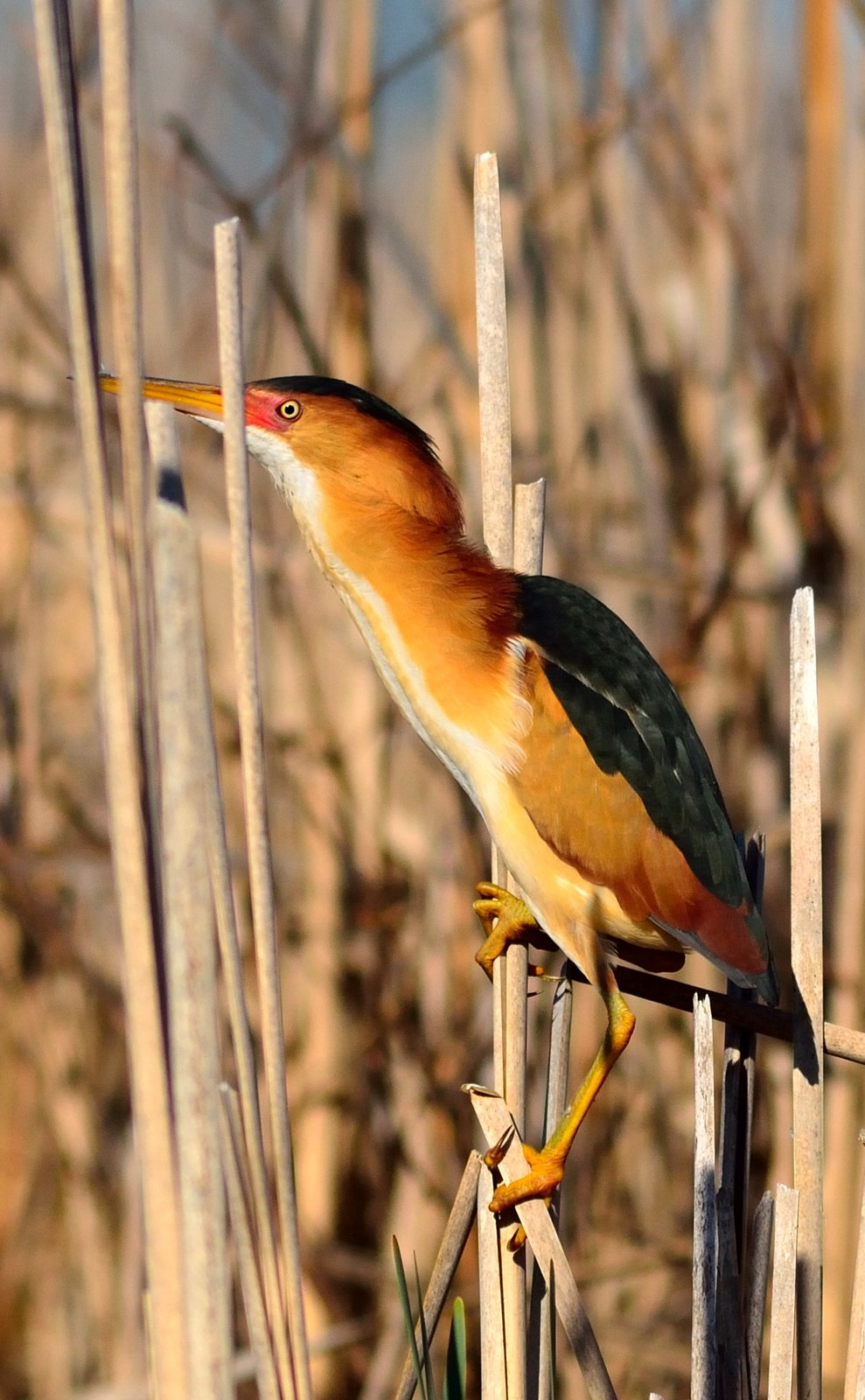
28–36 cm, small and slim, with a thin yellow bill and yellow-green legs. The male has a black crown and back, a creamy streaked foreneck, ochre-brown neck sides and a large pale buff wing patch that stands out in flight against the dark flight feathers. The female has a dark chestnut crown and back with pale stripes and a more heavily streaked neck. Juveniles resemble females but are duller and more streaked.
Confusion species
Green Heron Butorides virescens is larger and darker, with a dark green back, chestnut neck and no pale wing patch. Striated Heron Butorides striata is grey with a dark crown and also lacks the wing patch. American Bittern Botaurus lentiginosus is much larger, streaked brown and has a black neck stripe.
Habitat
Dense fresh and brackish marshes with cattail, reeds and sedges, pond edges with fringing vegetation, rice fields and the landward side of mangroves. It clambers skilfully through the stems, gripping several at once, and hunts from the vegetation for small fish, frogs and insects. When alarmed it freezes with the bill pointing up. The nest is a platform of bent stems over water.
Where the bird is most at home, classified by the vegetation types of the Caribbean.



Range and movements
Resident in Cuba, Jamaica, Hispaniola (Haiti and the Dominican Republic), Puerto Rico and Guadeloupe; in smaller numbers or irregularly reported from the Bahamas, the Cayman Islands, the Virgin Islands, Martinique and Trinidad. A rare vagrant to Aruba and Curaçao. Some winter birds in the north of the region come from North America. Outside the region from south-eastern Canada and the eastern and southern United States through Mexico and Central America to northern Argentina.
- Resident
- dark = core range, pale = thinly spread
How and when to look
Extensive cattail marshes, such as the Ciénaga de Zapata in Cuba, in early morning or evening. The bird is usually seen on a short flight over the reeds, with the pale wing patch as the key feature, or clinging at the edge of an opening in the vegetation. The cooing gives its presence away.
Conservation status
Not threatened. The species is widespread, but in the region habitat is lost through the draining and filling of marshes. Because of its secretive habits, numbers and trends on most islands are poorly known.
Scientific name
Botaurus exilis | (Gmelin, 1789)
Gmelin described the species in 1789 as Ardea exilis; because it was later moved to another genus, the author and year stand in brackets. The genus Botaurus was introduced in 1819 by Stephens. Botaurus is Medieval Latin for a bittern; the word combines Latin bos 'ox' with taurus 'bull', after the booming call (compare butire 'to boom'). exilis is Latin for 'small, slender', after the tiny size of this bittern. The specimen the first description was based on came from Jamaica.