All species › Passerines › Tanagers › Lesser Antillean Tanager
Lesser Antillean Tanager | Stilpnia cucullata
Grenadatangare | Tangara de Granada
The Lesser Antillean Tanager is the only tanager of the genus Stilpnia in the Lesser Antilles and occurs only on Grenada and St Vincent. The birds of the two islands belong to separate subspecies and are treated by some authors, including BirdLife, as two species: Grenada Tanager and St Vincent Tanager. They live in pairs or family groups and are also found in gardens and plantations.
Voice
Calls are thin, high tsip notes. The song is a short series of high, somewhat squeaky notes.
No recording with a suitable Creative Commons licence is available for this species yet.
Identification
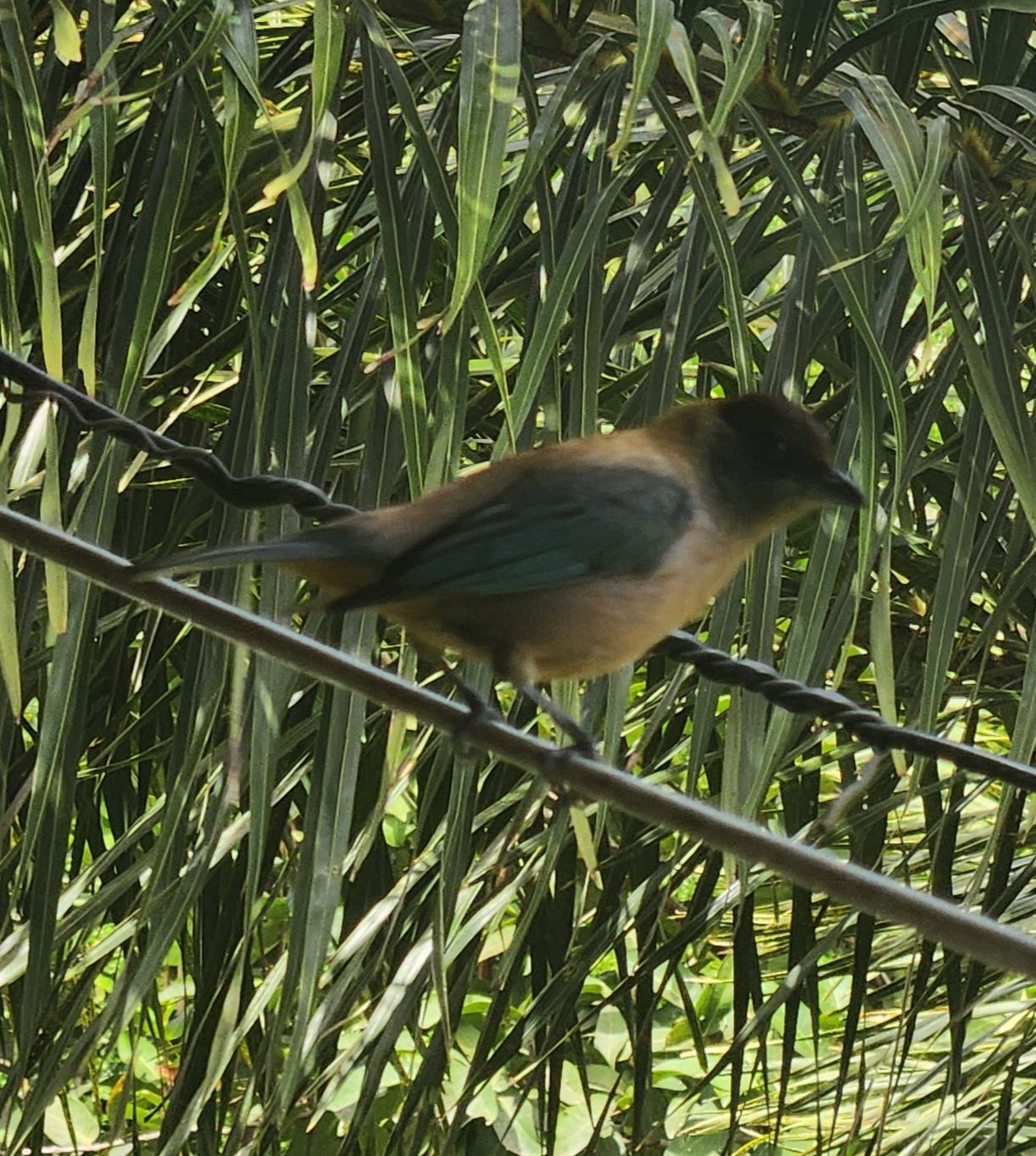
14–15 cm, with a short, pointed bill. The male has a chestnut cap covering the crown and ear-coverts, dark brown on Grenada and more reddish-brown on St Vincent. The upperparts are golden buff to orange-yellow, sometimes with a green sheen; wings and tail are blackish with blue-green edges. The underparts are grey-green to lavender-buff, with dark mottling on the throat, the undertail coverts tawny-buff. The female is duller and greener. Juveniles are duller, with an indistinct cap.
Confusion species
No other tanager of this shape occurs on Grenada or St Vincent. The female Lesser Antillean Bullfinch Loxigilla noctis is olive-brown and has a much heavier, conical bill. Lesser Antillean Euphonia Chlorophonia flavifrons is smaller and more compact, green with a yellow forehead and, in the male, a blue crown. Bananaquit Coereba flaveola is smaller, with a curved bill and a white supercilium.
Habitat
Rainforest and moist forest in the mountains, where it is most numerous, but also dry forest, secondary forest, forest edges, scrub, plantations and gardens, from sea level to about 850 m. It feeds mainly on fruit and gathers at fruiting trees; it also takes insects. It breeds from April to July; the nest is a cup of dead leaves a few metres up in a tree or shrub, often near buildings. The clutch is two eggs.
Where the bird is most at home, classified by the vegetation types of the Caribbean.




Range and movements
Only on Grenada (subspecies cucullata) and St Vincent (subspecies versicolor). Fairly common to scarce on both islands, most numerous in the forested mountains. It is not known to breed in the Grenadines. Single reports from Antigua and St Lucia are unconfirmed. The species does not occur outside these two islands.
- Resident
- dark = core range, pale = thinly spread
How and when to look
On Grenada the Grand Etang area and gardens with fruit trees in the hills are good places, on St Vincent the forest of the Vermont Nature Trail and the botanic garden in Kingstown. Fruiting trees attract family groups.
Conservation status
Not threatened. The range is very small, but the species is locally fairly common and adapts well to man-made landscapes. Hurricanes and, on St Vincent, volcanic eruptions can severely damage the forest for a time.
Scientific name
Stilpnia cucullata | (Swainson, 1834)
Swainson described the species in 1834 as A[glaia] Cucullata; because it was later moved to another genus, the author and year stand in brackets. The genus Stilpnia was introduced in 2016 by Burns, Unitt & Mason. Stilpnia comes from Greek stilpnos 'glittering, glistening', after the glossy plumage. cucullata is Latin for 'hooded', after the rufous hood. The specimen the first description was based on came from Grenada (designated later; originally no locality).