All species › Tubenoses › Petrels and shearwaters › Manx Shearwater
Manx Shearwater | Puffinus puffinus
Noordse pijlstormvogel | Pardela pichoneta
The Manx Shearwater breeds mainly on islands around Britain and Ireland and winters off the east coast of South America. On migration between these areas a small proportion of the birds passes through Caribbean waters. Here it is a rare passage migrant that sometimes mixes with Sargasso Shearwaters.
Voice
Silent at sea. At the colony, loud, harsh crowing calls at night, from burrows and in flight.
Recording: Anthony McGeehan — CC BY-NC-SA 4.0 · shortened to the first 60 s, mono · xeno-canto
Identification
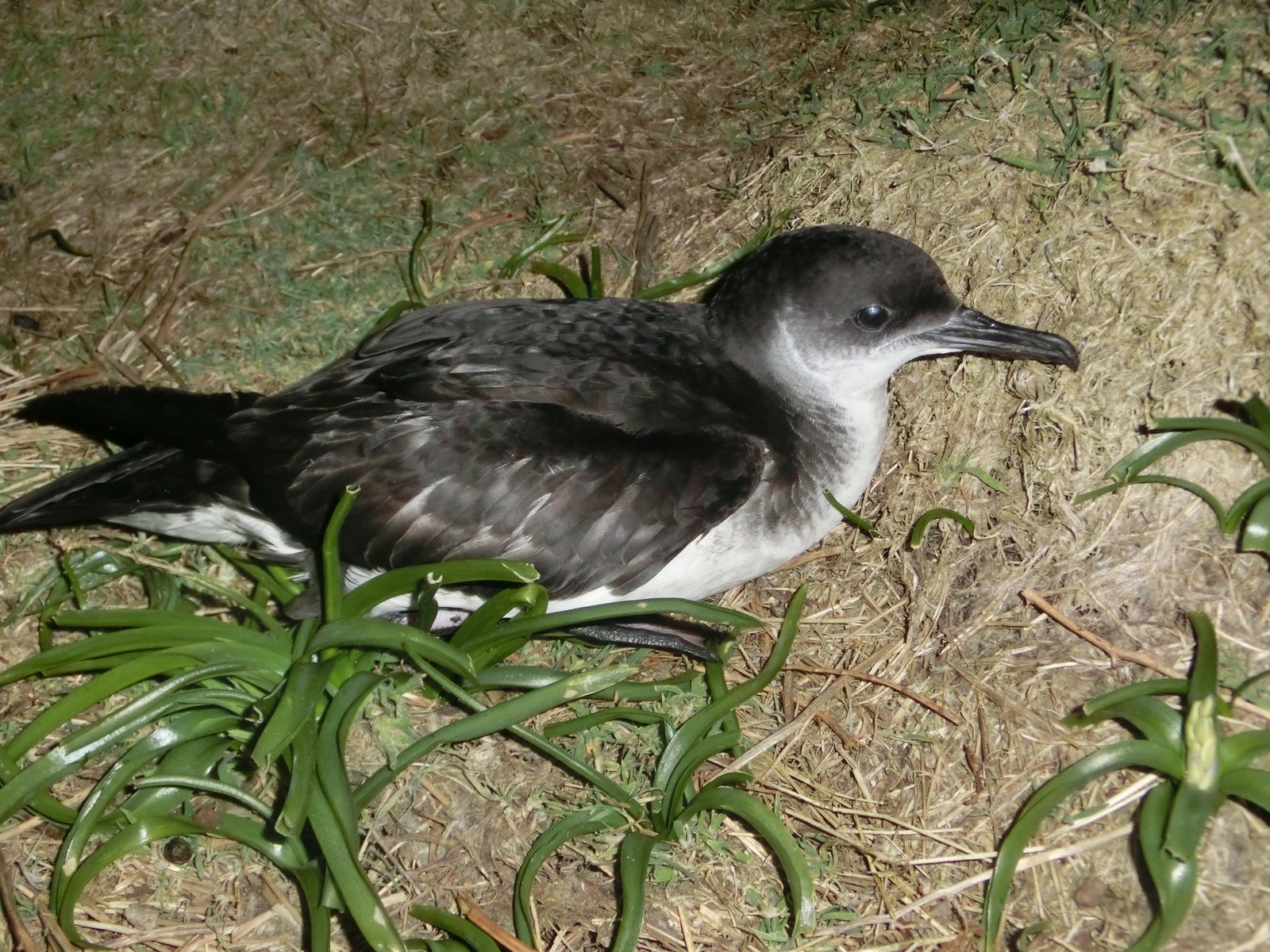
30–38 cm. A medium-sized black-and-white shearwater with long, straight, narrow wings. Upperparts, head to below the eye and tail blackish; underparts and underwing bright white with a narrow dark border. Behind the ear coverts the white of the neck side curves up in a crescent. The undertail coverts are white. Bill slender and dark, legs pink with a dark outer side. It flies low over the water with bursts of quick, stiff beats and banking glides, showing black upperparts and white underparts in turn. The sexes are alike.
Confusion species
Sargasso Shearwater Puffinus lherminieri, the common small shearwater of the region, is smaller, with shorter, broader wings, a relatively longer tail, dark undertail coverts and a faster, fluttering flight with shorter glides. Great Shearwater Ardenna gravis is much larger, with browner upperparts, a white collar and a white band across the rump.
Habitat
Open ocean and coastal waters over the continental shelf. It eats small shoaling fish and squid, caught at the surface or in short dives. It breeds in burrows on vegetated islands and mountain slopes.
Where the bird is most at home, classified by the vegetation types of the Caribbean.


Range and movements
A rare passage migrant at sea in the region, with records from, among others, the Bahamas, Puerto Rico and the Lesser Antilles. Beyond the region it breeds mainly on islands around Britain and Ireland, and also in Iceland, the Faroes, Brittany, the Azores, Madeira and the Canary Islands, with small numbers in north-eastern North America. It winters in the South Atlantic, mainly off Brazil and Argentina.
- Passage (Mar–Apr, Oct–Nov)
- dark = core range, pale = thinly spread
How and when to look
Chances are best on pelagic trips and during seawatches. Among Sargasso Shearwaters the white undertail, longer and narrower wings and calmer flight with longer glides stand out; photographs of the undertail help with identification.
Conservation status
Not threatened, although the population is slowly declining. About 95% of the world population breeds in Europe, partly in a few large colonies where introduced rats are the main threat; rat eradication has led to recovery on several islands. At sea bycatch and oil pollution play a part.
Scientific name
Puffinus puffinus | (Brünnich, 1764)
Brünnich described the species in 1764 as Procellaria puffinus; because it was later moved to another genus, the author and year stand in brackets. The genus Puffinus was introduced in 1760 by Brisson. Puffinus comes from English puffin and its variants, the name for the cured nestling of the shearwater, once a delicacy. The specific name repeats the genus name. The specimen the first description was based on came from the Faroe Islands and Norway.