All species › Passerines › Tanagers › Olive-grey Saltator
Olive-grey Saltator | Saltator olivascens
Caribische grijze saltator | Pepitero oliváceo
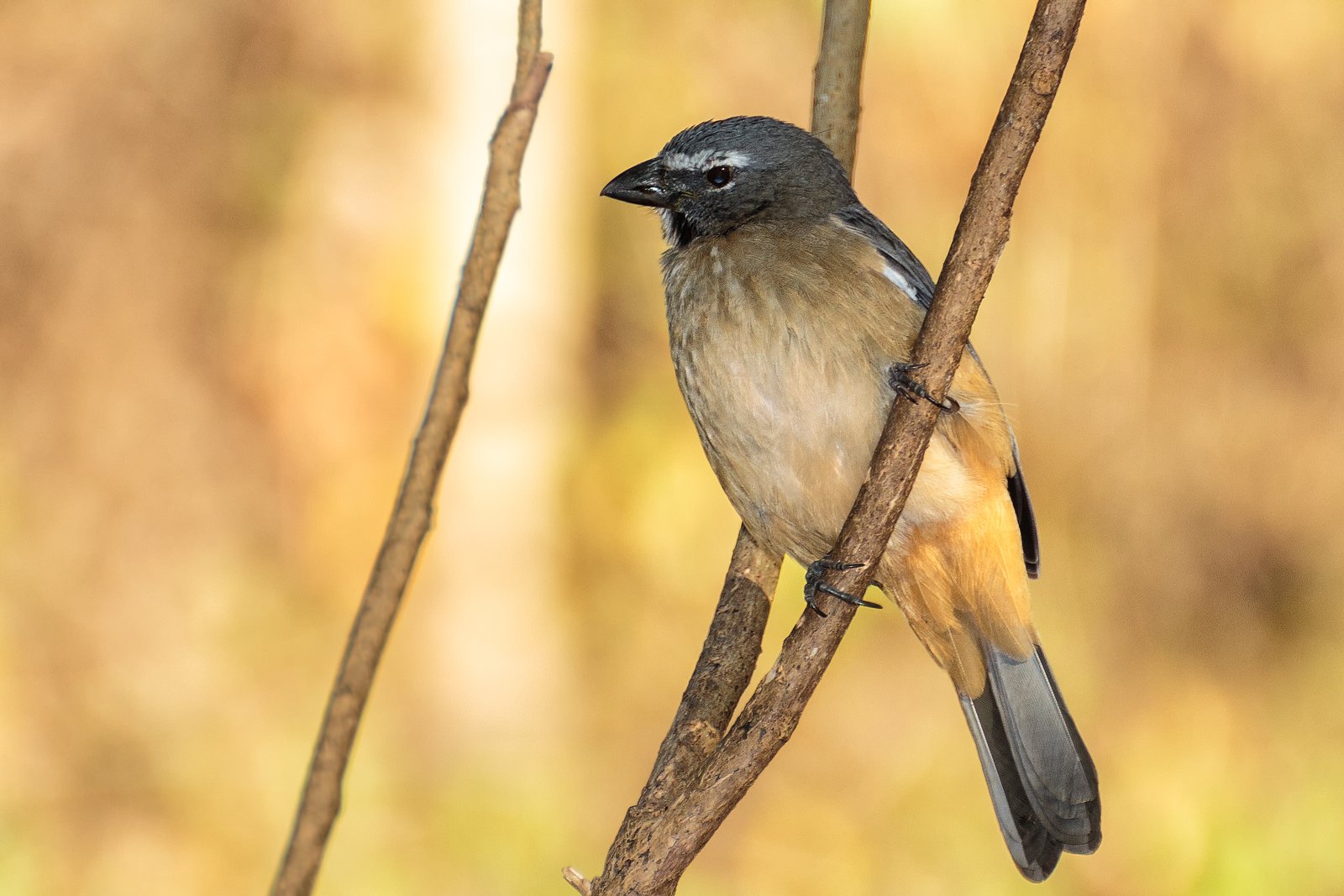
The Olive-grey Saltator is a large, grey tanager with a heavy bill, common on Trinidad in gardens, plantations and forest edges. It was long treated as part of Greyish Saltator Saltator coerulescens, but has been recognised by the IOC as a separate species since 2021, on the basis of differences in song and genetics.
Voice
The song is a stuttering series of rather harsh, downslurred whistles; both sexes sing and pairs sometimes duet. The call is a short, high tseet.
Recording: Hernán Arias — CC BY-NC-SA 4.0 · converted to mono · xeno-canto
Identification
20–21 cm, large, with a long tail and a thick, black, slightly hooked bill. Head, back, wings and tail are dark grey; despite the name, the back is barely olive. A short white eyebrow runs from the bill to above the eye, with a thin white crescent below the eye. The white throat is bordered on each side by a black malar stripe. The underparts are pale grey, the flanks and undertail coverts buff to cinnamon. The sexes are alike. Juveniles are washed olive-green and yellow, especially below.
Confusion species
Streaked Saltator Saltator striatipectus, in the region found only on Chacachacare, has an olive-green back and pale, darkly streaked breast, and lacks the sharp black malar stripe. Lesser Antillean Saltator Saltator albicollis of the Lesser Antilles also has a green back and streaked breast, and does not occur on Trinidad. Tropical Mockingbird Mimus gilvus is also grey, but slimmer, with a thin bill and white tips to the tail.
Habitat
Forest edges, scrub, second growth, marsh edges and farmland with scattered trees; also gardens, orchards, plantations and town parks. It often sings from the treetops but forages at all levels. It eats mainly plant matter, especially fruit and leaves, and feeds its young on insects. It often spends long periods resting, singing or preening.
Where the bird is most at home, classified by the vegetation types of the Caribbean.





Range and movements
In the region only on Trinidad, where it is common in the lowlands and hills; it is absent from Tobago. Trinidad birds belong to the subspecies brewsteri, which also occurs in north-eastern Colombia and Venezuela. Elsewhere the subspecies plumbeus lives in northern Colombia and the nominate form in southern Venezuela, the Guianas and adjacent northern Brazil.
- Resident
- dark = core range, pale = thinly spread
How and when to look
On Trinidad in almost any lowland garden, plantation or forest edge. The loud, stuttering song is the best lead; the singing bird often perches high and in the open in a tree.
Conservation status
Not threatened. The species is common and adapts well to man-made landscapes such as gardens, orchards and parks.
Scientific name
Saltator olivascens | Cabanis, 1849
Cabanis described the species in 1849 and placed it straight away in the genus where it still stands. The genus Saltator was introduced in 1816 by Vieillot. Saltator is Latin for 'dancer, leaper', after the birds' hopping movements. olivascens is Latin for 'becoming olive, olivaceous', after the greyish-olive upperparts. The specimen the first description was based on came from Guyana.