All species › Passerines › Tanagers › Orangequit
Orangequit | Euneornis campestris
Jamaicaanse suikervogel | Semillero azulillo
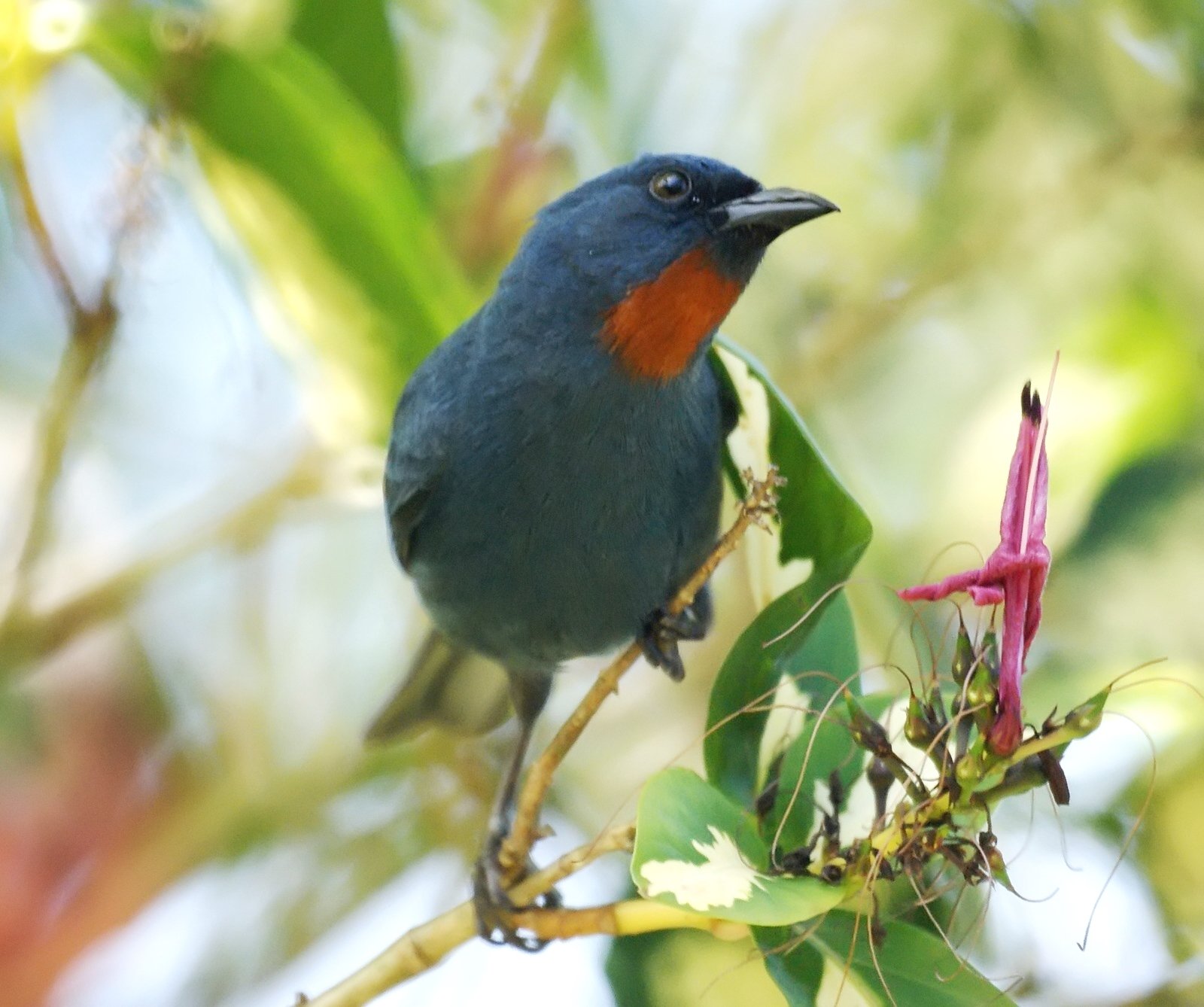
The Orangequit is an endemic songbird of Jamaica and the only member of the genus Euneornis. It belongs to the same group within the tanager family as the Bananaquit and the Antillean bullfinches. It feeds mainly on nectar and is locally common in the island's forests.
Voice
A thin, high tseet or swee, also given in flight. The song is weak.
Recording: Nick Komar — CC BY-NC-SA 4.0 · converted to mono · xeno-canto
Identification
14 cm, with a short, slightly curved, pointed black bill. The male is uniform grey-blue with an orange-red throat; in poor light it looks all dark. The female has an olive-grey crown and nape and is otherwise greyish white on the head and underparts, with a grey-olive back. Juveniles resemble the female.
Confusion species
The male Jamaican Euphonia Euphonia jamaica is also grey-blue, but smaller and stockier, with a stubby bill and a yellow belly, and no orange throat. The Bananaquit Coereba flaveola has a white supercilium and a yellow breast. Females may recall a female Jamaican Spindalis Spindalis nigricephala, but that is larger, with a thick bill and an orange-yellow wash on the breast.
Habitat
Moist and semi-evergreen forest, montane forest, the karst forest of Cockpit Country, forest edges, open woodland and shade coffee plantations, from the lowlands to about 1500 m. It feeds mainly on nectar, supplemented by fruit, seeds and invertebrates, and also drinks sap from the holes drilled by Yellow-bellied Sapsucker Sphyrapicus varius. It forages alone or in pairs, mostly in the lower and middle storeys. It breeds from April to June in an open cup of grass and plant fibres, usually up to about 6 m high; the clutch is two to four eggs and only the female incubates.
Where the bird is most at home, classified by the vegetation types of the Caribbean.





Range and movements
Only in Jamaica, throughout the island wherever there is forest, most numerous in the hills and mountains. The species does not occur outside Jamaica.
- Resident
- dark = core range, pale = thinly spread
How and when to look
In the Blue Mountains, for example along the road at Hardwar Gap, and in Cockpit Country. Flowering trees and shrubs at forest edges are the best places; in winter, trees with sapsucker wells are worth watching. The male stands out only when the orange throat catches the light.
Conservation status
Not threatened. The species is locally common and the population appears stable. Forest loss is the main potential threat, but tree cover loss in Jamaica is currently low.
Scientific name
Euneornis campestris | (Linnaeus, 1758)
Linnaeus described the species in 1758 as Motacilla campestris; because it was later moved to another genus, the author and year stand in brackets. The genus Euneornis was introduced in 1856 by Fitzinger. Euneornis combines Greek eu 'good' with Neornis, a genus introduced by Edward Blyth (1845), now a synonym of Cettia. campestris is Latin for 'of the fields'; a rather unfitting name for this bird of Jamaican forests. The specimen the first description was based on came from Jamaica.