All species › Waders, gulls and terns › Plovers and lapwings › Piping Plover
Piping Plover | Charadrius melodus
Dwergplevier | Chorlito melódico
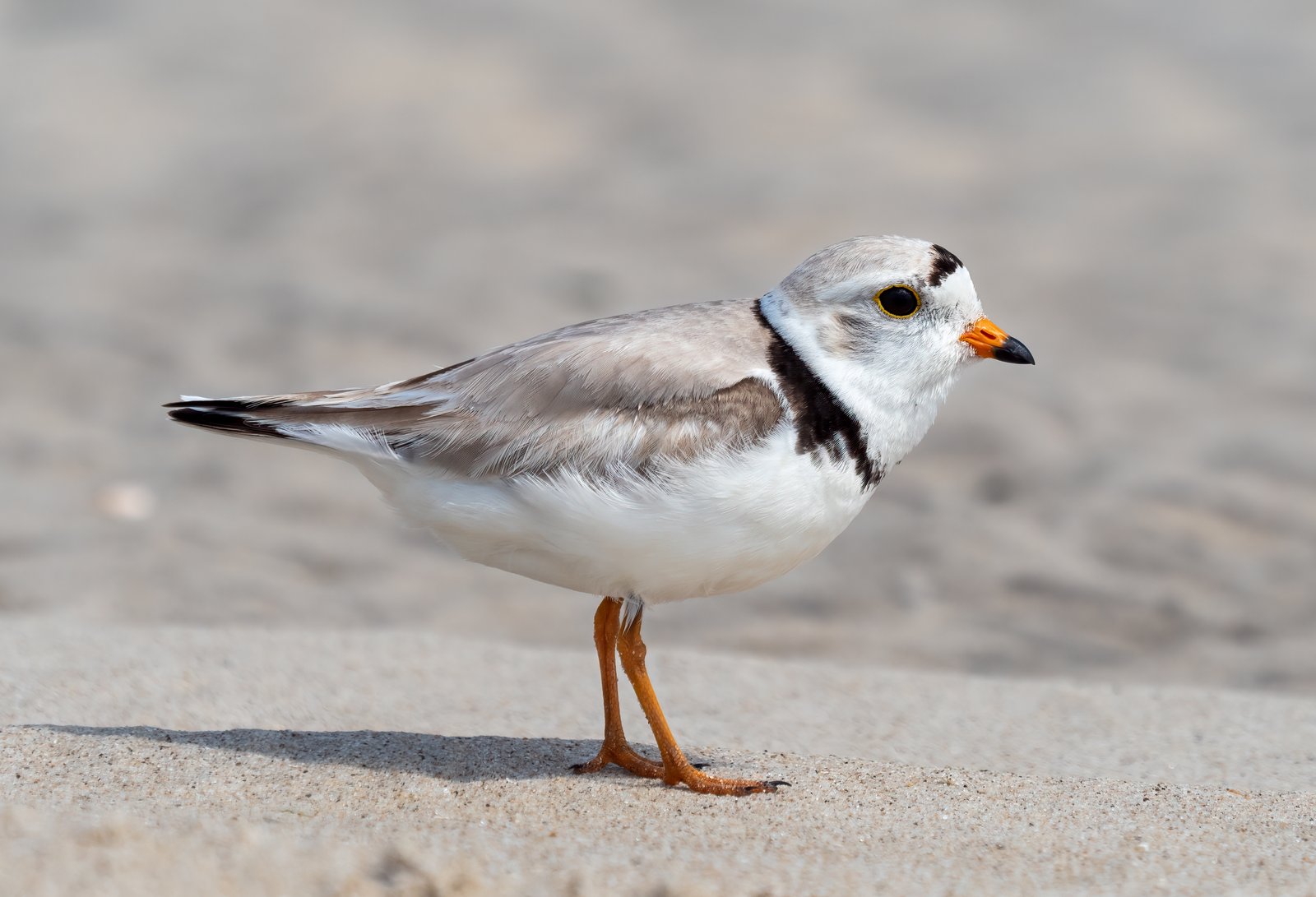
The Piping Plover is a pale, sand-coloured plover of North American beaches and lake shores that winters mainly in the northern Caribbean. Only in 2006 did it become clear how many birds spend the winter in the Bahamas; the archipelago is now regarded as one of the most important wintering areas for the species. In Cuba it is called frailecillo silbador.
Voice
A soft, clear whistled peep-lo or single peep, from which the English and Spanish names derive. In winter it calls little; often the call is heard only from birds taking flight.
Recording: Will Sweet — CC BY-NC-SA 4.0 · converted to mono · xeno-canto
Identification
17–18 cm. A small, compact plover with a round head and a short, stubby bill. The upperparts are pale sandy grey, the underparts white. In breeding plumage, which can already show in spring, there is a narrow black band across the forehead, a narrow black breast band that may be broken in the middle, and an orange bill with a black tip. In winter plumage the black is lacking; the breast band is then a faint grey patch on the side of the breast and the bill is dark. The legs are yellow-orange all year. In flight it shows a clear white wingbar and a white rump with a dark tail tip.
Confusion species
Snowy Plover Anarhynchus nivosus is just as pale but slimmer, with a thin black bill, dark legs and a dark patch on the side of the breast. Semipalmated Plover Charadrius semipalmatus is much darker brown above, with a dark mask. Sanderling Calidris alba uses the same beaches but has a longer black bill, black legs and the behaviour of a sandpiper.
Habitat
Wide sandy beaches, sand and mud flats exposed at low tide, the edges of shallow bays with seagrass, and sand and coral cays. It forages on open sand and mud for worms, small crustaceans and insects, in the typical plover rhythm of run, stop and peck. At high tide it roosts on higher sand ridges, wrack lines or bare cays, often with other small shorebirds.
Where the bird is most at home, classified by the vegetation types of the Caribbean.



Range and movements
Winters mainly in the Bahamas, with the largest numbers around Andros, the Joulter Cays and the Berry Islands, and further on the Turks and Caicos Islands and along the cays of the north coast of Cuba; in smaller numbers on Hispaniola. Elsewhere scarce to rare: Puerto Rico, the Virgin Islands, Sint Maarten and Guadeloupe, and very rarely further south. Beyond the region it breeds along the Atlantic coast of Canada and the United States, around the Great Lakes and on the Great Plains, and winters further along the coasts of the south-eastern United States, the Gulf of Mexico and north-eastern Mexico.
- Resident
- Winter visitor (c. Apr–Sep)
- Passage (Mar–Apr, Oct–Nov)
- dark = core range, pale = thinly spread
How and when to look
In the Bahamas best at low tide on the extensive sand flats of the Joulter Cays and Andros, reached by boat. On busy beaches the birds are sensitive to disturbance; keeping a distance and dogs on a lead gives them rest. Colour rings are widely read and reported to the research programmes on the breeding grounds.
Conservation status
Near Threatened. The world population is small; in Canada and the United States the species is legally protected and closely guarded on the breeding grounds. A count in 2011 found more than a thousand birds in the Bahamas, an estimated fifth of the Atlantic Coast population. On the wintering grounds disturbance, coastal development and sea-level rise are the main threats.
Scientific name
Charadrius melodus | Ord, 1824
Ord described the species in 1824 and placed it straight away in the genus where it still stands. The genus Charadrius was introduced in 1758 by Linnaeus. Charadrius is Late Latin, from Ancient Greek kharadrios, a plain-coloured nocturnal bird of ravines and river valleys, from kharadra 'ravine'. melodus is Greek, from melōidos 'melodious', after the clear, piping call. The specimen the first description was based on came from Great Egg Harbor, New Jersey.