All species › Hummingbirds and swifts › Hummingbirds › Puerto Rican Emerald
Puerto Rican Emerald | Riccordia maugaeus
Puerto Ricaanse smaragdkolibrie | Zumbadorcito de Puerto Rico
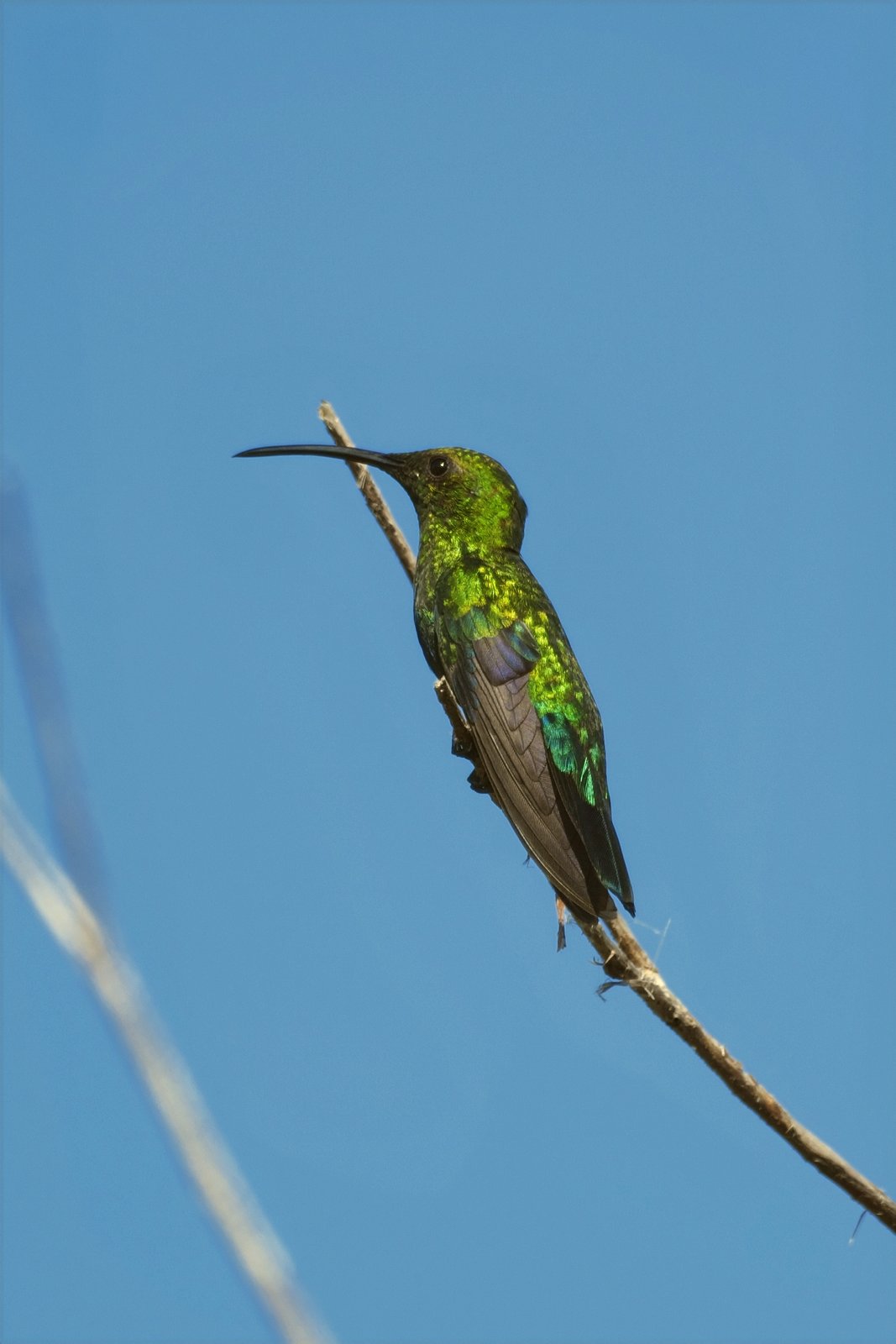
The Puerto Rican Emerald is the smallest hummingbird of Puerto Rico and occurs throughout the island, from coastal mangroves to montane forest on the summits. Male and female look very different.
Voice
The song is a repeated twittering phrase of high, descending notes followed by a series of lisping notes. The call is a high tsik.
Recording: Daniel Lane — CC BY-NC-SA 3.0 · shortened to the first 60 s, mono · xeno-canto
Identification
7.5–9.5 cm, the female smaller than the male, with a short, straight bill and, in both sexes, a small white spot behind the eye. The male is dark metallic green above, with a glossy bluish-green throat, shining green underparts and a forked, steel-blue tail. The female is grass-green above and pale grey below, darker towards the belly; her tail is less deeply forked, with green central feathers, steel-blue inner feathers and outer feathers with a pale base and white tip.
Confusion species
Antillean Crested Hummingbird Orthorhyncus cristatus, in eastern Puerto Rico, is similar in size, but the male has a pointed, green-blue crest, dark grey underparts and a rounded tail; the female lacks the white spot behind the eye. Green Mango Anthracothorax viridis and Hispaniolan Mango Anthracothorax dominicus are much larger, with a long, curved bill.
Habitat
Almost all wooded landscapes of the island: mangroves, dry coastal forest, humid lowland forest, montane forest and cloud forest on the summits, secondary forest, plantations, and also gardens and urban areas. It feeds at all levels of the forest and catches small insects. It breeds year-round, peaking from February to May; the nest is often low in a shrub.
Where the bird is most at home, classified by the vegetation types of the Caribbean.




Range and movements
Endemic to Puerto Rico, throughout the island. It is not known as a breeding bird on the surrounding islands.
- Resident
- dark = core range, pale = thinly spread
How and when to look
Common in El Yunque, the montane forest of Maricao and the dry forest of Guánica; also in gardens and parks. Females are recognised by the pale grey underparts and the white spot behind the eye, males by the steel-blue, forked tail.
Conservation status
Not threatened. The species is common and adapts well to man-modified landscapes.
Scientific name
Riccordia maugaeus | (Audebert & Vieillot, 1801)
Audebert & Vieillot described the species in 1801 as Trochilus Maugaeus; because it was later moved to another genus, the author and year stand in brackets. The genus Riccordia was introduced in 1854 by Reichenbach. Riccordia honours the French surgeon and naturalist Alexandre Ricord (b. 1798), after whom the type species ricordii is also named. maugaeus honours the French zoologist René Maugé (1757–1802), who collected in the West Indies in 1796–1798. The specimen the first description was based on came from Puerto Rico.