All species › Pelicans, herons and ibises › Herons and bitterns › Reddish Egret
Reddish Egret | Egretta rufescens
Roodhalsreiger | Garceta rojiza
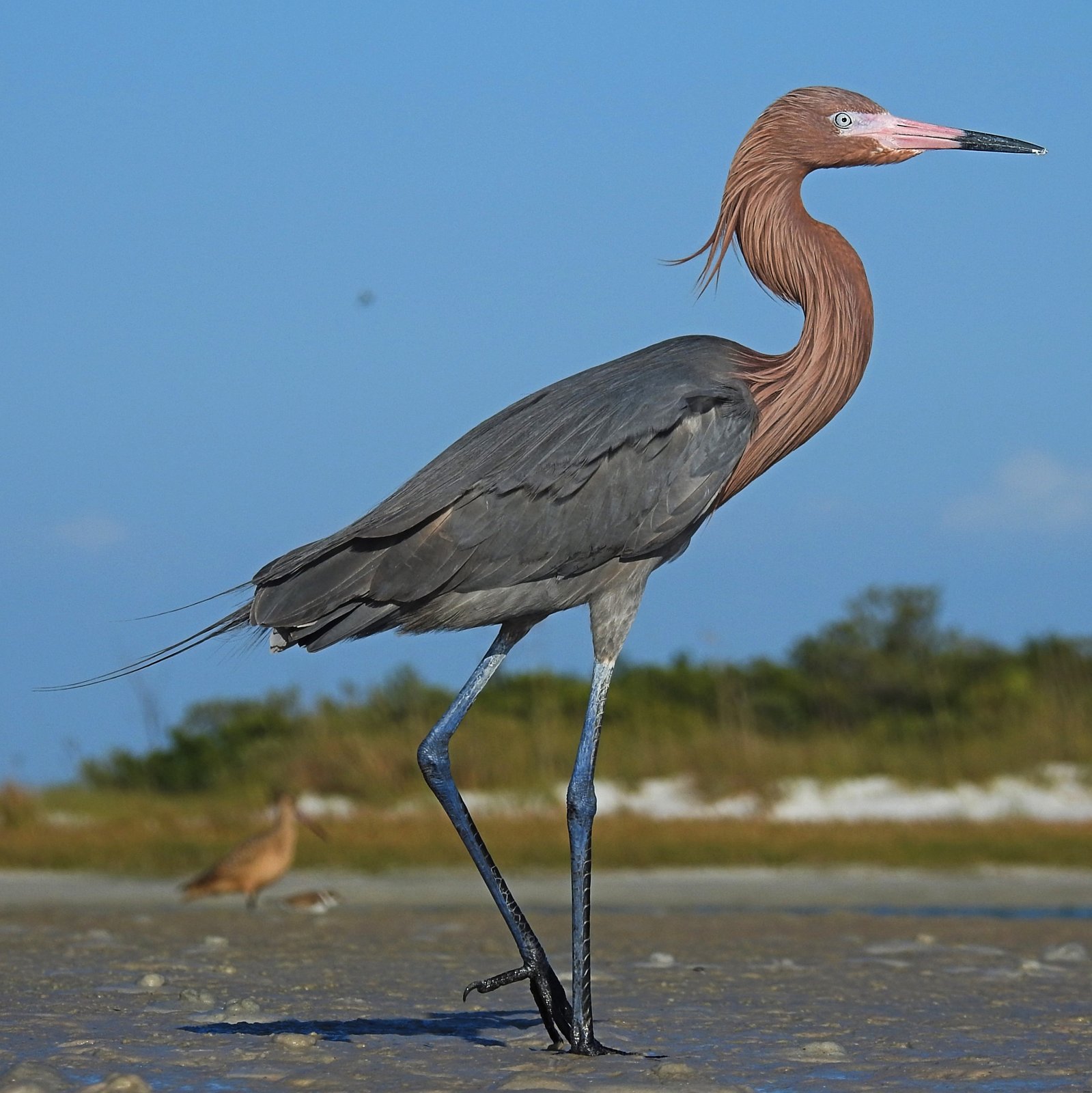
The Reddish Egret is a large heron of salt ponds and shallow, open coastal water, with a distinctive hunting style: it runs, leaps and spins through the water and at times spreads its wings as a canopy, probably to cut out glare from the surface. In the region it is mainly a bird of the Bahamas, the Turks and Caicos Islands, Cuba, Hispaniola and the ABC islands. It occurs in a dark and a white morph.
Voice
Mostly silent. At the colony and in disputes with other birds a low, hoarse croak and a short, grunting kraa.
Recording: Isain Contreras Rodríguez — CC BY-NC-SA 4.0 · converted to mono · xeno-canto
Identification
68–82 cm, heavy, with a long, straight bill and long, blue-black legs. The dark morph is slate grey with a rufous-brown head and neck; in the breeding season the neck feathers are long and shaggy, giving a maned look, and the back carries long grey plumes. The white morph is entirely white. Breeding adults of both morphs have a pink bill with a sharply defined black tip; outside the breeding season the bill is mostly dark. Juveniles of the dark morph are fairly uniform grey-brown with a paler, rufous-tinged neck, those of the white morph white; both have a dark bill. The sexes are alike.
Confusion species
Tricolored Heron Egretta tricolor is smaller and slimmer, with a white belly and a white neck stripe. Little Blue Heron Egretta caerulea is smaller, with a smooth, purplish-brown neck and a grey-blue bill with a black tip. The white morph resembles Great Egret Ardea alba, which is larger, with a yellow bill and black legs, and Snowy Egret Egretta thula, which is smaller, with a black bill and yellow feet. The two-toned bill, blue-black legs and restless feeding point to Reddish Egret.
Habitat
Shallow, open saltwater flats: salt ponds, clear lagoons, tidal flats, sandbars and seagrass shallows; rarely fresh water. It hunts small fish and crustaceans in water from a few centimetres to a few decimetres deep. It nests in colonies, often with other herons, in low mangroves or scrub on islets and cays.
Where the bird is most at home, classified by the vegetation types of the Caribbean.




Range and movements
Commonest in the Bahamas, with large numbers on Great Inagua, in the Turks and Caicos Islands, on Cuba and its cays, and on Hispaniola, especially in the Dominican Republic. Also regular on the ABC islands, with most birds on Bonaire. Scarce on Jamaica, the Cayman Islands and Puerto Rico; a rare visitor to the Virgin Islands, the Lesser Antilles, San Andrés and Trinidad and Tobago. Outside the region along the Gulf coast of the United States and Mexico, on the Yucatán Peninsula, along the Pacific coast of Mexico and locally along the Caribbean coast of Central America and northern South America.
- Resident
- dark = core range, pale = thinly spread
How and when to look
Shallow salt ponds and lagoons with open water, for example on Bonaire, Great Inagua and the cays off northern Cuba. The species can be picked out at a distance by its restless feeding and, in breeding adults, the two-toned bill.
Conservation status
Near Threatened globally. The world population is small and its habitat limited and fragmented. Around 1900 it suffered heavily from the plume trade. The main threats now are the loss and disturbance of coastal lagoons and nesting islets through building, tourism and recreation.
Scientific name
Egretta rufescens | (Gmelin, 1789)
Gmelin described the species in 1789 as Ardea rufescens; because it was later moved to another genus, the author and year stand in brackets. The genus Egretta was introduced in 1817 by Forster. Egretta comes from Provençal aigrette, the name for the little egret, a diminutive of aigron 'heron'. rufescens is Latin for 'reddish', after the rusty head and neck of the dark morph. The specimen the first description was based on came from Louisiana.