All species › Pigeons and doves › Pigeons and doves › Ring-tailed Pigeon
Ring-tailed Pigeon | Patagioenas caribaea
Ringstaartduif | Paloma jamaicana
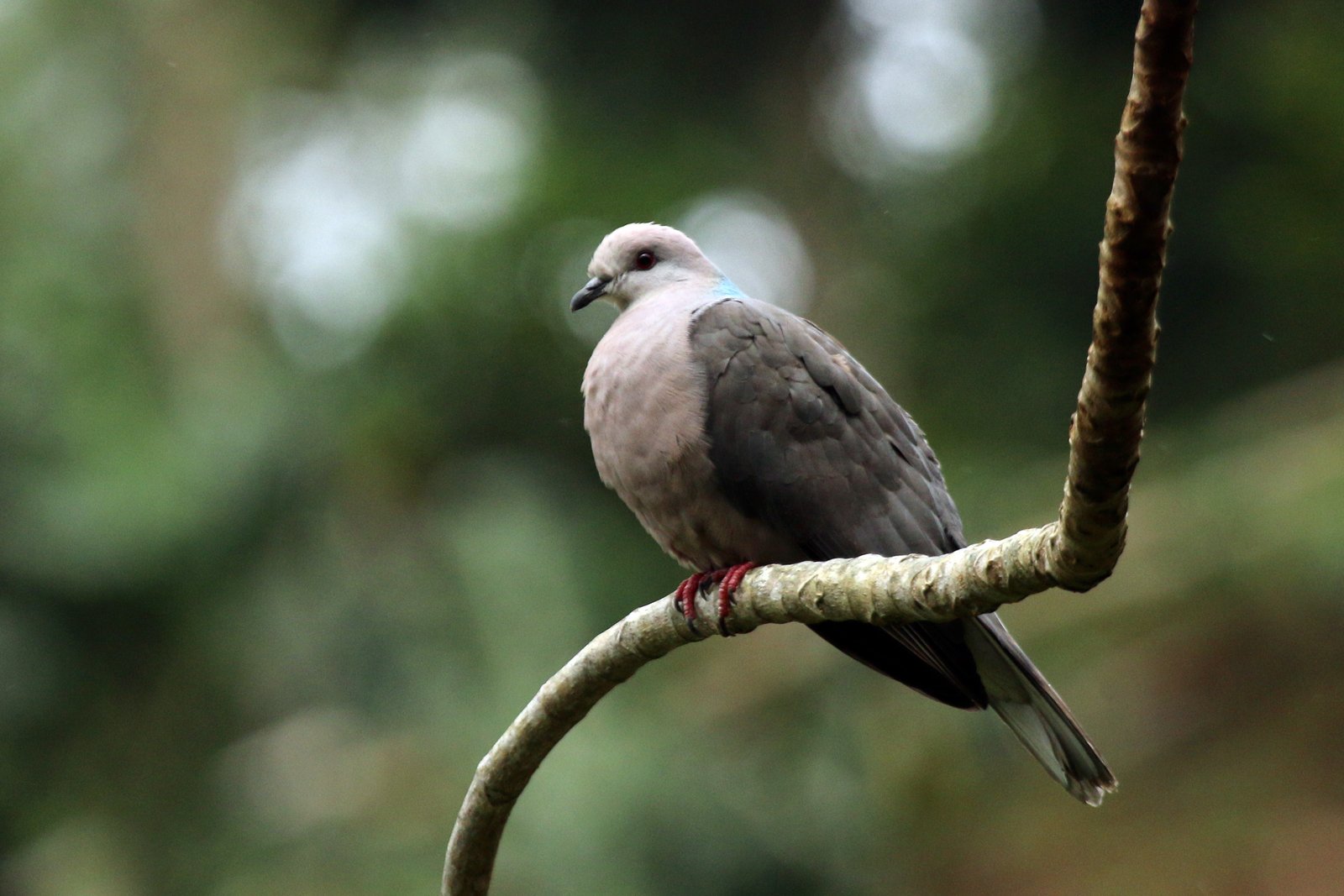
The Ring-tailed Pigeon is a large arboreal pigeon found only in Jamaica, in the wet montane forest and limestone forest of the east and centre of the island. It lives almost entirely in the canopy, feeding on fruit there, often hanging or clambering. The name refers to the dark band across the grey tail, the best mark of the species.
Voice
A soft series of four or five cooing notes, the last held longest, and a throaty croo-croo-crooooo, heard mainly in the morning from the canopy.
No recording with a suitable Creative Commons licence is available for this species yet.
Identification
38–43 cm, large and long-tailed; males average larger than females. In the male the head and underparts are vinaceous pink, the hindneck has an iridescent green to bronze patch, and the upperparts are brownish-grey. The flight feathers are blackish-brown, the undertail coverts off-white. The tail is grey, darker at the base, with a dark slate band halfway along, followed by a brownish-grey terminal band. The iris is orange with a red orbital ring, the bill black, the legs red. The female is duller, with an olive-brown wash on back and scapulars and less gloss on the nape. Young birds are greyish-brown with a cinnamon belly.
Confusion species
No other pigeon in Jamaica shows the tail band. Plain Pigeon Patagioenas inornata, rare in Jamaica and mainly in open country, is paler grey, with a white edge to the wing and no tail band. White-crowned Pigeon P. leucocephala is almost black with a white crown. White-winged Dove Zenaida asiatica and Zenaida Dove Z. aurita are much smaller and show white in the wing or tail.
Habitat
Wet montane forest, limestone karst forest and moist upland forest, from about 150 to 2000 m. Outside the breeding season part of the population moves to lower forest, depending on which trees are in fruit. It eats only fruit and seeds, including those of figs and mistletoe, and plays a part in dispersing the seeds of native trees. The nest is a sturdy platform of twigs lined with leaves and bark, high in a tree and hidden among climbers. It breeds in spring and summer, laying two white eggs.
Where the bird is most at home, classified by the vegetation types of the Caribbean.




Range and movements
Endemic to Jamaica. Its strongholds are Cockpit Country, the John Crow Mountains and the eastern Blue Mountains; elsewhere locally in other wooded hills. The species does not occur outside Jamaica.
- Resident
- dark = core range, pale = thinly spread
How and when to look
Early in the morning in Cockpit Country or along forest edges in the John Crow and Blue Mountains, where birds fly over the forest or sit in tall trees with ripe fruit. The tail band shows best in flight.
Conservation status
Vulnerable. The population is estimated at a few thousand to over ten thousand birds and is declining through the destruction and fragmentation of forest and through hunting. Hurricanes can sharply reduce fruiting trees, and with them the food supply, for some time.
Scientific name
Patagioenas caribaea | (Jacquin, 1784)
Jacquin described the species in 1784 as Columba caribaea; because it was later moved to another genus, the author and year stand in brackets. The genus Patagioenas was introduced in 1853 by Reichenbach. Patagioenas is Greek, from patageō 'to clatter' and oinas 'pigeon', after the clattering wings on take-off. caribaea is Latin for 'Caribbean', after its origin in the Caribbean. The specimen the first description was based on came from Jamaica.