All species › Waders, gulls and terns › Sandpipers and snipes › Short-billed Dowitcher
Short-billed Dowitcher | Limnodromus griseus
Kleine grijze snip | Agujeta gris
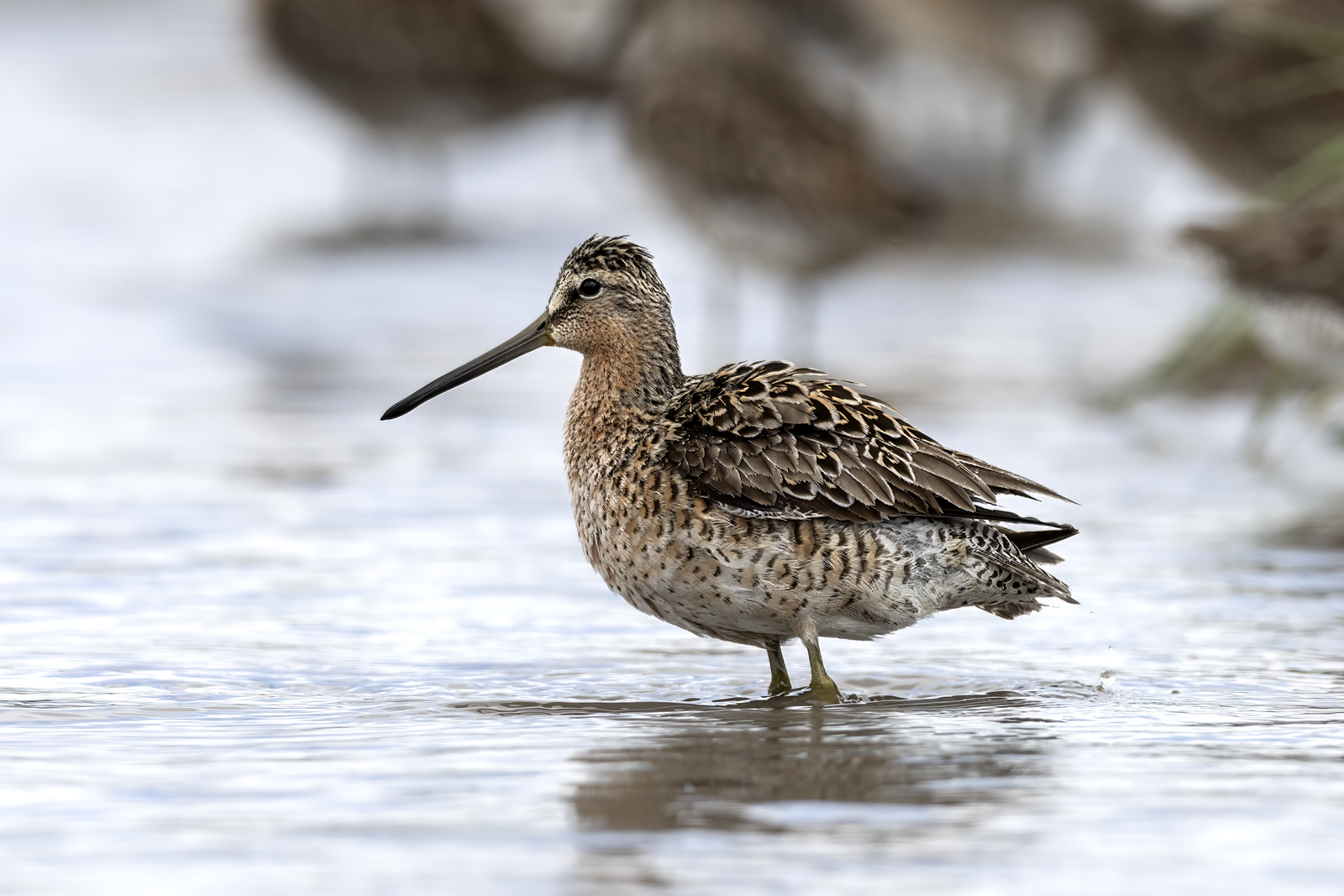
The Short-billed Dowitcher is one of the most common shorebirds in the Caribbean, often seen in dense flocks on mudflats, in salt ponds and along mangroves. The birds probe the mud at high speed with their long straight bills. Confusion with Long-billed Dowitcher is a real problem; that species is much scarcer in the region and prefers fresh water.
Voice
A soft, mellow tu-tu-tu, usually three syllables, mainly in flight. Rather quiet while feeding.
Recording: Stanislas Wroza — CC BY-NC-SA 4.0 · converted to mono · xeno-canto
Identification
25–29 cm. Compact, short-legged shorebird with a long, straight bill and greenish-yellow legs. In non-breeding plumage pale grey above, with a pale grey, finely speckled breast that grades into the white belly, and a white supercilium. In breeding plumage orange-brown with a dark-spotted breast; in the subspecies hendersoni the orange extends onto the belly, while the nominate has a white belly. Juveniles are warm brown with tertials showing pale internal bars. In flight a white wedge runs from the rump halfway up the back, and the tail is finely barred. Females average longer-billed.
Confusion species
Long-billed Dowitcher Limnodromus scolopaceus has a darker, uniformly grey breast in non-breeding plumage and calls a sharp keek; juveniles have plain grey tertials. Stilt Sandpiper Calidris himantopus has longer, yellowish legs and a shorter bill slightly drooping at the tip. Wilson's Snipe Gallinago delicata has a striped head and back, lives hidden in marsh vegetation and lacks the white wedge.
Habitat
Tidal flats and mudbanks, saline lagoons and salt ponds, mangrove edges, and also sewage ponds, fish ponds and rice fields. It feeds in shallow water and on wet mud with rapid, vertical jabs of the bill for worms, small bivalves and insect larvae, often in flocks with other shorebirds.
Where the bird is most at home, classified by the vegetation types of the Caribbean.





Range and movements
Winter visitor and passage migrant throughout the region, in the Bahamas, the Turks and Caicos Islands, Cuba, the Cayman Islands, Jamaica, Hispaniola, Puerto Rico, the Virgin Islands, the Lesser Antilles, the ABC Islands, San Andrés and Trinidad and Tobago. Most numerous on coasts with extensive mudflats and salt ponds. Outside the region it breeds in Alaska and Canada and winters along the coasts from the southern United States to Peru and Brazil.
- Resident
- Summer visitor (c. Oct–Mar)
- Winter visitor (c. Apr–Sep)
- Passage (Mar–Apr, Oct–Nov)
- dark = core range, pale = thinly spread
How and when to look
Salt ponds and sewage ponds are the best places, even on small islands; flocks are often tame and can be watched at close range. A dowitcher that does not call tu-tu-tu or feeds on fresh water deserves a second look.
Conservation status
Vulnerable according to the IUCN, owing to a marked decline in recent decades. Threats are the loss of intertidal areas along the flyway, disturbance and hunting; on Barbados the species is still shot, and it has been recommended there that the harvest should not increase.
Scientific name
Limnodromus griseus | (Gmelin, 1789)
Gmelin described the species in 1789 as Scolopax grisea; because it was later moved to another genus, the author and year stand in brackets. The genus Limnodromus was introduced in 1833 by Wied-Neuwied. Limnodromus is Ancient Greek, from limnē 'marsh' and -dromos '-runner'. griseus is Medieval Latin for 'grey', after the grey winter plumage. The specimen the first description was based on came from Long Island, New York.