All species › Cranes, rails and allies › Rails and crakes › Sora
Sora | Porzana carolina
Soraral | Polluela sora
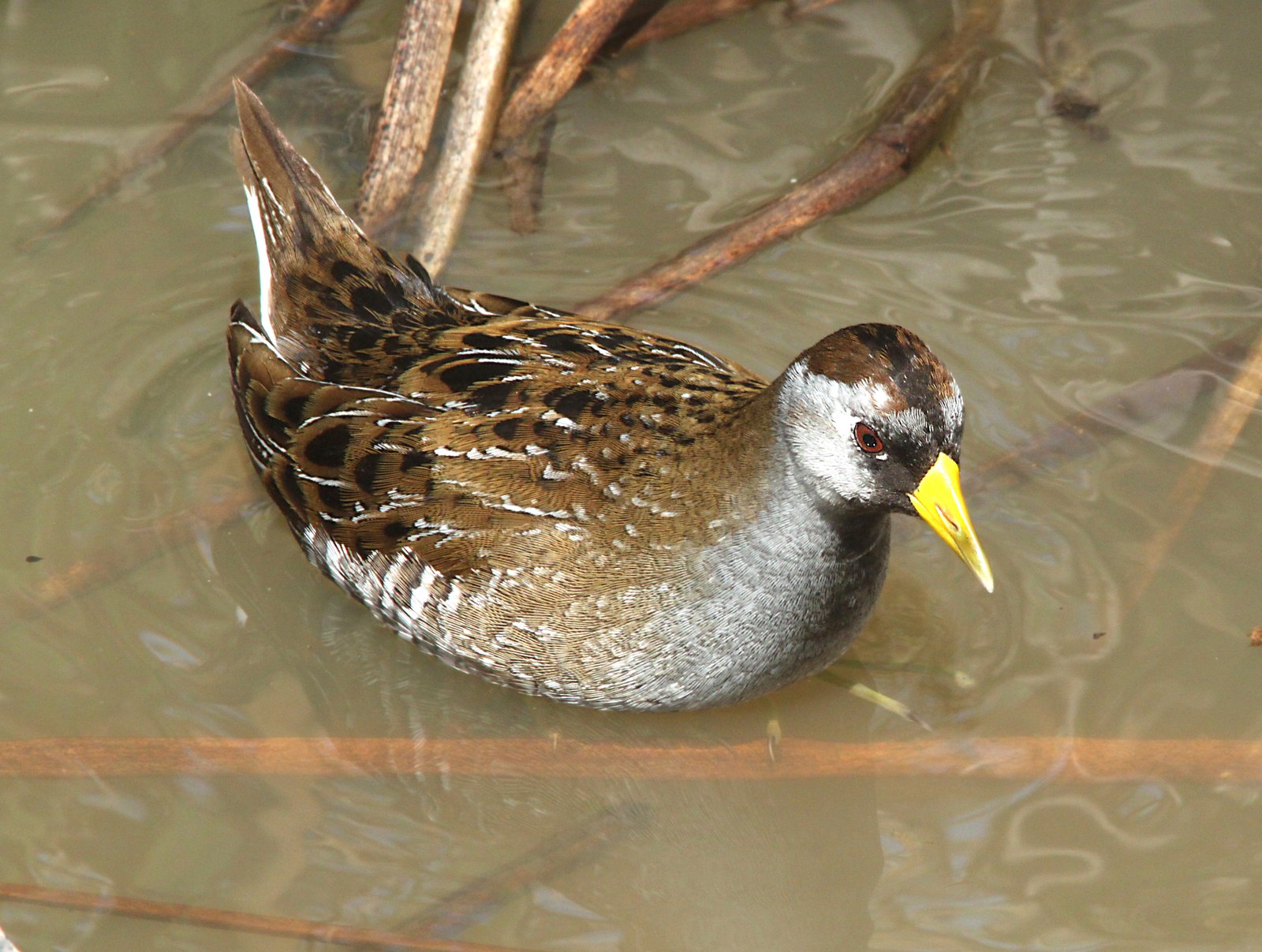
The Sora is a small, plump rail with a short, thick yellow bill and a black mask. It breeds in North America and in the Caribbean is a widespread winter visitor to freshwater marshes and rice fields, from the Bahamas to Trinidad and the ABC Islands. Unlike most rails in the region, it often walks over open mud or floating plants at the edge of vegetation.
Voice
A descending, accelerating whinny, ko-wee-ee-ee-ee-ee, a clear rising ker-wee and a sharp keek when disturbed. Heard regularly in winter too, often in response to a loud bang or other sound in the marsh.
Recording: Don Profota — CC BY-NC-SA 4.0 · converted to mono · xeno-canto
Identification
20–25 cm, with a short tail that is often cocked and flicked. The bill is short, thick and yellow. The upperparts are brown with black and white streaks. Face, neck and breast are blue-grey; adults have black around the base of the bill, on the throat and down the centre of the breast. The flanks are grey-brown with white bars, the undertail white to buff. In the first winter the black in the face is absent, and face and breast are buffy with a whitish throat. The legs are greenish-yellow.
Confusion species
Yellow-breasted Crake Laterallus flaviventer is much smaller, with a dark bill, a white supercilium and a yellowish neck and breast. Black Rail Laterallus jamaicensis is smaller and dark slate-grey, with a rusty nape and a black bill. Grey-breasted Crake Laterallus exilis of Trinidad is smaller, with a grey breast, rusty nape and a greenish bill. Larger rails such as Clapper Rail Rallus crepitans have a long, slender bill.
Habitat
Freshwater marshes with cattail, sedges and aquatic plants, edges of ponds and lakes, flooded grassland, rice fields and fish ponds; also brackish marshes at the edge of mangroves. It feeds along the edge of dense vegetation and on floating plants on seeds, insects, small snails and other small invertebrates.
Where the bird is most at home, classified by the vegetation types of the Caribbean.




Range and movements
Winter visitor to almost all islands with suitable fresh or brackish water: the Bahamas, the Turks and Caicos Islands, the Greater Antilles, the Cayman Islands, the Virgin Islands, the Lesser Antilles, the ABC Islands, San Andrés and Trinidad and Tobago. Most numerous in the large marshes and rice-growing areas of the Greater Antilles. It breeds in North America, from southern Canada to the central United States, and winters from the southern United States through Mexico and Central America to northern South America.
- Winter visitor (c. Apr–Sep)
- Passage (Mar–Apr, Oct–Nov)
- dark = core range, pale = thinly spread
How and when to look
Early in the morning and late in the afternoon along the edges of marshes, rice fields and ponds with floating vegetation, where birds step briefly out of cover. A spot overlooking an open strip of mud or water beside reeds often produces several birds.
Conservation status
Not threatened. The species is numerous in North America; in the Caribbean it depends on freshwater marshes and rice fields, which are declining through drainage, building and changes in farming. The birds are hunted locally.
Scientific name
Porzana carolina | (Linnaeus, 1758)
Linnaeus described the species in 1758 as Rallus carolinus; because it was later moved to another genus, the author and year stand in brackets. The genus Porzana was introduced in 1816 by Vieillot. Porzana is a Latinised Venetian folk name for the small crakes. carolina refers to Carolina in North America. The specimen the first description was based on came from Hudson Bay, Canada.