All species › Passerines › Tyrant flycatchers › Spotted Tody-Flycatcher
Spotted Tody-Flycatcher | Todirostrum maculatum
Gevlekte schoffelsnavel | Espatulilla moteada
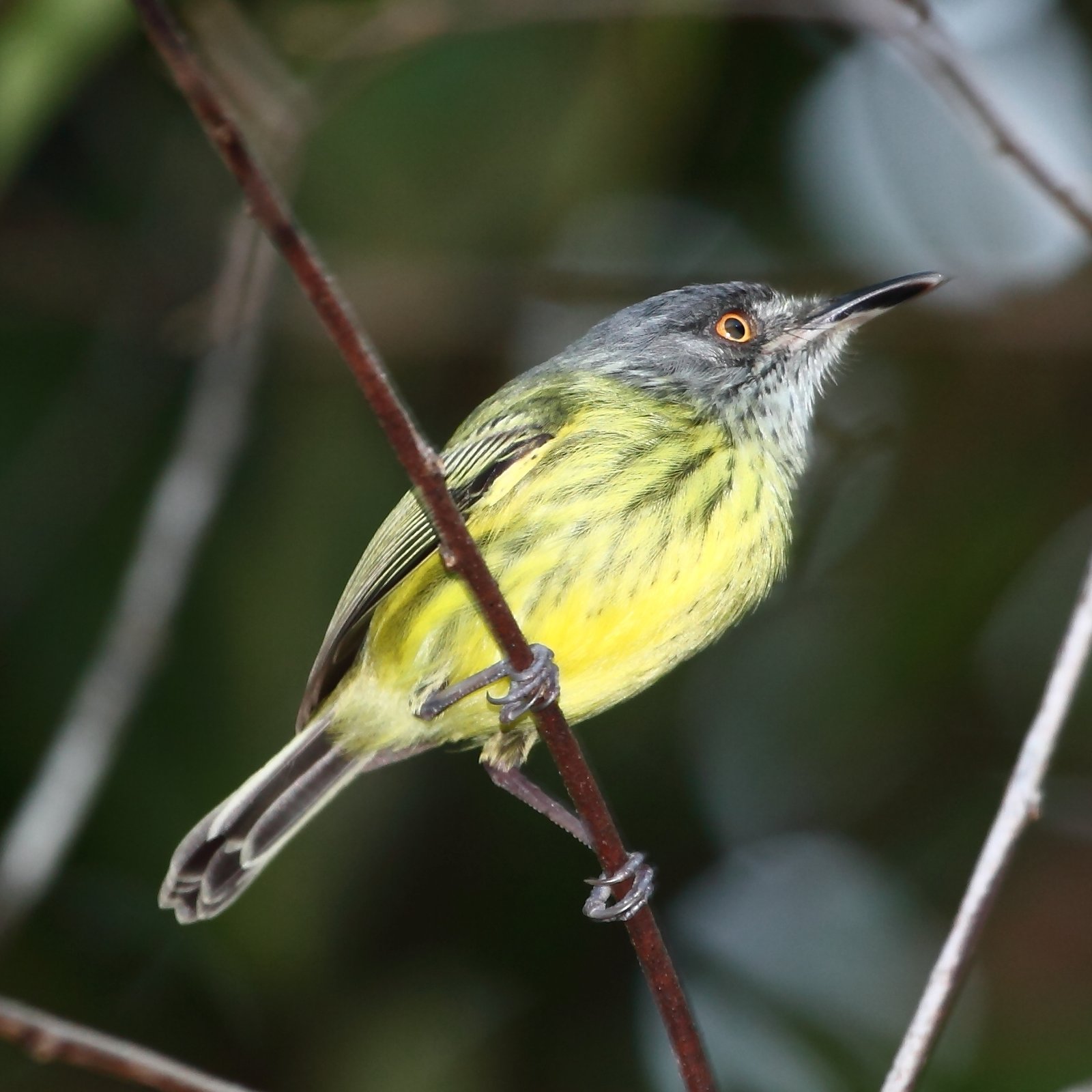
The Spotted Tody-Flycatcher is a small, active tyrant with a long, flat bill and a pale iris, found in Trinidad in mangroves, damp thickets and gardens. It is constantly on the move, often with its tail cocked and wagging, and is usually seen in pairs. It is the only tody-flycatcher in this guide.
Voice
A very high, slow, staccato series of evenly spaced, slightly descending notes, like pip pip pip pip, and high, short, dry trills. The snap of the bill is often audible when it catches an insect.
Recording: JAYRSON ARAUJO DE OLIVEIRA — CC BY-NC-SA 4.0 · converted to mono · xeno-canto
Identification
9–10 cm. The head is grey, with a small white spot above the lores and fine black-and-white streaking on the crown. The iris is yellow-orange. Back and rump olive-green; the blackish wings have yellow edges to the coverts and flight feathers. Throat and upper breast white with bold black streaks, the rest of the underparts yellow. The bill is long, straight and flat, almost as long as the head. The tail is fairly short and often cocked. The sexes are alike.
Confusion species
Short-tailed Pygmy Tyrant Myiornis ecaudatus is smaller and almost tailless, with a short bill and white, unstreaked underparts, and lives in the forest canopy. White-throated Spadebill Platyrinchus mystaceus has a very broad, short bill and an unstreaked white throat, and lives in the understorey of closed forest. The flatbills of the genus Tolmomyias are larger, with a shorter, broader bill and unstreaked underparts.
Habitat
Mangroves, dense thickets along rivers, ditches and swamps, clearings, overgrown pastures and gardens in the lowlands, usually near water. It searches low vegetation for insects, snatched from leaves with a short hop or sally. The nest is an elongated hanging pouch of grass and plant fibres with a side entrance under a small roof, usually within three metres of the ground and often near a wasp nest.
Where the bird is most at home, classified by the vegetation types of the Caribbean.





Range and movements
Resident in Trinidad, mainly in the lowlands in and around mangroves, swamps and gardens; absent from Tobago and the rest of the region. Outside the region in eastern Venezuela, the Guianas and Amazonia from Colombia and Brazil to Peru and Bolivia.
- Resident
- dark = core range, pale = thinly spread
How and when to look
In Trinidad at the edges of mangroves and coastal swamps and in damp lowland gardens and thickets. The high, regular call series gives the bird away; the streaked throat and pale iris are obvious in a good view.
Conservation status
Not threatened. The species has a large range and also occurs in man-modified vegetation such as gardens and overgrown pastures.
Scientific name
Todirostrum maculatum | (Desmarest, A-G, 1806)
Desmarest, A-G described the species in 1806 as Todus maculatus; because it was later moved to another genus, the author and year stand in brackets. The genus Todirostrum was introduced in 1831 by Lesson. Todirostrum combines the genus Todus (tody) with Latin rostrum 'bill', after the long, flat, tody-like bill. maculatum is Latin for 'spotted', from macula 'spot', after the dark streaks on throat and breast. The specimen the first description was based on came from Cayenne, French Guiana.