All species › Passerines › New World blackbirds › St. Lucia Oriole
St. Lucia Oriole | Icterus laudabilis
Sint-Luciatroepiaal | Turpial de Santa Lucía
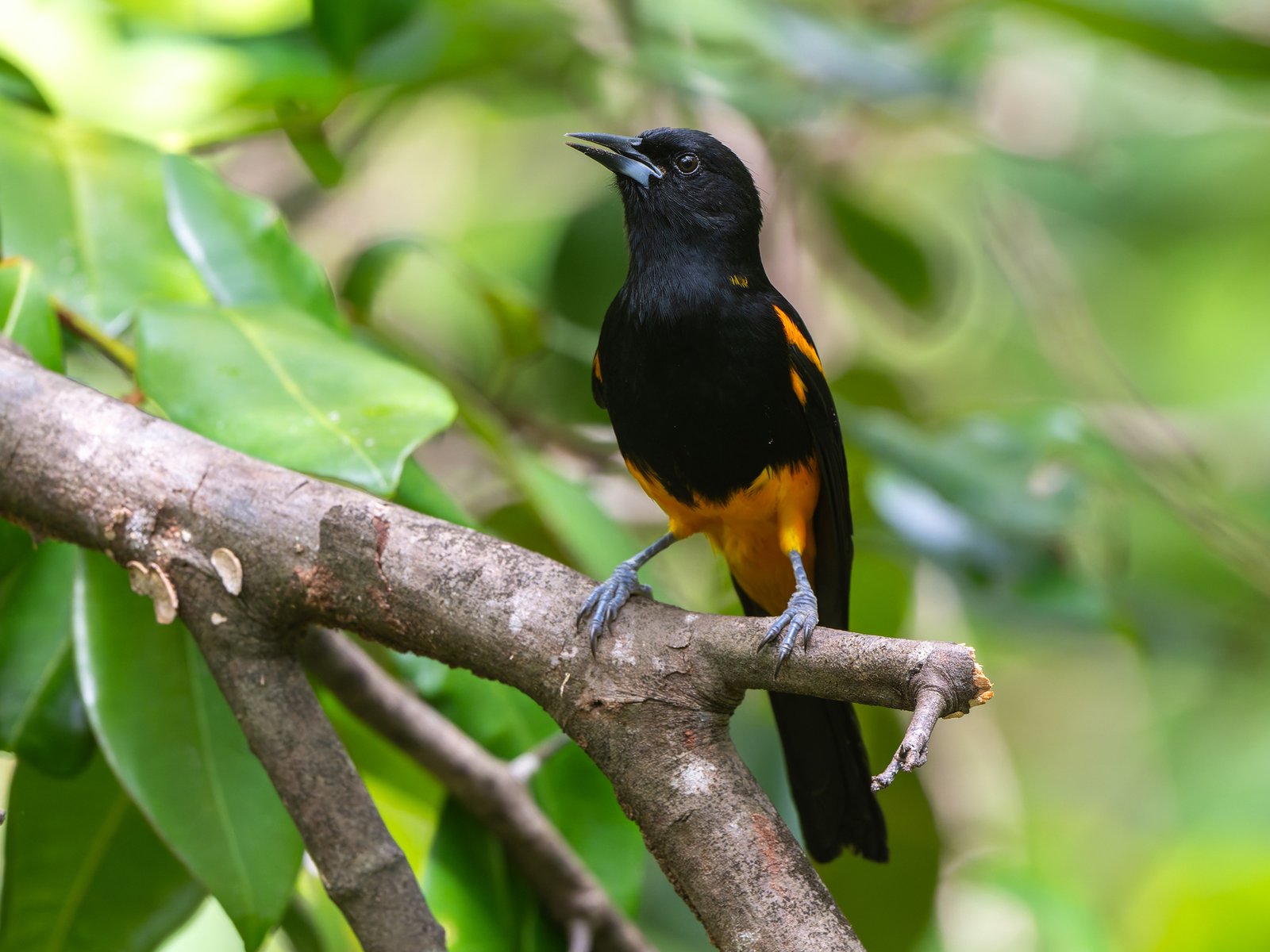
The St. Lucia Oriole is one of three orioles each confined to a single Lesser Antillean island, alongside the Montserrat and Martinique Orioles. It is black and orange and occurs across the island, from montane forest to mangroves. The species has declined and is listed as Endangered.
Voice
The song is a series of varied whistles lasting about two seconds. Calls are a harsh chwee and a soft chup.
Recording: Barry Edmonston — CC BY-NC-SA 4.0 · shortened to the first 60 s, mono · xeno-canto
Identification
20–22 cm, slender, with a long tail and a pointed, slightly decurved bill. Adults are black, with rusty orange on the shoulder, rump, belly and undertail coverts. The female closely resembles the male but is slightly duller, with more golden orange than rusty orange. Immatures largely lack the black and are brownish to olive, with golden olive where the adult is orange.
Confusion species
Carib Grackle Quiscalus lugubris and Shiny Cowbird Molothrus bonariensis are all black and lack the orange. The male Lesser Antillean Bullfinch Loxigilla noctis is much smaller, with a thick bill and a rufous throat. No other native oriole occurs on St. Lucia; Baltimore Oriole Icterus galbula is a vagrant in the Lesser Antilles and has white wing bars.
Habitat
Humid montane rainforest, semi-evergreen and dry forest, secondary forest, coastal woodland, mangroves and plantation edges, from sea level to about 700 m; the largest numbers are in humid forest. It forages in the canopy for insects, fruit and nectar. The nest is a woven basket of plant fibres beneath a banana or palm leaf; breeding is mainly from April to June.
Where the bird is most at home, classified by the vegetation types of the Caribbean.



Range and movements
Only on St. Lucia, across most of the island but increasingly local. The species does not occur outside St. Lucia.
- Resident
- dark = core range, pale = thinly spread
How and when to look
Forest edges and open woodland in the interior, including along trails in the montane forest, give the best chances. Pairs are often heard first by their harsh call.
Conservation status
Endangered. The population is estimated at a little over 1,000 adults and is declining through forest loss, agricultural pesticide spraying and brood parasitism by Shiny Cowbird, which has become established on the island.
Scientific name
Icterus laudabilis | Sclater, 1871
Sclater described the species in 1871 and placed it straight away in the genus where it still stands. The genus Icterus was introduced in 1760 by Brisson. Icterus is from Ancient Greek ikteros, a yellow bird usually taken to be the golden oriole, the sight of which was thought to cure jaundice. laudabilis is Latin for 'praiseworthy', after the handsome black-and-orange pattern. The specimen the first description was based on came from Saint Lucia.