All species › Waders, gulls and terns › Sandpipers and snipes › Stilt Sandpiper
Stilt Sandpiper | Calidris himantopus
Steltstrandloper | Correlimos zancolín
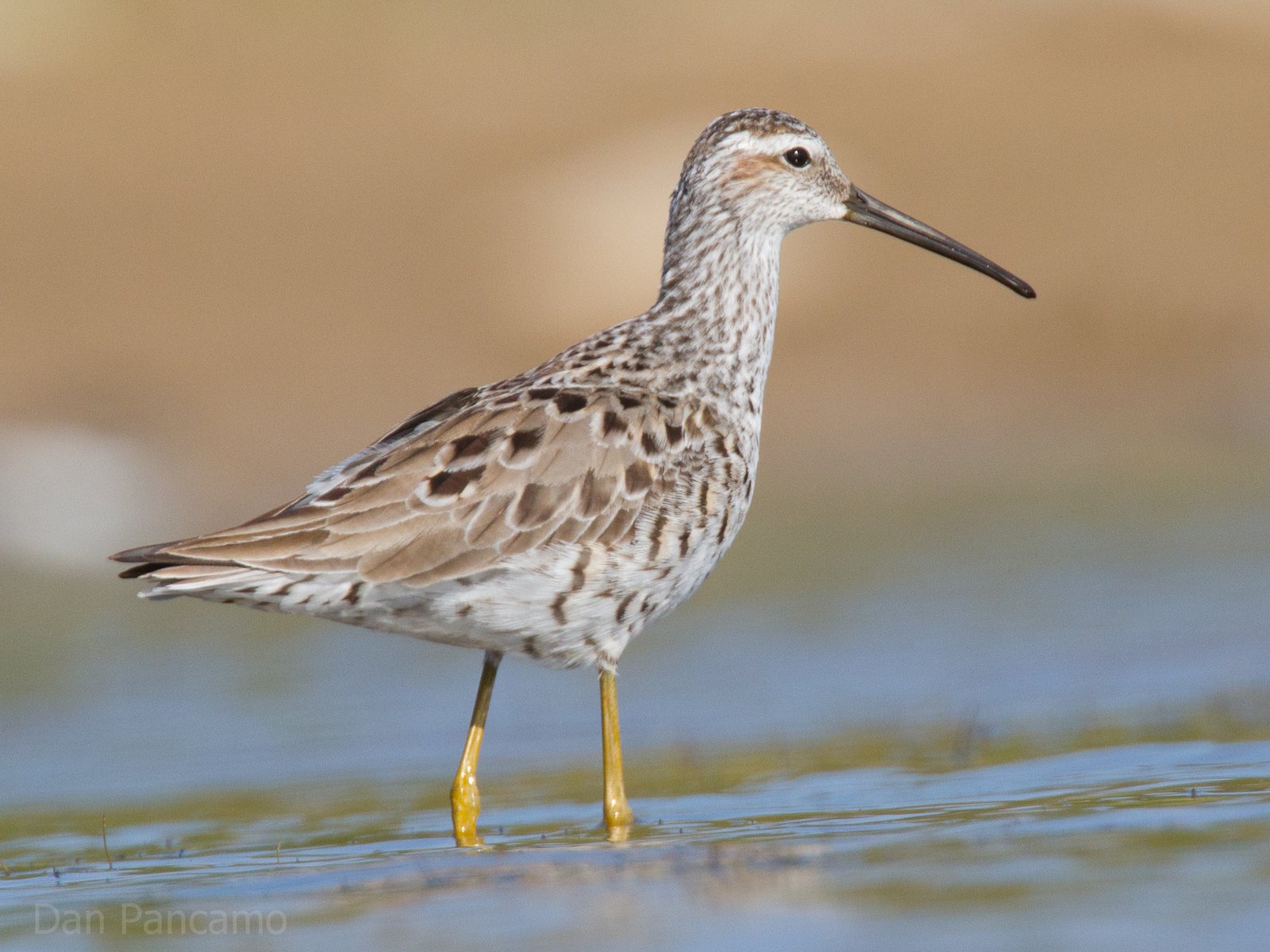
The Stilt Sandpiper is a long-legged sandpiper of the North American tundra that winters in South America and passes through the Caribbean in large numbers. It feeds like a small dowitcher, belly-deep in water with its bill deep in the bottom, and often keeps company with yellowlegs and dowitchers on shallow salt pans and pools.
Voice
A soft, slightly hoarse choo or kirr, and a low, rolling krrr; usually not very vocal.
Recording: Andrew Spencer — CC BY-NC-SA 4.0 · shortened to the first 60 s, mono · xeno-canto
Identification
18–23 cm, with a small head, long greenish-yellow legs and a long black bill with a slightly drooping, somewhat swollen tip. In winter plumage brownish-grey above, with a white supercilium and pale underparts finely streaked grey on breast and flanks. Juveniles have a dark back with pale feather fringes and a pale buff breast. In breeding plumage, in spring and early autumn, a rufous ear patch and crown and densely barred underparts. In flight no obvious wing bar, a white rump and toes projecting beyond the tail.
Confusion species
Lesser Yellowlegs Tringa flavipes is larger, with brighter yellow legs and a thinner, straight bill, and moves around more actively. Short-billed Dowitcher Limnodromus griseus is larger and stockier, with a much longer bill and a white wedge reaching high up the back. Curlew Sandpiper Calidris ferruginea has black legs and a white wing bar.
Habitat
Shallow salt pans and lagoons, fresh and brackish pools, rice fields, fish ponds and flooded grassland; less on open tidal flats. It feeds by wading, often in small groups, with a rapid up-and-down sewing-machine action of the bill, sometimes submerging the head completely.
Where the bird is most at home, classified by the vegetation types of the Caribbean.





Range and movements
Passage migrant and winter visitor in almost the whole region: the Bahamas, the Turks and Caicos Islands, Cuba, the Cayman Islands, Jamaica, Hispaniola, Puerto Rico, the Virgin Islands, the Lesser Antilles, the ABC Islands, San Andrés and Trinidad and Tobago. Locally common, especially on Puerto Rico, Guadeloupe, Bonaire, Curaçao and Aruba, Cuba and the Dominican Republic; scarcer on Jamaica and the smaller mountainous islands without salt pans. Beyond the region it breeds on the tundra of Alaska and Arctic Canada and winters mainly in central South America.
- Resident
- Summer visitor (c. Oct–Mar)
- Winter visitor (c. Apr–Sep)
- Passage (Mar–Apr, Oct–Nov)
- dark = core range, pale = thinly spread
How and when to look
Salt pans in autumn migration, such as those of Cabo Rojo on Puerto Rico and of Bonaire and Curaçao. At a distance the belly-deep wading, sewing-machine action and long legs give the species away among the yellowlegs.
Conservation status
Near Threatened globally, owing to a population decline. In the region the species depends on salt pans and shallow pools, which are locally drained, filled in or built over.
Scientific name
Calidris himantopus | (Bonaparte, 1826)
Bonaparte described the species in 1826 as Tringa himantopus; because it was later moved to another genus, the author and year stand in brackets. The genus Calidris was introduced in 1804 by Merrem. Calidris goes back to Ancient Greek kalidris or skalidris, a name Aristotle used for an unidentified grey waterside bird. himantopus is Greek for 'strap foot', after the long legs; it is also the genus name of the stilts. The specimen the first description was based on came from Long Branch, New Jersey.