All species › Passerines › Tyrant flycatchers › Sulphury Flycatcher
Sulphury Flycatcher | Tyrannopsis sulphurea
Zwaveltiran | Mosquero azufrado
The Sulphury Flycatcher is a stocky, short-tailed flycatcher that is almost everywhere tied to the moriche palm Mauritia flexuosa. In the Caribbean it occurs only on Trinidad, where it lives locally in swamps and savannas with these palms. It is not very vocal and is often overlooked.
Voice
Not very vocal. Calls are high and penetrating, including fast, buzzy trills and sharp notes, often given as a duet by a pair from a palm crown.
Recording: Mauricio Cuellar Ramirez (@Birding.travel) — CC BY-NC-SA 4.0 · converted to mono · xeno-canto
Identification
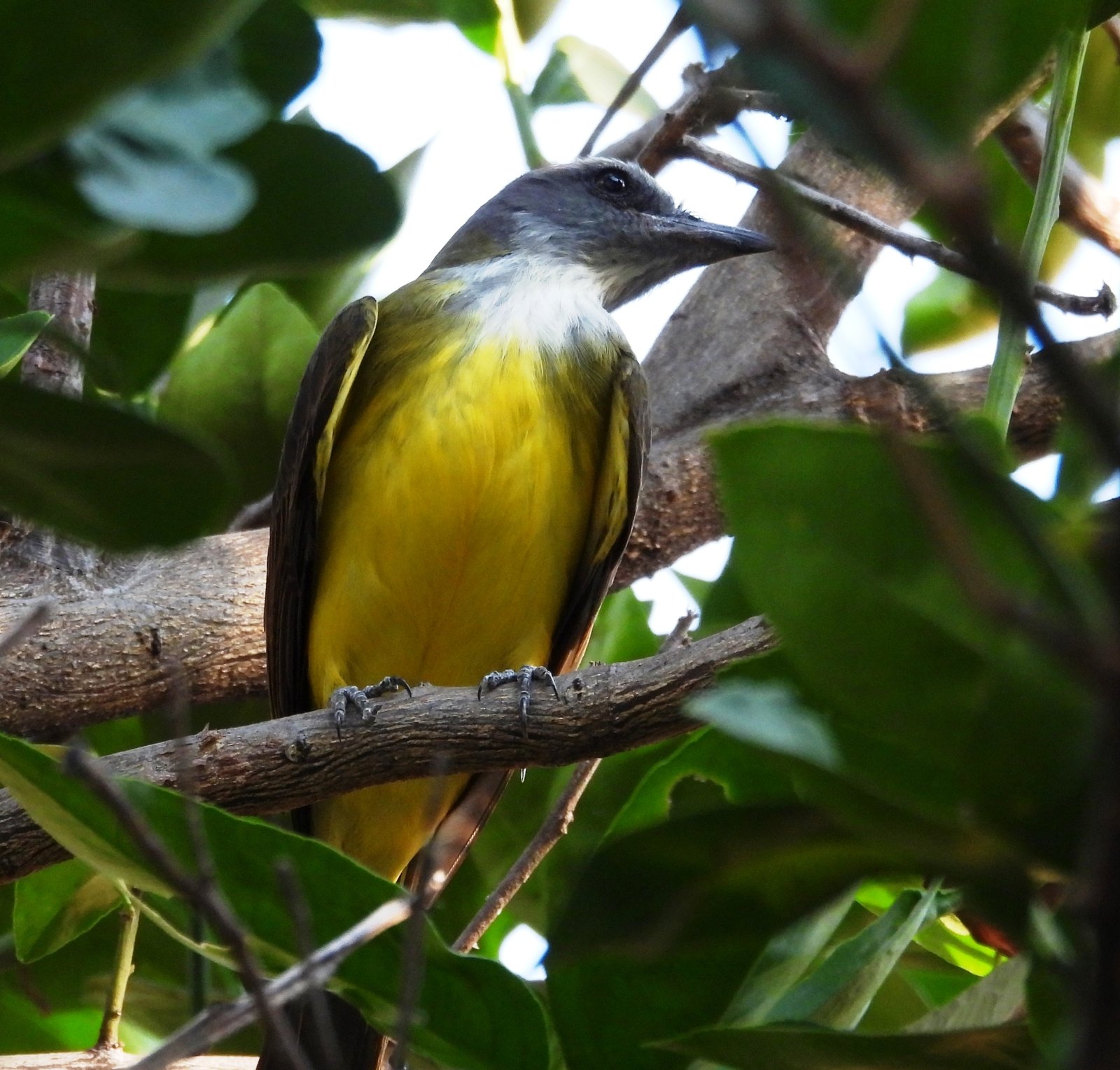
19–20 cm, sturdily built, with a short, square tail and a short but broad black bill. The head is dark slate grey with a concealed orange-yellow crown patch, an indistinct pale supercilium and a dark band from lores to ear coverts. The upperparts are dull olive-brown, the wings dark brown. The throat is white with fine grey streaks, the upper breast whitish with an olive-grey wash on breast and sides, the rest of the underparts bright yellow. Iris brown, legs black. The sexes are alike.
Confusion species
Tropical Kingbird Tyrannus melancholicus is slimmer, with a paler grey head, a longer, notched tail and a longer bill, and calls far more often. Great Kiskadee Pitangus sulphuratus and Boat-billed Flycatcher Megarynchus pitangua have a black-and-white head with a broad white supercilium.
Habitat
Stands of moriche palms in swamp forest and palm swamps, scattered palms in savanna and flooded grassland, and sometimes single palms in farmland and near houses. It hunts insects from the palm fronds and also eats fruit. The nest is placed in the crown of a palm, among the leaf bases.
Where the bird is most at home, classified by the vegetation types of the Caribbean.



Range and movements
Only on Trinidad, locally in the east and centre of the island where moriche palms grow, including Nariva Swamp. Absent from Tobago. A single report from Aruba is unconfirmed. Outside the region in northern South America, from Colombia, Venezuela and the Guianas to the Amazon basin of Brazil, Peru and Bolivia.
- Resident
- dark = core range, pale = thinly spread
How and when to look
Best found by scanning stands of moriche palms early in the morning, when the birds sit on the fronds or leaf stalks. On Trinidad a yellow flycatcher with a short, square tail in a palm crown is a good candidate.
Conservation status
Not threatened. Because it depends on moriche palms, the species is locally vulnerable to the draining of palm swamps and the felling of palms.
Scientific name
Tyrannopsis sulphurea | (Spix, 1825)
Spix described the species in 1825 as Muscicapa sulphurea; because it was later moved to another genus, the author and year stand in brackets. The genus Tyrannopsis was introduced in 1905 by Ridgway. Tyrannopsis combines the genus Tyrannus with Greek opsis 'appearance': 'resembling a kingbird'. sulphurea is Latin for 'sulphur-yellow', after the yellow belly. The specimen the first description was based on came from Brazil (later restricted to Manaus, Rio Negro).