All species › Passerines › Vireos › Thick-billed Vireo
Thick-billed Vireo | Vireo crassirostris
Dikbekvireo | Vireo piquigrueso
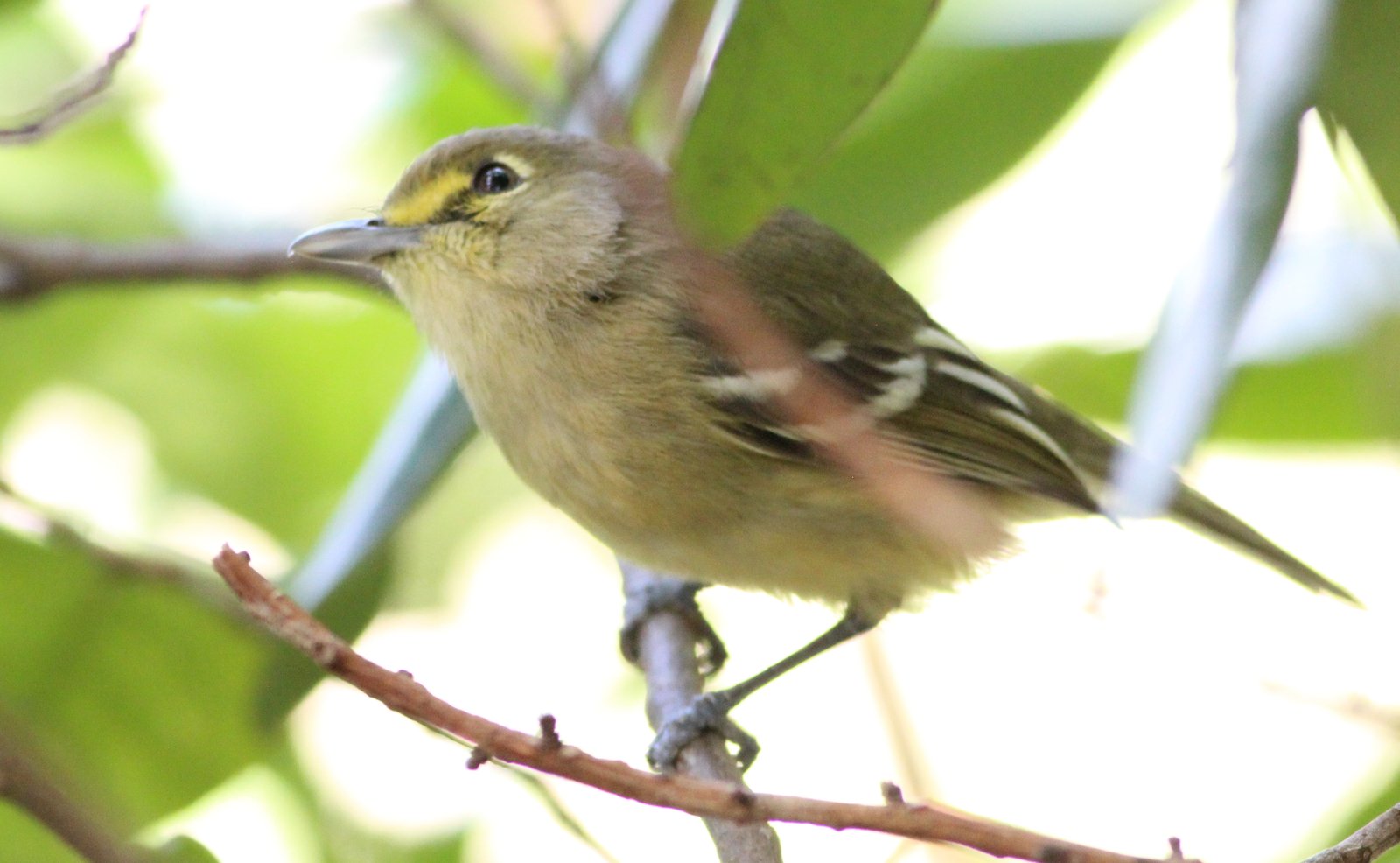
The Thick-billed Vireo is a vireo of the low, dry islands in the north-western Caribbean. In the Bahamas it is one of the commonest birds of scrub, and its loud, varied song can be heard there all year. Each island group has its own subspecies. The birds of Providencia, formerly included in this species, are now placed in Mangrove Vireo.
Voice
The song is a loud, bubbly and highly variable phrase, such as chik-didle-wer-chip, repeated over and over. Only males sing. It also gives harsh scolds.
Recording: Paul Driver — CC BY-NC-SA 4.0 · converted to mono · xeno-canto
Identification
11.5–13.5 cm, compact, with a thick, dark horn-coloured bill. Crown, face and nape are greyish olive to brownish olive, the lores blackish. A pale yellow line runs above the lores and joins a pale to deep yellow eye-ring, giving the bird yellow spectacles. The upperparts are olive-green, the wings dark with two clear white wing bars. The underparts are greyish white with a yellow tinge on the flanks. The iris is dark and the legs blue-grey. The sexes are alike. Subspecies differ in tone and the amount of yellow.
Confusion species
White-eyed Vireo Vireo griseus, a winter visitor to the Bahamas and Cuba, is very similar but has a smaller bill, a greyer nape and, in adults, a white iris; young White-eyed Vireos have a dark iris and are told only by bill and nape. Cuban Vireo Vireo gundlachii is browner, with faint buffy spectacles and weak wing bars. Yucatan Vireo Vireo magister on Grand Cayman is larger and browner, without wing bars. Flat-billed Vireo Vireo nanus of Hispaniola has a white iris and white tail tips.
Habitat
Scrub and low dry forest (known in the Bahamas as coppice), coastal scrub, mangrove edges and well-vegetated gardens. It searches dense bushes and low trees for insects and also eats berries.
Where the bird is most at home, classified by the vegetation types of the Caribbean.





Range and movements
Resident on almost all larger islands of the Bahamas, in the Turks and Caicos Islands and on all three Cayman Islands. Also on a few cays off the north coast of Cuba, including Cayo Coco and Cayo Paredón Grande, and on Île de la Tortue off the north coast of Haiti. Isolated reports from mainland Hispaniola probably involve confusion with other vireos. Outside the Caribbean a few vagrants have been recorded in southern Florida.
- Resident
- dark = core range, pale = thinly spread
How and when to look
In the Bahamas in almost any patch of scrub, including around Nassau and at hotels; the loud repeated song is the best lead. On the Cuban cays it can be found in the coastal scrub of Cayo Paredón Grande; there the thick bill and yellow spectacles separate it from Cuban Vireo.
Conservation status
Not threatened. The species is common on most islands within its range, but populations on small islands are vulnerable to loss of scrub through development.
Scientific name
Vireo crassirostris | (Bryant, 1859)
Bryant described the species in 1859 as Lanivireo crassirostris; because it was later moved to another genus, the author and year stand in brackets. The genus Vireo was introduced in 1808 by Vieillot. Vireo was used by Latin authors for a small, green, migratory bird, probably the Eurasian golden oriole, though the European greenfinch has also been suggested. crassirostris is Latin, from crassus 'thick' and rostrum 'bill', after the stout bill. The specimen the first description was based on came from New Providence, Bahamas.