All species › Passerines › Tyrant flycatchers › Tropical Kingbird
Tropical Kingbird | Tyrannus melancholicus
Tropische koningstiran | Tirano tropical
The Tropical Kingbird is one of the most widespread birds of tropical America and on Trinidad and Tobago a familiar sight on wires, fences and bare branches in open country. There it largely replaces the Grey Kingbird, which is the common kingbird on most other Caribbean islands.
Voice
A high, rapid, twittering trill such as pi-ri-ri-ri-ri, often given from a perch and in flight. The male's dawn song, at twilight, is a more complex series of short notes and trills.
Recording: JAYRSON ARAUJO DE OLIVEIRA — CC BY-NC-SA 4.0 · converted to mono · xeno-canto
Identification
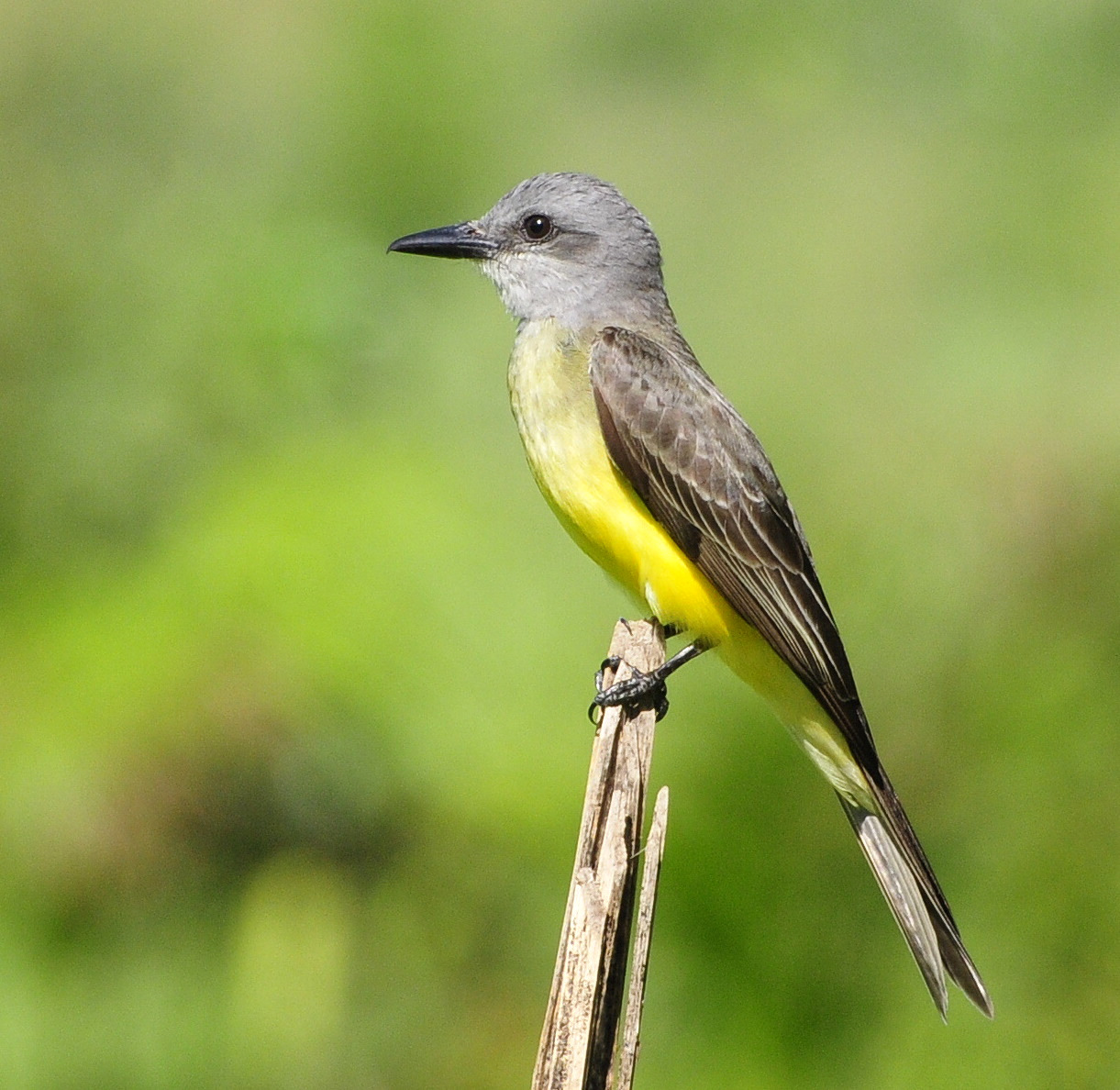
20–23 cm, with a heavy, fairly long dark bill and a notched brown tail. The head is grey with a darker grey mask and a concealed orange crown patch. The back is grey-green to olive-grey, the wings brown with pale edges. The throat is pale grey to whitish, the breast yellow with an olive wash, the belly bright yellow. The sexes are alike; juveniles have paler wing fringes and no crown patch.
Confusion species
Grey Kingbird Tyrannus dominicensis has white underparts without yellow and a dark eye mask. Western Kingbird Tyrannus verticalis, a vagrant, has a black, square tail with white outer edges and a pale grey breast. Sulphury Flycatcher Tyrannopsis sulphurea on Trinidad is stockier, with a shorter bill and a short, square tail. Cattle Tyrant Machetornis rixosa on the ABC Islands walks on the ground and has long legs.
Habitat
Almost any semi-open country with perches: gardens, roadsides, pasture, savanna, farmland, plantations, dry forest and forest edge, mangroves and coastal scrub. It sallies from an open perch for flying insects and also eats some fruit. The nest is a shallow, open cup in a tree or bush.
Where the bird is most at home, classified by the vegetation types of the Caribbean.






Range and movements
A common resident on Trinidad and Tobago; resident on Aruba, Curaçao and Bonaire and on San Andrés. Rare on Grenada and the Grenadines; a vagrant to Cuba, the Cayman Islands, the Bahamas and the Virgin Islands. Outside the region from southern Arizona and Texas through Mexico and Central America to Argentina.
- Resident
- dark = core range, pale = thinly spread
How and when to look
On Trinidad and Tobago found on almost any wire along open country; its trilling call is one of the first sounds of the morning. On the ABC Islands and San Andrés mainly in gardens and open country with trees; there the tail shape and yellow breast separate it from Grey Kingbird.
Conservation status
Not threatened. The species has a very large range and benefits from open, man-made landscapes.
Scientific name
Tyrannus melancholicus | Vieillot, 1819
Vieillot described the species in 1819 and placed it straight away in the genus where it still stands. The genus Tyrannus was introduced in 1799 by De Lacépède. Tyrannus is Latin (from Greek turannos) for 'tyrant, despot', after the aggressive way these birds drive off even raptors. melancholicus is Latin (from Greek melankholikos) for 'melancholy, gloomy', presumably after the dark grey head and sombre look. The specimen the first description was based on came from Paraguay.