All species › Waders, gulls and terns › Sandpipers and snipes › Upland Sandpiper
Upland Sandpiper | Bartramia longicauda
Bartrams ruiter | Correlimos batitú
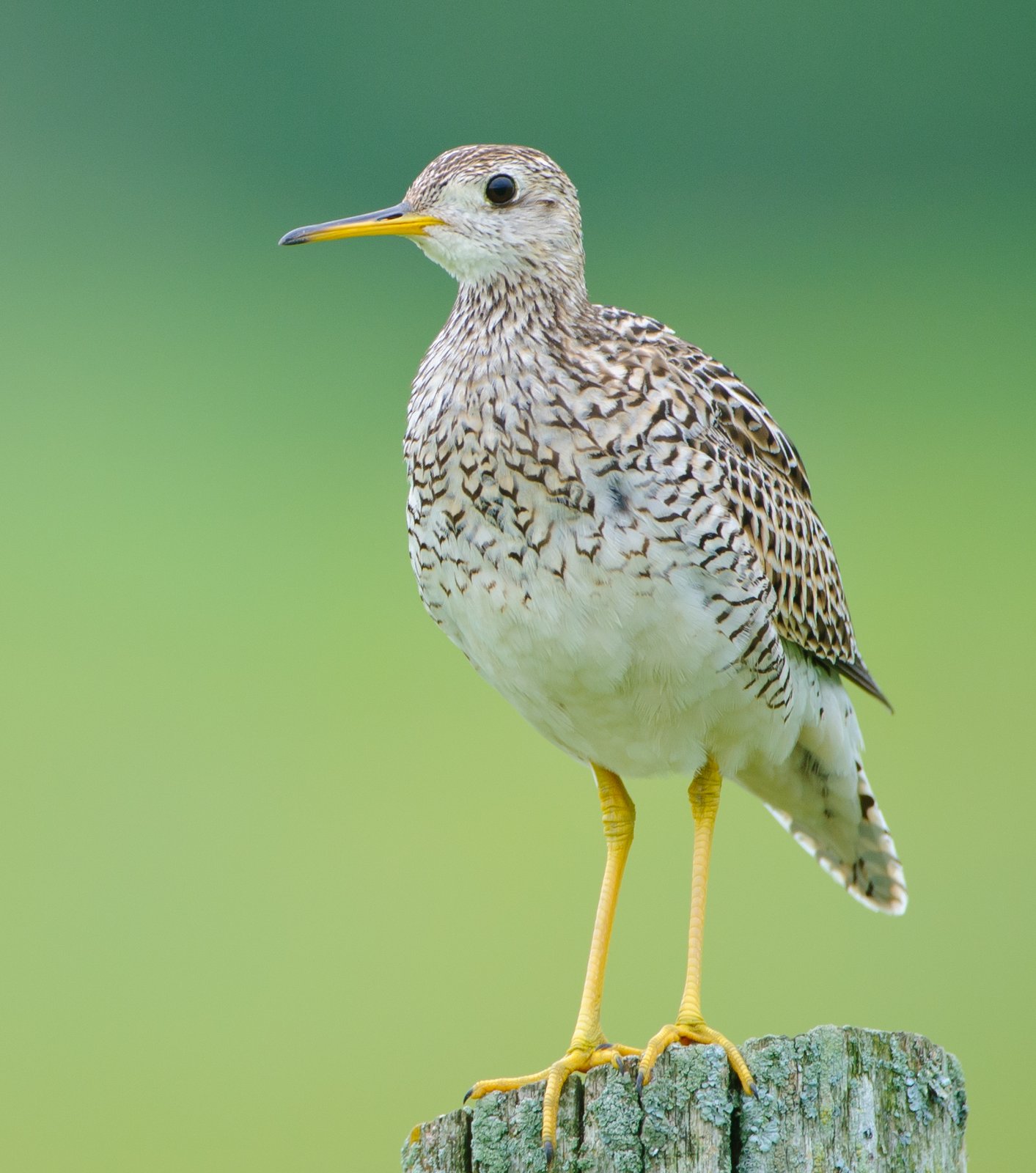
The Upland Sandpiper is a shorebird of dry grassland that rarely comes near water. With its small round head, thin neck and long tail it looks more like a miniature curlew than a typical sandpiper. It migrates between the prairies of North America and the pampas of South America and drops in on the islands in small numbers during migration, mostly at airfields and on short grass.
Voice
In flight a liquid, bubbling kwi-pi-pi-pi or pulip-pulip, often on take-off or at night during migration. The whistled display call of the breeding grounds is hardly ever heard in the region.
Recording: Stanislas Wroza — CC BY-NC-SA 4.0 · converted to mono · xeno-canto
Identification
28–32 cm. Small round head with a large dark eye in a plain pale face, a long thin neck, a short, straight, yellowish bill with a dark tip and yellow legs. At rest the tail projects well beyond the wing tips. Upperparts brown with dark centres and pale fringes, giving a scaly pattern; neck and breast pale buff-brown with fine streaks, flanks with dark chevrons, belly white. The sexes are alike; juveniles are warmer brown and more finely scaled. In flight the dark primaries, dark rump and long tail with barred edges stand out. On landing it often holds its wings raised for a moment.
Confusion species
Buff-breasted Sandpiper Calidris subruficollis is smaller, with a shorter neck and tail, a dark bill and plain buff underparts without chevrons; in flight it shows white underwings. Pectoral Sandpiper Calidris melanotos has a sharp border between the streaked breast and white belly and a shorter tail. American Golden Plover Pluvialis dominica has a shorter neck, a dark plover bill and long wings with no tail projection.
Habitat
On migration short, dry grassland: airfields, golf courses, playing fields, pastures and waste ground, sometimes fields with low crops. It walks steadily with jerky head movements, picking insects such as grasshoppers, beetles and caterpillars from the ground and grass. It rarely visits pools or mudflats.
Where the bird is most at home, classified by the vegetation types of the Caribbean.




Range and movements
Uncommon to rare passage migrant throughout the region. Most records come from Puerto Rico, the Bahamas, the Cayman Islands, the ABC Islands, Barbados, Guadeloupe and Trinidad and Tobago; rare on Cuba, Hispaniola, Jamaica and the remaining Lesser Antilles, partly because suitable grassland there is seldom checked. Early autumn birds sometimes arrive in July. Outside the region it breeds on prairies and grasslands from Alaska and southern Canada to the central United States and winters on the pampas of Argentina, Uruguay and southern Brazil.
- Summer visitor (c. Oct–Mar)
- Passage (Mar–Apr, Oct–Nov)
- dark = core range, pale = thinly spread
How and when to look
Airfields with large areas of grass are the best places, especially in September after rain or northerly winds. The birds often stand upright in the grass and are usually first noticed by their call on take-off. Fences and posts along grassland are sometimes used as lookouts.
Conservation status
Not threatened. In the nineteenth century numbers fell sharply through mass hunting, and later through the ploughing of prairies. On Barbados the species is legally protected. Loss of grassland along the flyway and in the wintering range remains a threat.
Scientific name
Bartramia longicauda | (Bechstein, 1812)
Bechstein described the species in 1812 as Tringa longicauda; because it was later moved to another genus, the author and year stand in brackets. The genus Bartramia was introduced in 1831 by Lesson. Bartramia honours the American naturalist William Bartram (1739–1823). longicauda combines Latin longus 'long' and cauda 'tail'. The specimen the first description was based on came from North America.