All species › Passerines › New World warblers › Vitelline Warbler
Vitelline Warbler | Setophaga vitellina
Caymanzanger | Reinita de las Caimán
The Vitelline Warbler is a yellow wood-warbler with a tiny range: the three Cayman Islands and the Swan Islands off Honduras. It is closely related to Prairie Warbler and looks very similar. Three subspecies are recognised: vitellina on Grand Cayman, crawfordi on Little Cayman and Cayman Brac, and nelsoni on the Swan Islands.
Voice
The song is a series of four or five rising, buzzy notes, recalling the song of Prairie Warbler. The call is a short chip.
Recording: Craig Brookes — CC BY-NC-SA 4.0 · shortened to the first 60 s, mono · xeno-canto
Identification
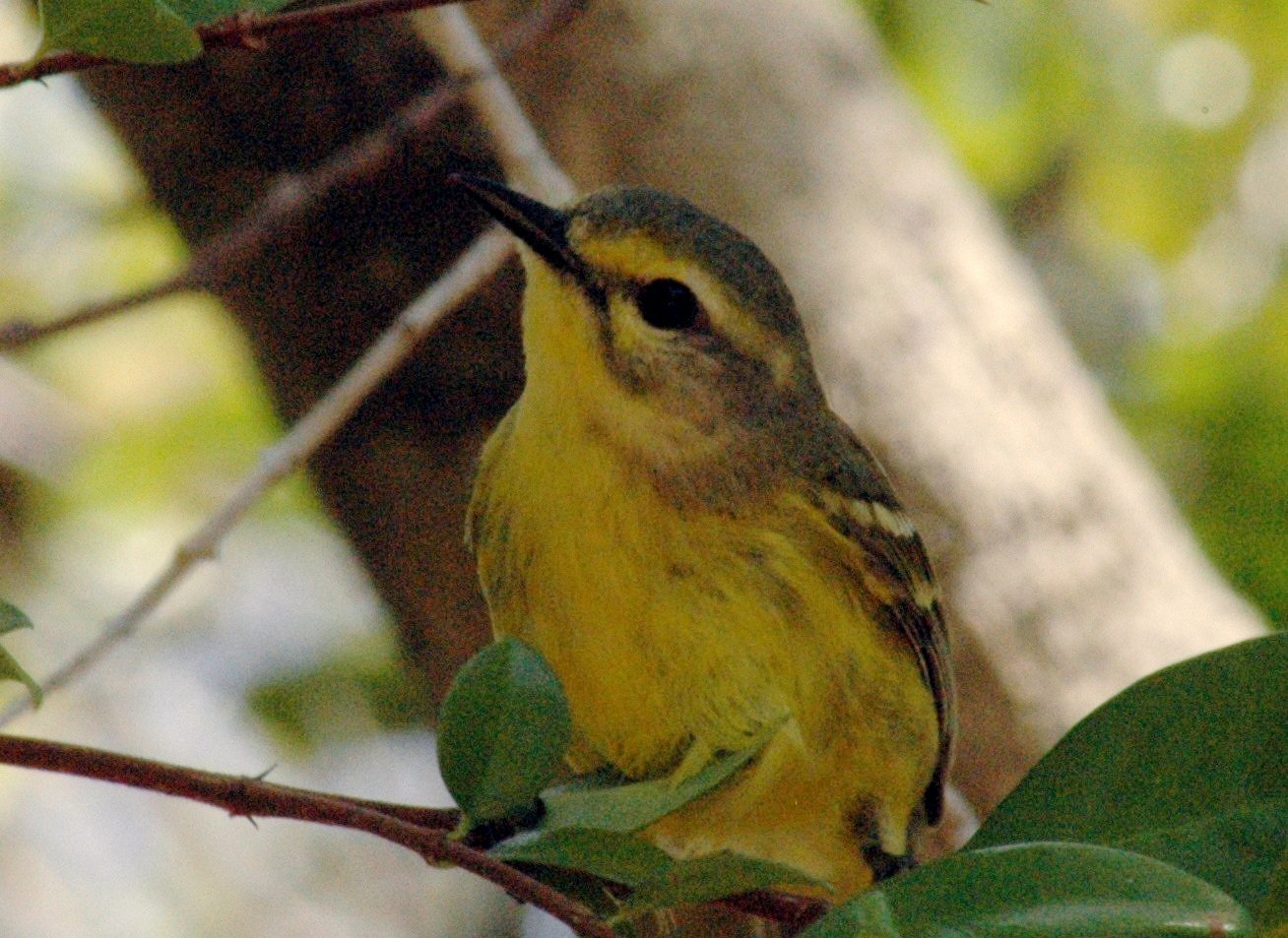
About 13 cm. The upperparts are yellow-green to olive-green, the underparts bright yellow. The face is yellow, with an olive eye-line and a faint dark crescent below the eye. Faint olive streaks run along the sides of the breast and flanks. The wings show two indistinct, yellowish wing bars, and the outer tail feathers have white spots. The subspecies differ in underpart colour and head pattern. Females and young birds are duller.
Confusion species
Prairie Warbler Setophaga discolor, a common winter visitor to the same islands, has black rather than olive flank streaks, a crisper black face pattern and, in the male, chestnut streaks on the back. Mangrove Warbler Setophaga petechia and American Yellow Warbler Setophaga aestiva have a plain yellow face and yellow tail spots. Bananaquit Coereba flaveola is dark above, with a white supercilium and a curved bill.
Habitat
Dry woodland with much scrub, coastal scrub and thorn scrub; it tolerates some disturbance and also occurs in gardens and built-up areas. It searches shrubs and the lower canopy for insects.
Where the bird is most at home, classified by the vegetation types of the Caribbean.





Range and movements
On Grand Cayman, Little Cayman and Cayman Brac. Also on the Swan Islands (Honduras), outside the area covered by this guide. It occurs nowhere else.
- Resident
- dark = core range, pale = thinly spread
How and when to look
The dry woodland and scrub of Little Cayman and Cayman Brac, or the Mastic Trail area on Grand Cayman. Prairie Warblers are also present in winter; the colour of the flank streaks and the face pattern are then the points to check.
Conservation status
Near Threatened (NT). The range is very small; on Grand Cayman in particular dry woodland is being lost to development. The species does tolerate some disturbance.
Scientific name
Setophaga vitellina | (Cory, 1886)
Cory described the species in 1886 as Dendroica vitellina; because it was later moved to another genus, the author and year stand in brackets. The genus Setophaga was introduced in 1827 by Swainson. Setophaga is Greek, from sēs, sētos 'moth' and -phagos '-eating': 'moth-eater'. vitellina is Latin, from vitellus 'egg yolk': 'yolk-yellow', after the yellow underparts. The specimen the first description was based on came from Grand Cayman, Cayman Islands.