All species › Passerines › Manakins › White-bearded Manakin
White-bearded Manakin | Manacus manacus
Bonte manakin | Saltarín barbiblanco
On Trinidad the White-bearded Manakin is heard more often than seen: at their display sites in the forest the males make loud snaps with their wings. Groups of males form a communal lek in which each keeps its own patch of bare forest floor. Trinidad holds the subspecies trinitatis, which is slightly larger than mainland birds and in which the female has yellower underparts.
Voice
A high, trilled peeeerr given by both sexes. At the lek the males call chee-poo and make loud snaps with their wings, singly or in rapid series that sound like a rattle.
Recording: Juan Freile — CC BY-NC-SA 4.0 · converted to mono · xeno-canto
Identification
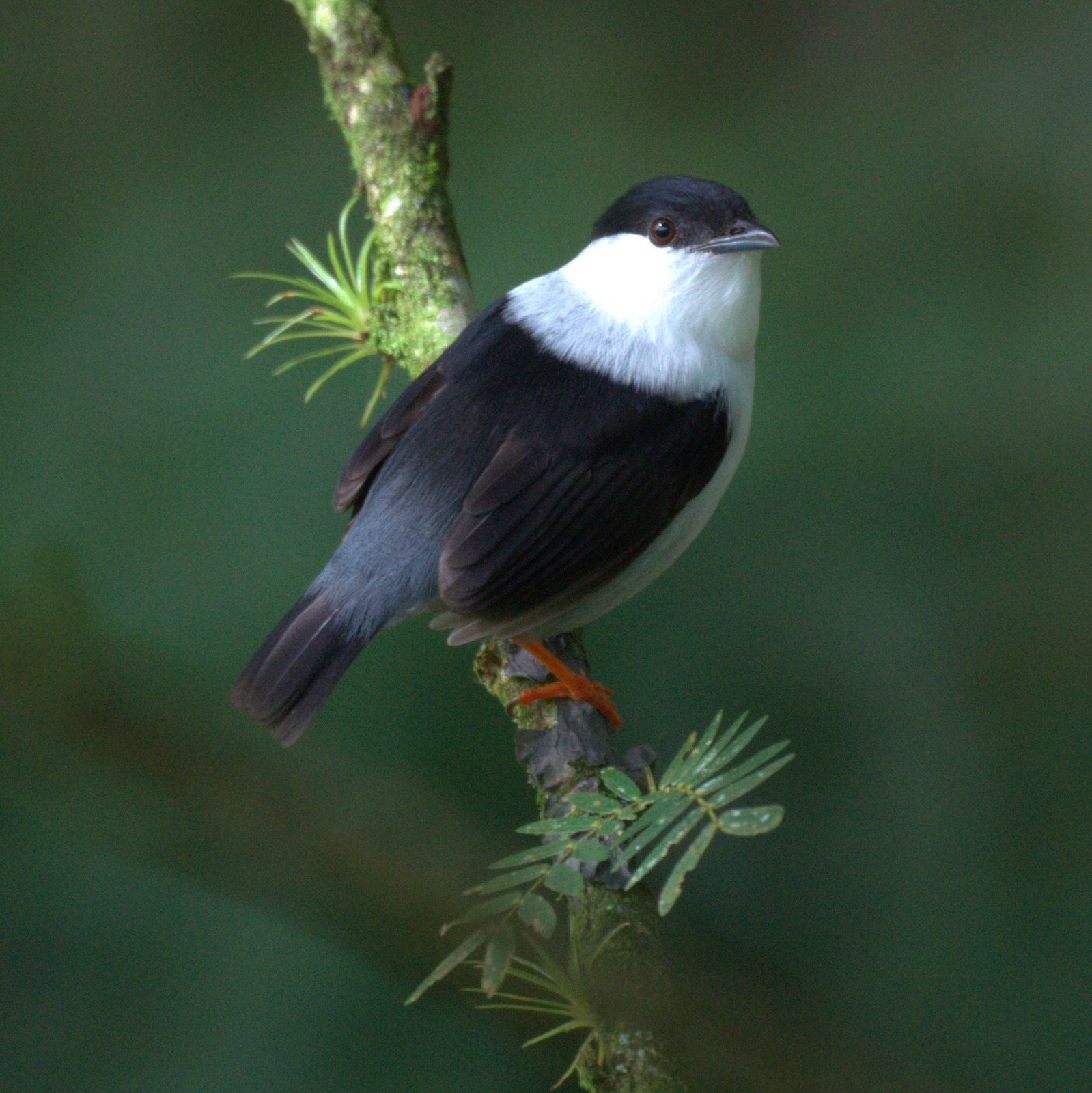
10–12 cm, compact, with a very short tail. The male has a black crown, upper back, wings and tail; the rest of the plumage is white, with a grey rump. In display it puffs the white throat feathers forward into a beard. The female is olive-green, paler below and, on Trinidad, yellowish. Both sexes have orange legs and a dark brown eye.
Confusion species
The male has no similar species in the region. The female resembles the female Golden-headed Manakin Ceratopipra erythrocephala, which is smaller and has flesh-coloured to grey legs instead of orange. The male White-winged Becard Pachyramphus polychopterus is also black and white, but larger, with grey underparts and white wing bars.
Habitat
Forest edges, secondary growth and moist forest with dense undergrowth, also cacao plantations, up to about 1000 m. It eats mainly small fruits, plucked in flight, and insects. Each male clears a patch of forest floor and jumps back and forth between thin stems above it; leks with several dozen males are known on Trinidad. Males display almost all year except during moult. The female builds a shallow cup nest low in a shrub or sapling; the two eggs are incubated for 18–19 days.
Where the bird is most at home, classified by the vegetation types of the Caribbean.


Range and movements
In the region only on Trinidad, where it is common in forested areas across the whole island; it is absent from Tobago. Outside the region across much of tropical South America, from Colombia and Venezuela to Bolivia, Paraguay and northern Argentina.
- Resident
- dark = core range, pale = thinly spread
How and when to look
In the forests of the Northern Range, for example at the Asa Wright Nature Centre, where leks lie close to the trails. The snapping gives away a lek from a distance; males are most active in the morning.
Conservation status
Not threatened. Common, and well represented in secondary growth and plantations.
Scientific name
Manacus manacus | (Linnaeus, 1766)
Linnaeus described the species in 1766 as [Pipra] manacus; because it was later moved to another genus, the author and year stand in brackets. The genus Manacus was introduced in 1760 by Brisson. Manacus was Latinised by Brisson from the Dutch 'manakin' (from 'manneken', little man), the name these birds bore in Surinam. manacus repeats the genus name, Latinised from the Dutch 'manakin', the name these birds bore in Surinam. The specimen the first description was based on came from Suriname.