All species › Passerines › Vireos › White-eyed Vireo
White-eyed Vireo | Vireo griseus
Witoogvireo | Vireo ojiblanco
The White-eyed Vireo is a small North American vireo that occurs in the Caribbean as a winter visitor, mainly in the Bahamas and Cuba. It keeps to dense thickets and is heard more often than seen, although it sings less in winter than on the breeding grounds.
Voice
The song is a rapid, variable series of notes beginning and ending with a sharp chick, as in chick-a-per-weeoo-chick. The call is a dry, rasping chatter. On the wintering grounds mostly the call, but wintering birds also sing at times.
Recording: steve — CC BY-SA 4.0 · converted to mono · xeno-canto
Identification
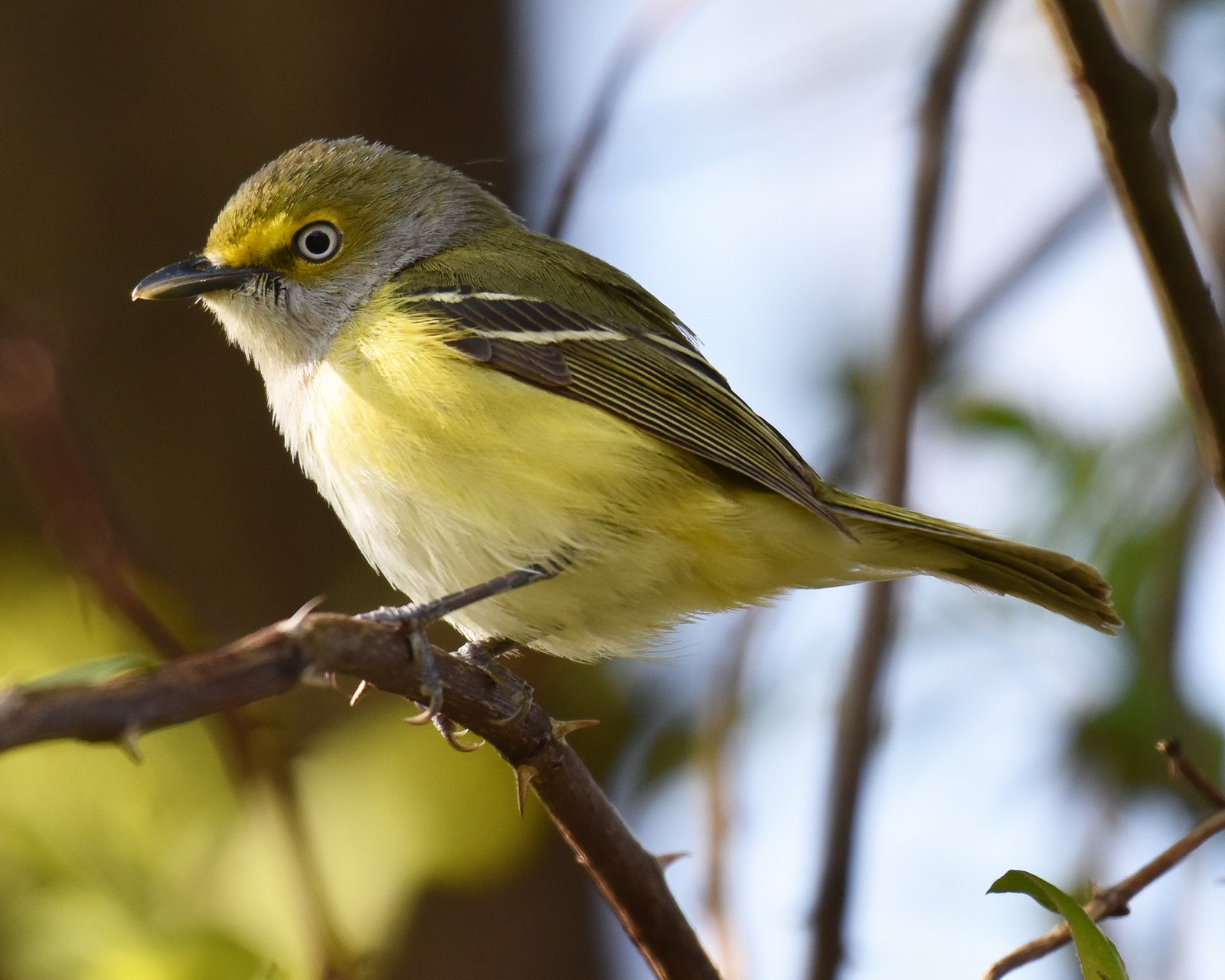
11–13 cm. Head and upperparts are greyish olive-green, the throat and belly white, the flanks yellow. The yellow spectacles are distinctive: yellow lores joining a yellow eye-ring. Adults have a white iris, first-autumn and first-winter birds a dark one. Wings and tail are dark, with two distinct white wing bars. The sexes are alike.
Confusion species
Cuban Vireo Vireo gundlachii is plumper, with a larger head, a broad, diffuse yellow patch around the eye, a dark iris and weaker wing bars. Thick-billed Vireo Vireo crassirostris of the Bahamas, the Cayman Islands and the Cuban cays has a heavier bill, less sharply defined spectacles, a dark iris and more yellow-tinged underparts without the contrast between white belly and yellow flanks. Blue-headed Vireo Vireo solitarius, a rare winter visitor, has a blue-grey head with white spectacles and a dark iris.
Habitat
Dense thickets, scrub and forest edges, dry lowland forest (the coppice of the Bahamas), coastal scrub, overgrown fields and pastures and well-vegetated gardens. It forages low in the vegetation for insects and spiders and in winter also takes berries and small fruits.
Where the bird is most at home, classified by the vegetation types of the Caribbean.





Range and movements
In the Caribbean a winter visitor. Fairly common in the northern Bahamas, scarcer in the southern islands and the Turks and Caicos Islands; scarce to fairly common in Cuba, mainly in the west and on the Isla de la Juventud; scarce in the Cayman Islands and rare in Jamaica. A vagrant to Hispaniola, Puerto Rico and the Virgin Islands. Breeds in the eastern United States and north-eastern Mexico; also resident in Florida and along the Gulf Coast.
- Resident
- Winter visitor (c. Apr–Sep)
- Passage (Mar–Apr, Oct–Nov)
- dark = core range, pale = thinly spread
How and when to look
In the northern Bahamas and western Cuba, in dense thickets along forest edges and tracks, especially in the morning. Imitating an alarm or owl call often brings the bird curiously to the edge of the vegetation, where the yellow spectacles and white wing bars can be seen.
Conservation status
Not threatened. The species has a large range and a stable to slightly increasing population.
Scientific name
Vireo griseus | (Boddaert, 1783)
Boddaert described the species in 1783 as Tanagra grisea; because it was later moved to another genus, the author and year stand in brackets. The genus Vireo was introduced in 1808 by Vieillot. Vireo was used by Latin authors for a small, green, migratory bird, probably the Eurasian golden oriole, though the European greenfinch has also been suggested. griseus is Medieval Latin for 'grey', after the grey tones of the head and back. The specimen the first description was based on came from New Orleans, Louisiana (USA).