All species › Passerines › Thrushes › White-necked Thrush
White-necked Thrush | Turdus albicollis
Witneklijster | Zorzal cuelliblanco
The White-necked Thrush is a shy thrush of the interior of humid forest, more often heard than seen. It forages on the forest floor and in the lower storey, alone, in pairs or in small groups. Birds on Trinidad and Tobago belong to the subspecies phaeopygoides; the classification of this species, which ranges from Colombia to Argentina, is still unsettled.
Voice
A melodious, rather slow song of repeated phrases, often from early morning. The characteristic call is a descending too-eeoo; also short calls such as yup and a clucking cluck.
Recording: João Capurucho — CC BY-NC-SA 4.0 · converted to mono · xeno-canto
Identification
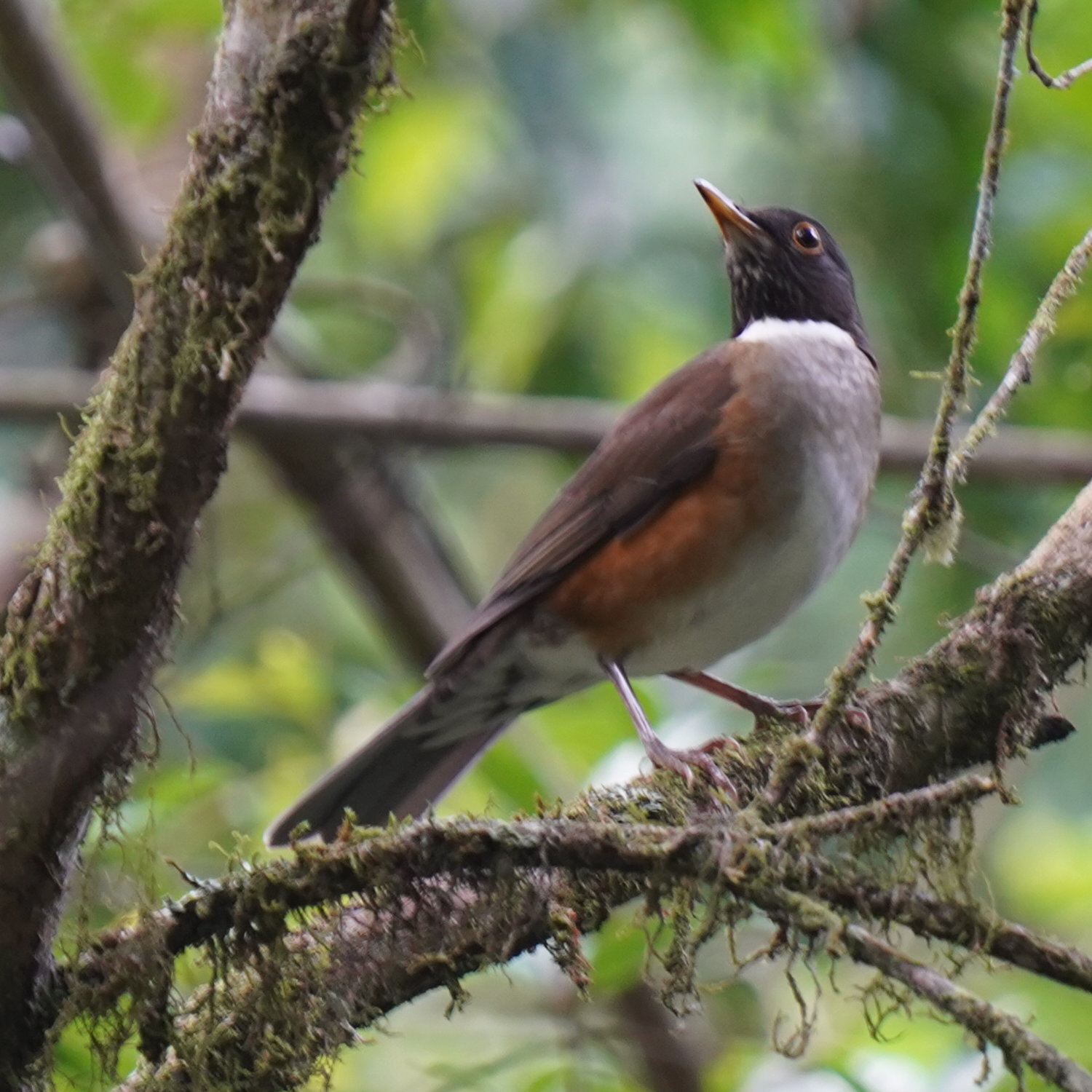
21–23 cm. Head and upperparts are dark olive-brown, the head somewhat greyer. The throat is white with dense blackish streaks and is closed off below by a white half-collar. The breast is grey, the flanks grey-brown to orange-brown, the belly and undertail white. Distinctive is the yellow-orange eye-ring; the bill is yellowish and the legs pinkish brown. The sexes are alike. Juveniles have pale spots above and brown barring on the pale underparts.
Confusion species
Spectacled Thrush Turdus nudigenis has a broader, bare eye-ring, a plain grey-brown breast and no white collar, and lives more in the open. Cocoa Thrush Turdus fumigatus is mainly rufous-brown, without an eye-ring or white collar. The female Yellow-legged Thrush Turdus flavipes is warmer brown, with yellow legs and no white collar.
Habitat
The interior of humid primary and older secondary forest with dense, tangled undergrowth, mainly in hilly country and on lower slopes, less often at forest edges. It searches the leaf litter for insects and other invertebrates and eats fruit. The nest is a sturdy cup of mud, leaves and twigs with moss on the outside, 1 to 9 m up.
Where the bird is most at home, classified by the vegetation types of the Caribbean.



Range and movements
On Trinidad in the forests of the Northern Range and in other larger forest blocks; on Tobago in the forests of the Main Ridge. Outside the area in northern Colombia and Venezuela, the Guianas, the Amazon basin and eastern and south-eastern Brazil to Paraguay, Uruguay and north-eastern Argentina.
- Resident
- dark = core range, pale = thinly spread
How and when to look
Early in the morning in Northern Range forest on Trinidad or along the forest trails of the Main Ridge on Tobago, listening for the descending call. Birds often walk on the trail itself but retreat into the undergrowth at the slightest movement.
Conservation status
Least Concern. The species has a very large range. On the islands it depends on continuous forest, which is lost locally to clearance and development.
Scientific name
Turdus albicollis | Vieillot, 1818
Vieillot described the species in 1818 and placed it straight away in the genus where it still stands. The genus Turdus was introduced in 1758 by Linnaeus. Turdus is the ordinary Latin word for 'thrush'. albicollis is Latin, from albus 'white' and collum 'neck', after the white band below the streaked throat. The specimen the first description was based on came from Rio de Janeiro, Brazil.