All species › Nightjars › Nightjars › White-tailed Nightjar
White-tailed Nightjar | Hydropsalis cayennensis
Witstaartnachtzwaluw | Chotacabras coliblanco
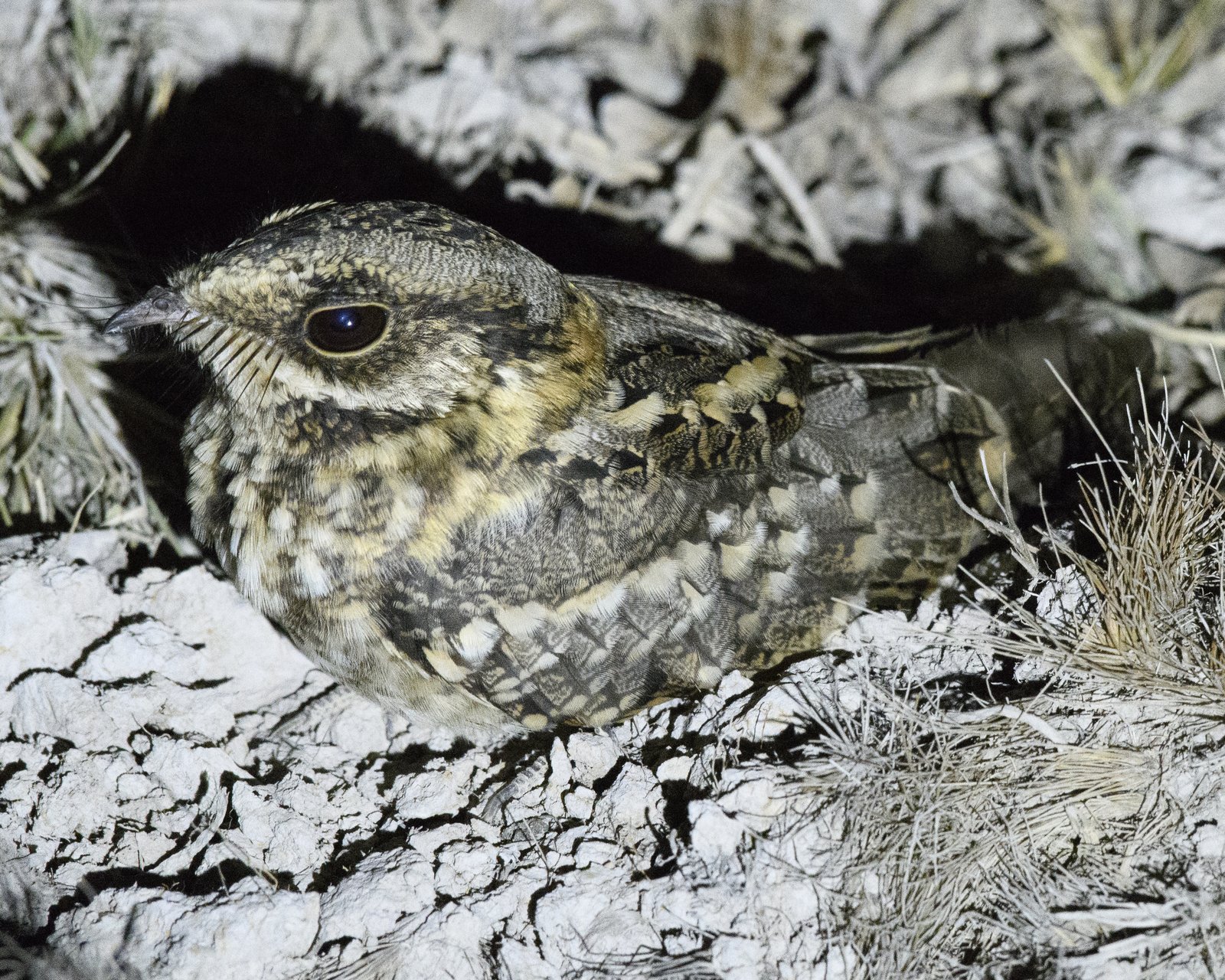
The White-tailed Nightjar is a small nightjar of open, grassy country. In the Caribbean it occurs on Trinidad and Tobago, on Aruba, Curaçao and Bonaire, and on Martinique, which has its own subspecies, manati. In flight the male shows a lot of white in wing and tail; the female is almost uniformly camouflaged.
Voice
The male's song is a high, thin pt-tseeeeee, the second note long-drawn-out and rising, dropping slightly at the end. Also scratchy calls in flight and thin ticking notes when disturbed.
Recording: Paul Lenrumé — CC BY-NC-SA 4.0 · converted to mono · xeno-canto
Identification
20–22 cm, slim, with a fairly long, slightly notched tail. Upperparts grey-brown with dark spots and streaks, and a rufous collar on the hindneck. The male has a white throat patch, a white band across the primaries and largely white outer tail feathers, so that the tail looks mainly white from below. The female is darker and browner, with a buff throat and no white in wing or tail. Subspecies on Martinique and the ABC Islands differ slightly in tone and in the amount of white.
Confusion species
Pauraque Nyctidromus albicollis on Trinidad is larger, with a longer tail and a white wing band closer to the wing tip. Antillean Nighthawk Chordeiles gundlachii and Common Nighthawk Chordeiles minor have pointed wings with a white bar midway, a forked tail and hunt high in the air, also by day. The female closely resembles females of other small nightjars; on the ABC Islands and Martinique it is the only resident member of the family.
Habitat
Open country: savanna, pasture, grassy slopes with scattered bushes, dry scrub and open coastal vegetation. On the ABC Islands it uses open patches in thorn and cactus scrub, on Martinique mainly the dry south and east coasts, such as the Caravelle peninsula. It hunts insects from the ground or in low flight. The egg is laid without a nest on the ground, often among grass or under a shrub.
Where the bird is most at home, classified by the vegetation types of the Caribbean.





Range and movements
Resident on Trinidad and Tobago, on Aruba, Curaçao and Bonaire, and on Martinique. On Martinique the population is small and confined to a few dry areas. Outside the region from Costa Rica through northern South America to the Guianas and northern Brazil.
- Resident
- Summer visitor (c. Oct–Mar)
- Winter visitor (c. Apr–Sep)
- Passage (Mar–Apr, Oct–Nov)
- dark = core range, pale = thinly spread
How and when to look
Best at dusk along grasslands and savannas on Trinidad and Tobago or in the open scrub of Curaçao and Bonaire, where singing males often call from the ground or a low rock. Eyeshine on roads and tracks shows up in headlights or a torch beam.
Conservation status
Not threatened as a species. On Martinique the subspecies manati is threatened by the loss of dry habitat to development and by introduced predators such as mongooses, cats and rats, which take eggs and chicks on the ground.
Scientific name
Hydropsalis cayennensis | (Gmelin, 1789)
Gmelin described the species in 1789 as Caprimulgus cayennensis; because it was later moved to another genus, the author and year stand in brackets. The genus Hydropsalis was introduced in 1832 by Wagler. Hydropsalis is Greek, from hudro- 'water-' and psalis 'pair of scissors', after the scissor-like tail; why 'water' is unclear. cayennensis means 'from Cayenne', after French Guiana, where the type specimen came from. The specimen the first description was based on came from Cayenne, French Guiana.