All species › Passerines › Tityras and becards › White-winged Becard
White-winged Becard | Pachyramphus polychopterus
Witvleugelbekarde | Cabezón aliblanco
The White-winged Becard is a small, large-headed tree-dwelling bird of the tityra and becard family. In the region it occurs only on Trinidad and Tobago. It moves sluggishly through the middle and upper canopy, recalling a vireo rather than a flycatcher, and often joins mixed flocks of insect-eaters.
Voice
A soft, melodious series of clear whistles, something like tew-tew-tew-tew, often speeding up slightly; also short, soft calls. The song does not carry far and is often overlooked.
Recording: José María Loaiza B. — CC BY-NC-SA 4.0 · shortened to the first 60 s, mono · xeno-canto
Identification
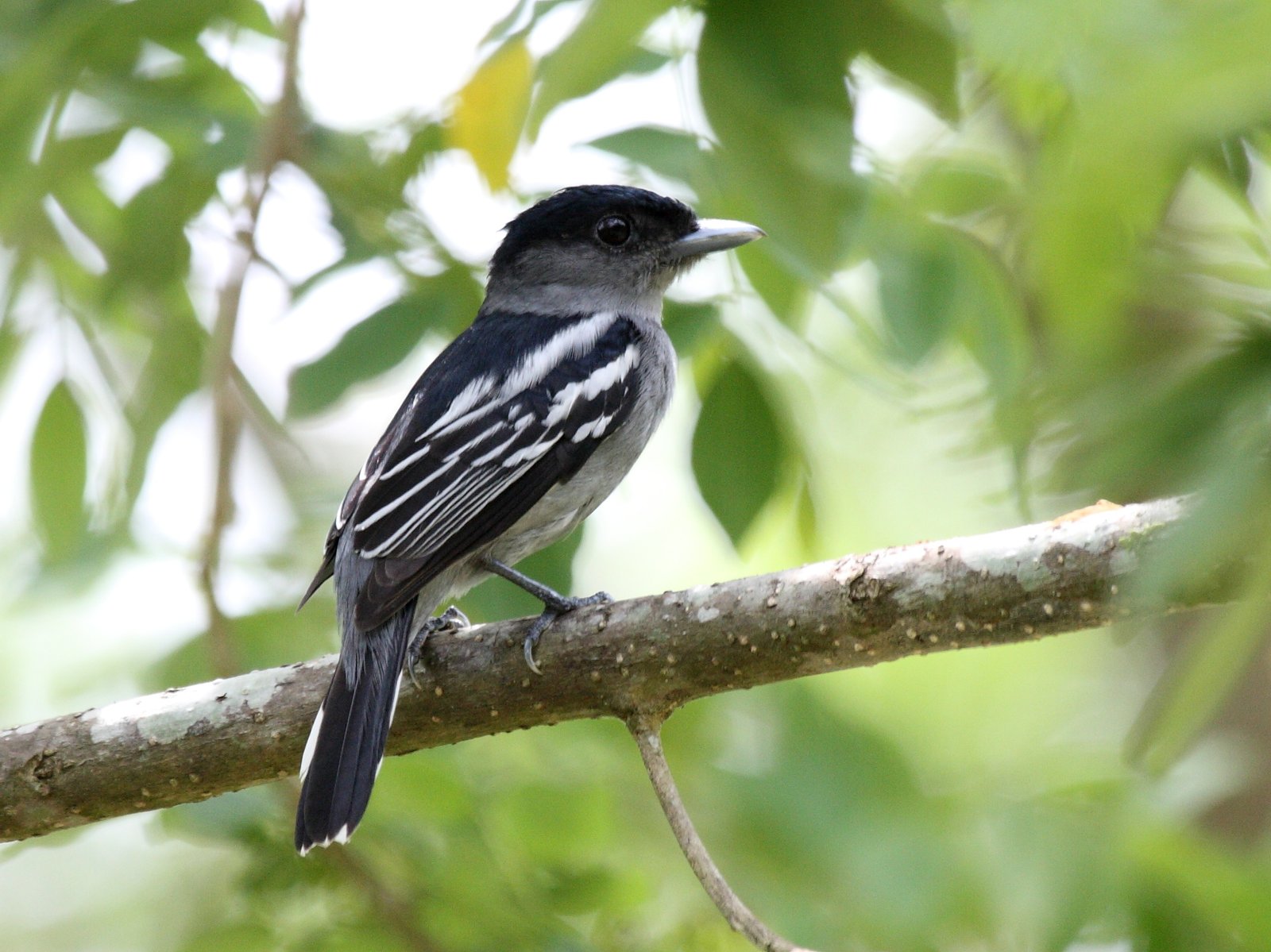
14–15.5 cm, with a large rounded head and a short, fairly broad bill. The male is black above with a glossy black crown and slate grey below; birds on Trinidad and Tobago are dark below. The wing coverts and scapulars have broad white edges forming two wing bars and a white stripe along the shoulder, and the black tail feathers are tipped white. The female is olive-brown above with a browner crown, a pale eye-ring and lores, cinnamon edges to the wing feathers and pale yellow underparts. Young males first resemble the female and gradually become grey and black.
Confusion species
Male Black-crested Antshrike Sakesphorus canadensis has a black crest, a browner back and a heavier hooked bill, and keeps lower in scrub. Barred Antshrike Thamnophilus doliatus is barred black and white all over. The female may recall a vireo or a flatbill such as Yellow-olive Flatbill Tolmomyias sulphurescens, but has a larger head, a stouter bill and cinnamon wing edgings. Black-tailed Tityra Tityra cayana is much larger and largely white.
Habitat
Edges and clearings of evergreen and semi-evergreen forest, secondary forest, riverine woodland and plantations with shade trees, also semi-open country with tall trees; from the lowlands into the hills. It searches the foliage for insects and their larvae, picked from a perch or in a short fluttering sally to the leaves; it also takes some small fruit. The nest is a bulky globe of grass, plant fibres and moss with a side entrance, high in a tree.
Where the bird is most at home, classified by the vegetation types of the Caribbean.



Range and movements
In the region only on Trinidad and Tobago, where it is fairly common on both islands in forest and at forest edges. Outside the region from Guatemala and Belize through Central America and over most of South America east of the Andes to northern Argentina and Uruguay; the southernmost populations are migratory.
- Resident
- dark = core range, pale = thinly spread
How and when to look
Found by checking mixed flocks of insect-eaters along forest edges and trails, both on Trinidad and in the Main Ridge forest on Tobago. The soft whistled series gives away a bird in the canopy; the male then stands out by its white wing pattern.
Conservation status
Not threatened. The species has a very large range, is locally common and also occurs in secondary forest, forest edge and plantations.
Scientific name
Pachyramphus polychopterus | (Vieillot, 1818)
Vieillot described the species in 1818 as Platyrhynchos polychopterus; because it was later moved to another genus, the author and year stand in brackets. The genus Pachyramphus was introduced in 1840 by Gray. Pachyramphus is Greek, from pakhus 'thick' and rhamphos 'bill', after the stout, broad bill. polychopterus is Greek, probably from polus 'many' and -pteros 'winged', after the many white edgings on the wing; the exact formation is unclear. The specimen the first description was based on came from Bahia, Brazil.