All species › Passerines › New World warblers › Wilson's Warbler
Wilson's Warbler | Cardellina pusilla
Wilsons zanger | Reinita de Wilson
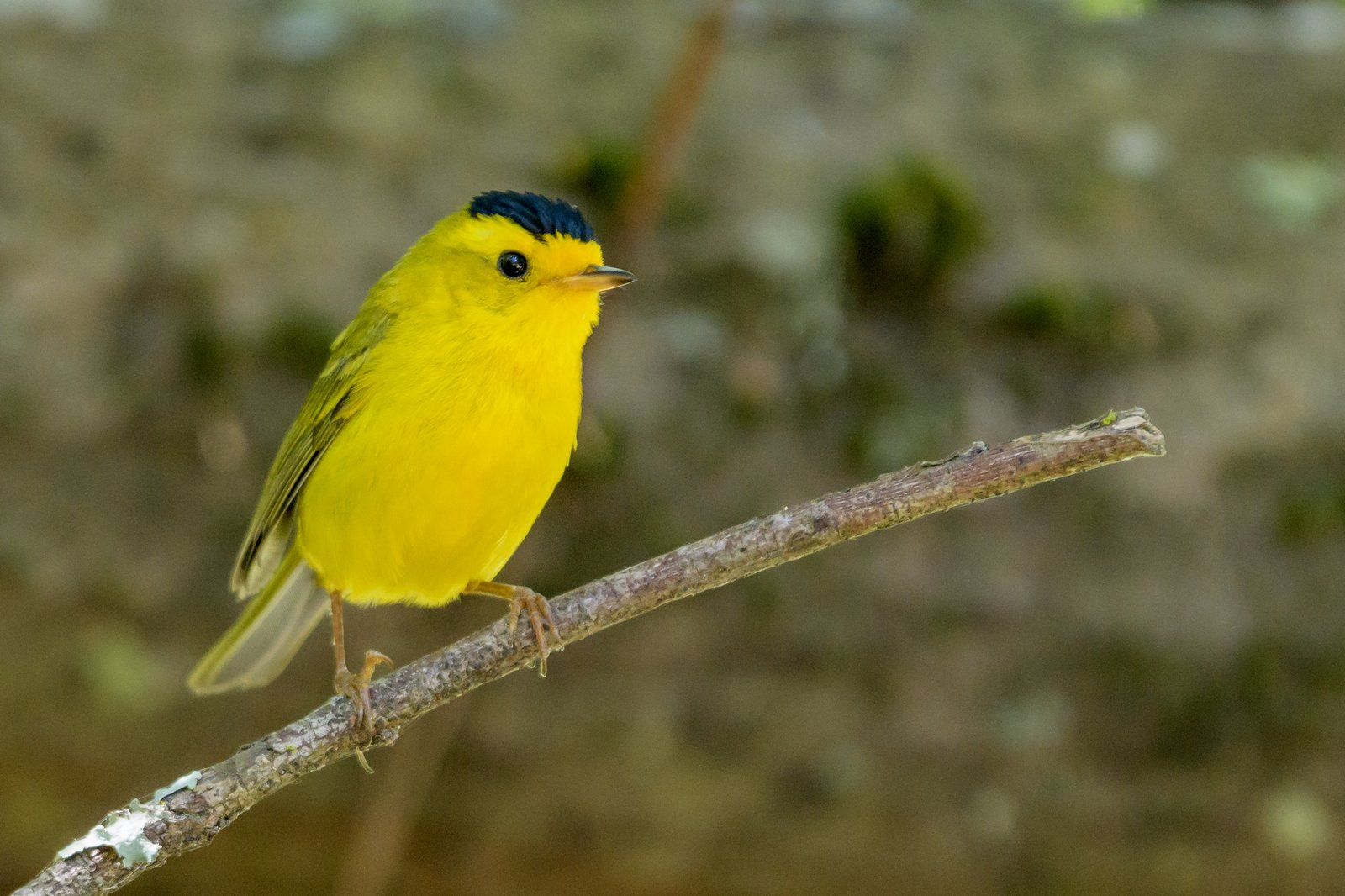
Wilson's Warbler is a small olive-green and yellow wood-warbler; the male wears a black cap. It breeds in scrub and young woodland in Canada, Alaska and the western United States and winters mainly in Mexico and Central America. The Caribbean lies east of its usual migration route, and it is a rare visitor there.
Voice
The call is a flat, somewhat nasal chep. The song, rarely heard in the region, is a rapid chattering series that drops in pitch and speed.
Recording: Andrew McCafferty — CC BY-NC-SA 4.0 · shortened to the first 60 s, mono · xeno-canto
Identification
10–12 cm, small, with a fairly long, rounded tail that is often flicked or swung around. Upperparts olive-green, underparts entirely yellow, and a yellow face with a dark eye. The male has a glossy black cap. The female has a smaller or olive cap, or none. Young birds in autumn are duller, with no cap or a faint one. No wing bars and no white tail spots. Birds from the east of the breeding range, which are the ones most likely to reach the Caribbean, are duller olive than the western forms.
Confusion species
Female Hooded Warbler Setophaga citrina is larger, with a yellow face bordered by olive-green and white spots in the tail that show when it is flicked. American Yellow Warbler Setophaga aestiva and Mangrove Warbler Setophaga petechia have a shorter tail with yellow inner webs and yellow edges to the wing feathers, and no cap. Orange-crowned Warbler Leiothlypis celata is greenish with faint streaking on the breast and a dark eye-line. Canada Warbler Cardellina canadensis has a grey back, an eye-ring and a necklace.
Habitat
Scrub, forest edges, open moist and semi-evergreen woodland, coastal woodland and mangrove edges, and also gardens and parks with shrubs. It forages low to mid-height, actively, gleaning insects from leaves and catching them in short flights.
Where the bird is most at home, classified by the vegetation types of the Caribbean.





Range and movements
A rare winter visitor and passage migrant in the Bahamas, Cuba, the Cayman Islands, Jamaica and Puerto Rico; very rare on Hispaniola. There are hardly any records from the Lesser Antilles, Trinidad and Tobago or the ABC Islands. Breeds in Alaska, Canada and the western United States, and winters from the southern United States through Mexico and Central America to Panama.
- Winter visitor (c. Apr–Sep)
- Passage (Mar–Apr, Oct–Nov)
- dark = core range, pale = thinly spread
How and when to look
Shrubs and forest edges in the Bahamas and western Cuba, and botanic gardens and parks on Grand Cayman and in Puerto Rico, in the winter months. The habit of swinging and flicking the tail helps in finding it; the black cap of a male is diagnostic.
Conservation status
Not threatened. The population is large, but breeding-range surveys show a decline since the 1960s. The western subspecies chryseola is declining sharply in places through habitat loss.
Scientific name
Cardellina pusilla | (Wilson, 1811)
Wilson described the species in 1811 as Muscicapa pusilla; because it was later moved to another genus, the author and year stand in brackets. The genus Cardellina was introduced in 1850 by Bonaparte. Cardellina is a diminutive of the Italian dialect word cardella 'goldfinch'. pusilla is Latin for 'very small'. The specimen the first description was based on came from southern New Jersey (USA).