All species › Parrots › Parrots › Yellow-crowned Amazon
Yellow-crowned Amazon | Amazona ochrocephala
Geelvoorhoofdamazone | Amazona coroniamarilla
The Yellow-crowned Amazon is a widespread South American amazon that occurs in the Caribbean in two ways: as a scarce native resident on Trinidad, and as an alien on a few other islands, derived from escaped or released cage birds. It has long been popular in captivity for its ability to mimic sounds.
Voice
Loud, hoarse shrieks and long rambling series of gurgling, trilling and whistled notes mixed with repeated screeches. Most active just after sunrise and before sunset.
Recording: Jacob Wijpkema — CC BY-NC-SA 4.0 · shortened to the first 60 s, mono · xeno-canto
Identification
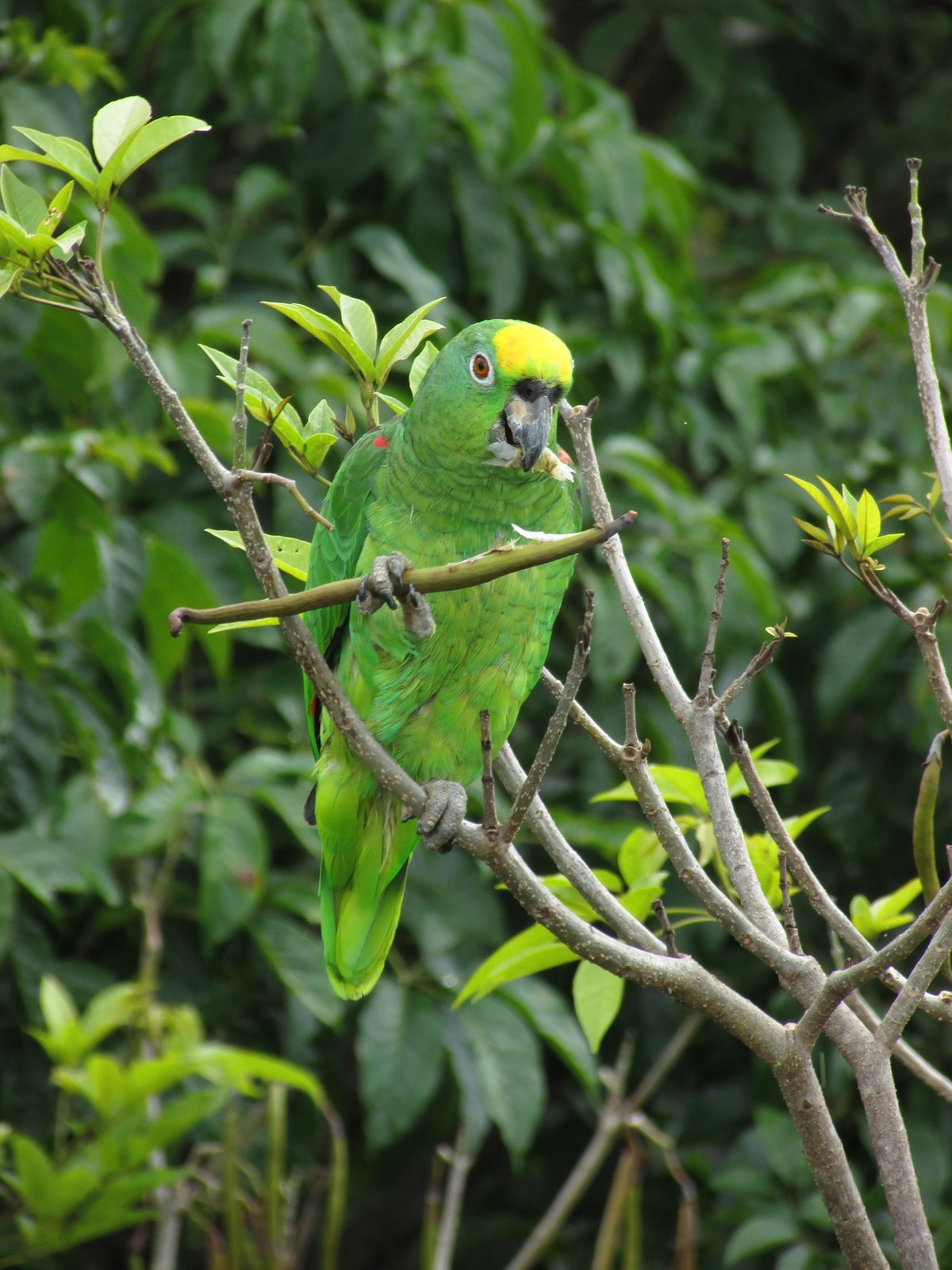
33–38 cm, heavy-bodied, with a short broad tail. Green, with a yellow patch on forehead and crown; the nape feathers are dark-edged. A white eye-ring. The wing shows a red speculum and red bend of the wing, with dark blue tips to the secondaries and primaries; the outer tail feathers are red at the base. The bill is dark with a large horn-coloured or reddish patch on the upper mandible. The sexes are alike. Subspecies differ in the amount of yellow on the head, and escaped birds may belong to the yellow-headed forms.
Confusion species
On Trinidad Orange-winged Amazon Amazona amazonica is far more common; it has blue and yellow on the head, yellow cheeks, an orange speculum and no red at the bend of the wing. Yellow-shouldered Amazon A. barbadensis of Bonaire has a white forehead, yellow around the eye and a yellow bend of the wing. Turquoise-fronted Amazon A. aestiva has blue above the bill and a mainly black bill; Yellow-naped Amazon A. auropalliata has the yellow on the nape.
Habitat
On Trinidad lowland forest, swamp forest and palm swamp and riverside forest edge, also mangroves and open country with scattered trees. On Grand Cayman and Puerto Rico mainly around settlements, in gardens and parks. It eats fruit, seeds, nuts and blossom. Nests in tree cavities, including dead palms.
Where the bird is most at home, classified by the vegetation types of the Caribbean.





Range and movements
Native to Trinidad, where it is scarce and local; not known from Tobago. Introduced on Grand Cayman and in Puerto Rico, where it appears to breed in the wild. Isolated records of probable escapes come from Curaçao and Barbados, among others. Outside the region in Panama and northern South America, from Colombia and Venezuela to the Guianas and the Amazon basin.
- Resident
- dark = core range, pale = thinly spread
How and when to look
On Trinidad, look among the far commoner Orange-winged Amazons for birds without blue and yellow on the cheeks, with a yellow crown and red at the bend of the wing; in flight the red rather than orange speculum stands out. Small flocks travel between roost and feeding sites mainly in the morning and towards evening.
Conservation status
Not threatened globally, but locally reduced by trapping for the trade and forest loss. On Trinidad a scarce native species; on Grand Cayman and in Puerto Rico an alien.
Scientific name
Amazona ochrocephala | (Gmelin, 1788)
Gmelin described the species in 1788 as Psittacus ochrocephalus; because it was later moved to another genus, the author and year stand in brackets. The genus Amazona was introduced in 1830 by Lesson. Amazona comes from 'Amazone', the French name Buffon gave to various tropical American parrots because they came from the Amazon region. ochrocephala is Greek, from ōkhros 'ochre-yellow' and kephalē 'head', after the yellow crown. The specimen the first description was based on came from Venezuela (restricted from 'South America').