All species › Passerines › Tanagers › Yellow-shouldered Grassquit
Yellow-shouldered Grassquit | Loxipasser anoxanthus
Jamaicagrondvink | Semillero jamaicano
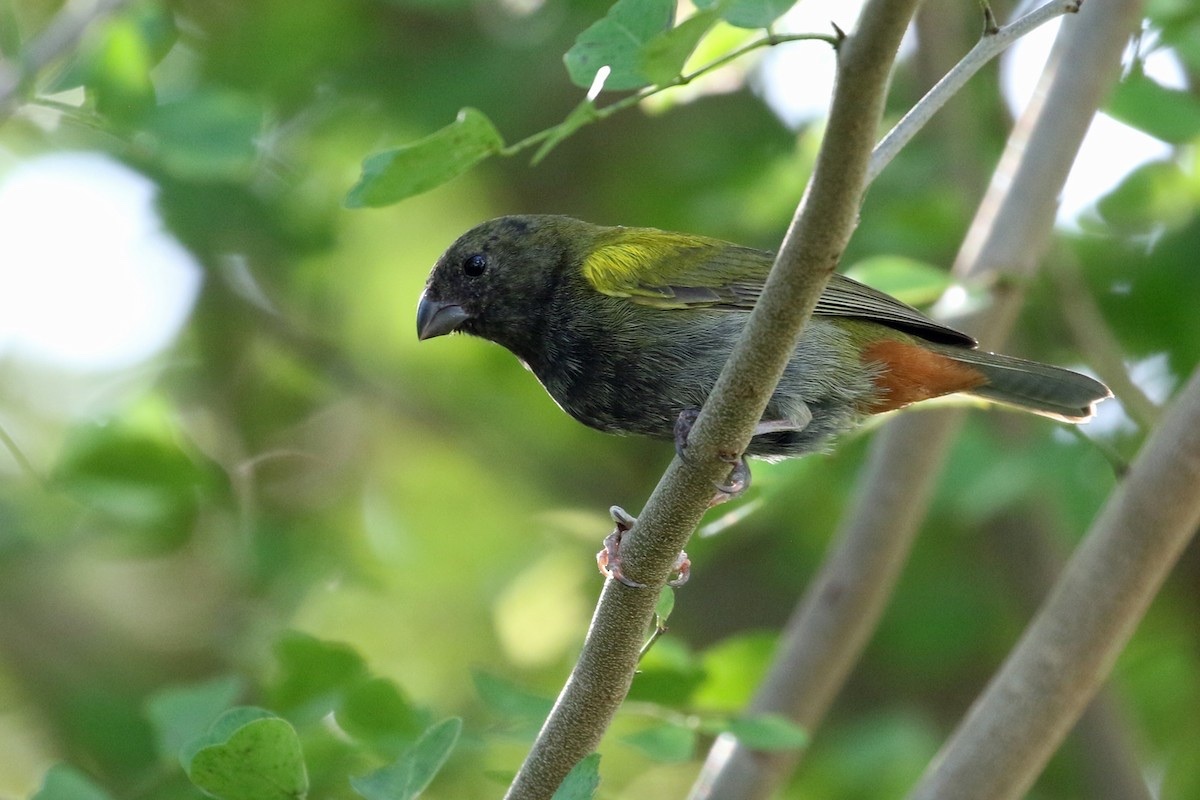
The Yellow-shouldered Grassquit is a compact, big-headed grassquit found only in Jamaica, and the only member of the genus Loxipasser. Unlike most grassquits it is a bird of forest edge and hill country rather than open grassland. It is usually seen in pairs or family groups, low in shrubs and trees.
Voice
The song is a series of four or five high, buzzy notes, rising or falling, followed by one to three notes at a different pitch. There is also a descending chi-chi-chi-chi-chi. Several local song dialects have been described.
Recording: Bobby Wilcox — CC BY-NC-SA 4.0 · converted to mono · xeno-canto
Identification
10–11.5 cm, with a large head, short tail and thick bill with a curved culmen. The male has an all-black head and breast, dark grey belly and flanks and rusty undertail coverts. The upperparts are olive-green, the lesser coverts and shoulder bright yellow. The female is olive-grey on the head and breast and grey on the belly, with a yellow patch at the bend of the wing, paler rusty undertail coverts and a horn-coloured bill. Juveniles resemble the female, with less yellow on the wing.
Confusion species
Black-faced Grassquit Melanospiza bicolor has a slimmer bill, a duller back and no yellow on the wing; in the male the black is limited to the face and breast. The male Yellow-faced Grassquit Tiaris olivaceus has a yellow facial mask and no yellow shoulder. The yellow shoulder and rusty undertail are diagnostic in both sexes, but are not always visible.
Habitat
Edges of moist and montane forest, open woodland, limestone forest, roadside thickets and gardens near woodland, from sea level to about 1,800 m, but mainly in the hills and mountains. It eats seeds and small fruits, and probably insects. The female builds a well-hidden domed nest of grass and twigs with a side entrance, often among epiphytes or bromeliads. The breeding season runs from about March to September; the clutch is usually three or four eggs.
Where the bird is most at home, classified by the vegetation types of the Caribbean.






Range and movements
Only in Jamaica, throughout the hills and mountains of the island; scarcer in the lowlands. It does not occur outside Jamaica.
- Resident
- dark = core range, pale = thinly spread
How and when to look
Forest edges and roads through the hills are the best places, for example in the Blue Mountains and along the Ecclesdown Road in Portland. Pairs often sit low in thickets and at the forest edge; the yellow shoulder is most obvious when a bird flies up.
Conservation status
Not threatened. It is fairly common within its small range. The population is suspected to be declining as forest is lost.
Scientific name
Loxipasser anoxanthus | (Gosse, 1847)
Gosse described the species in 1847 as Spermophila anoxantha; because it was later moved to another genus, the author and year stand in brackets. The genus Loxipasser was introduced in 1866 by Bryant. Loxipasser combines Loxia, the crossbill genus, with Passer, the sparrow genus. anoxanthus is Greek, from anō 'above' and xanthos 'yellow', after the yellow shoulders and mantle. The specimen the first description was based on came from Mount Edgecumbe, Jamaica.