All species › Passerines › Tyrant flycatchers and allies › American Dusky Flycatcher
Position in the tree Birds Aves › Birds with a flexible palate Neognathae › All other modern birds Neoaves › Landbirds Telluraves › Falcons, parrots and passerines Australaves › Falcons and passerines Eufalconimorphae › Parrots and passerines Psittacopasserae
American Dusky Flycatcher | Empidonax oberholseri
Struikfeetiran | Mosquero oscuro
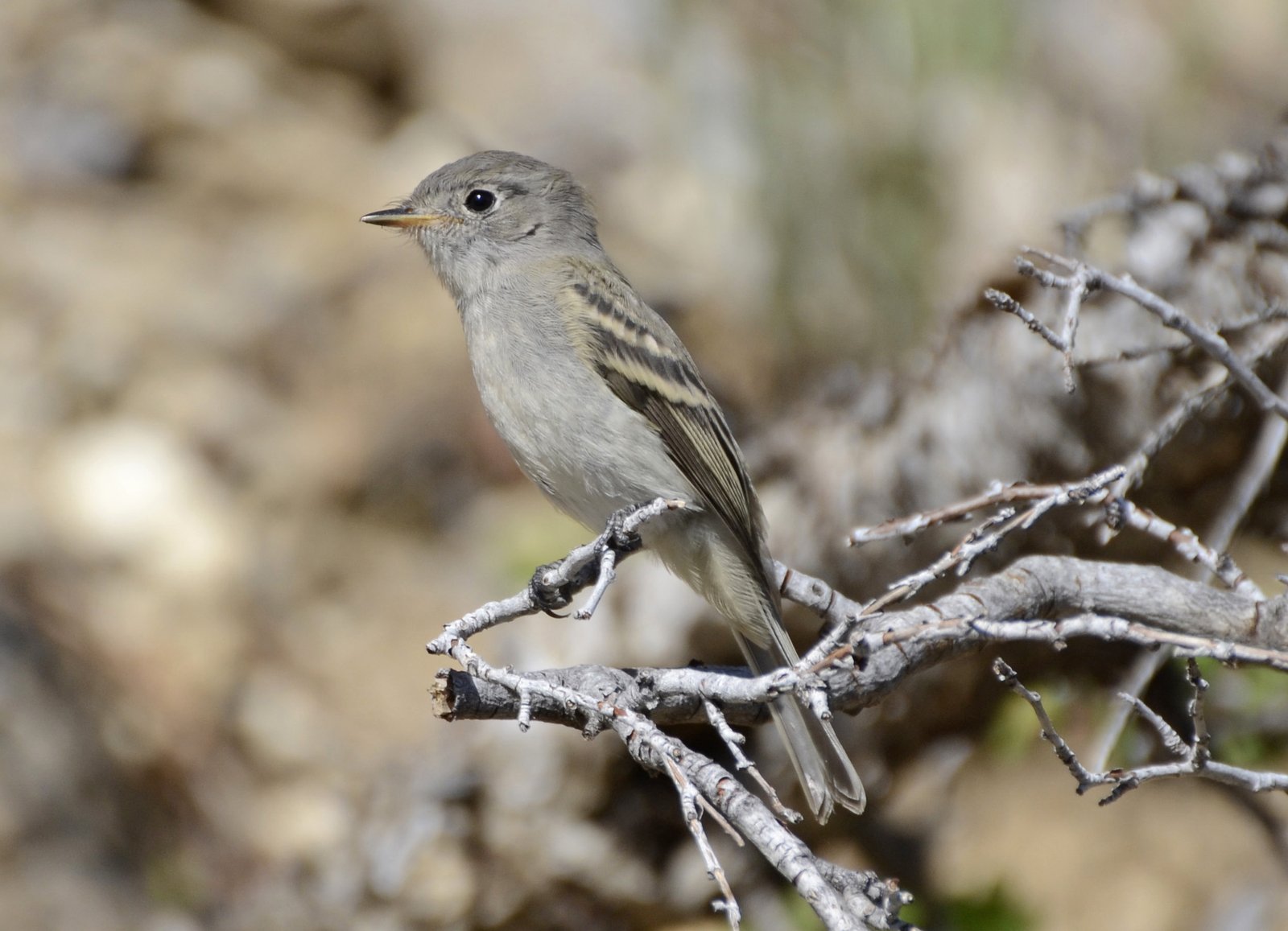
The American Dusky Flycatcher is a greyish-olive Empidonax flycatcher that breeds in brush and open coniferous forest in the mountains of western North America. In winter it moves to Mexico, where it lives in brushy country and open woodland at middle elevations. It closely resembles Hammond's and American Grey Flycatchers and can often be separated only with care, on posture, proportions and call.
Voice
The call is a soft, dry whit. The song, a series of short phrases ending in a high, clear note, is heard in the guide area mainly in spring.
Recording: Brian Cox — CC BY-NC-SA 4.0 · converted to mono · xeno-canto
Identification
13–15 cm, with fairly short wings and a fairly long tail. Bill fairly narrow, the lower mandible pale at the base and dark towards the tip. Upperparts greyish olive, head slightly greyer; throat pale grey to whitish, breast greyish olive, belly pale, sometimes tinged pale yellow. A whitish eye-ring, often less sharp than in Hammond's. Two pale wing-bars; the primaries project only a short way beyond the secondaries. Male and female are alike.
Confusion species
Hammond's Flycatcher Empidonax hammondii has longer wings, a shorter tail, a smaller, darker bill and a greyer throat, and gives a high peek call. American Grey Flycatcher Empidonax wrightii is paler and greyer, has a longer bill with a sharply defined dark tip and dips its tail slowly downwards. Least Flycatcher Empidonax minimus is smaller, with a shorter tail, a broader bill and a bolder white eye-ring. Western Flycatcher Empidonax difficilis is greener above and yellower below, with an eye-ring drawn out into a point behind the eye.
Habitat
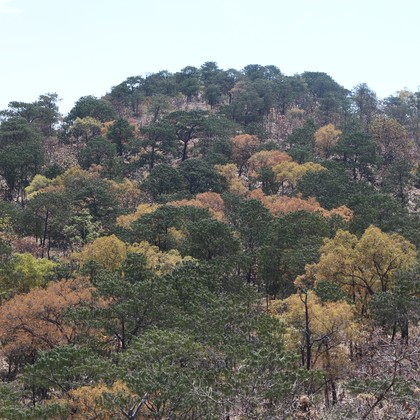
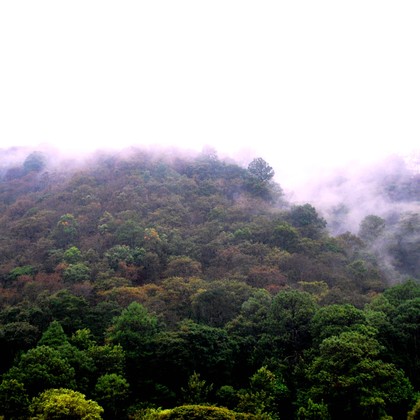
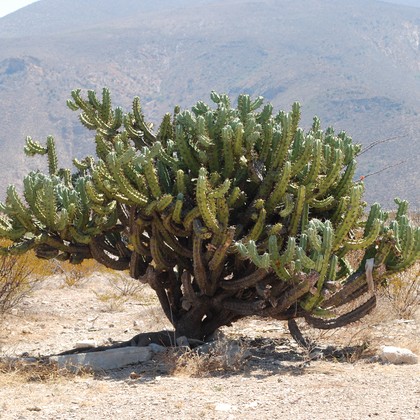
In winter in brushy country, open pine-oak woodland, forest edges, riparian growth and dense scrub, mainly at middle elevations in the mountains and on plateaus; on migration also in drier, lower areas. It catches insects from a low to mid-level perch, flicking its tail upwards. It does not breed in the guide area.
Where the bird is most at home, classified by the vegetation units of Mexico and Central America.



Range and movements
Breeds in the mountains of western North America, from southern Canada to California and New Mexico. Winters from the extreme south-western United States through western and central Mexico to southern Mexico; rare farther south.
- Winter visitor (c. Oct–Mar)
- dark = core range, pale = thinly spread
How and when to look
In winter in the Mexican highlands often in scrub and at forest edges, lower down than Hammond's Flycatcher. The soft whit and the long tail, regularly flicked up, are useful clues.
Conservation status
Not threatened. Common in its breeding range and a regular winter visitor to Mexico.
Scientific name
Empidonax oberholseri | Phillips, 1939
Phillips described the species in 1939 and placed it straight away in the genus where it still stands. The genus Empidonax was introduced in 1855 by Cabanis. Empidonax is Greek, from empis 'gnat' and anax 'master': 'gnat-king', after its insect hunting. oberholseri honours the American ornithologist Harry Church Oberholser (1870–1963). The specimen the first description was based on came from Hart Prairie, San Francisco Peaks, Arizona.