All species › Passerines › Tyrant flycatchers and allies › Hammond's Flycatcher
Position in the tree Birds Aves › Birds with a flexible palate Neognathae › All other modern birds Neoaves › Landbirds Telluraves › Falcons, parrots and passerines Australaves › Falcons and passerines Eufalconimorphae › Parrots and passerines Psittacopasserae
Hammond's Flycatcher | Empidonax hammondii
Hammonds feetiran | Mosquero de Hammond
Hammond's Flycatcher is a small, grey-green Empidonax flycatcher that breeds in coniferous forest in western North America and winters in the highlands of Mexico and northern Central America. It forages mainly in the canopy and mid-levels of pine and oak forest and often flicks its wings and tail. As with all Empidonax flycatchers, the call is an important feature.

Voice
The call is a high, sharp peek, clearly different from the soft whit of American Dusky and American Grey Flycatchers. The song, a short series of husky, partly hoarse phrases, is heard in the guide area mainly in spring.
Recording: Andrew McCafferty — CC BY-NC-SA 4.0 · shortened to the first 60 s, mono · xeno-canto
Identification
13–14 cm, with long wings and a fairly short tail. Bill small and narrow, the lower mandible mostly dark. Head and breast grey, back greyish olive; the throat greyish and not clearly paler than the breast. A white eye-ring, often slightly wider behind the eye. Wings dark with two pale wing-bars; the primaries project well beyond the secondaries. In fresh plumage in autumn and winter the belly may be tinged yellowish. Male and female are alike.
Confusion species
American Dusky Flycatcher Empidonax oberholseri has a longer tail, shorter wings, a longer bill with a paler base to the lower mandible and a paler throat. American Grey Flycatcher Empidonax wrightii is paler grey, with a longer bill with a pale lower mandible and a dark tip, and dips its tail slowly downwards rather than flicking it up. Least Flycatcher Empidonax minimus has shorter wings, a broader bill with a pale lower mandible and a white throat. Pine Flycatcher Empidonax affinis is a resident of pine forest with yellower underparts and a pale lower mandible.
Habitat
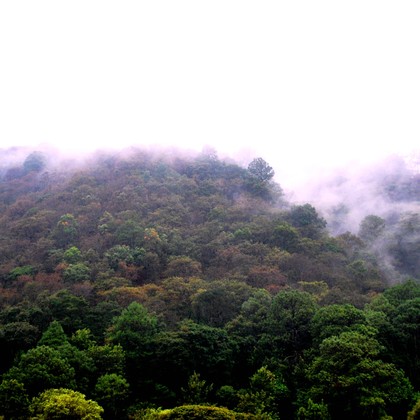
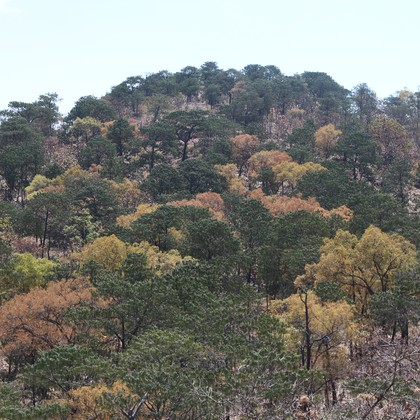
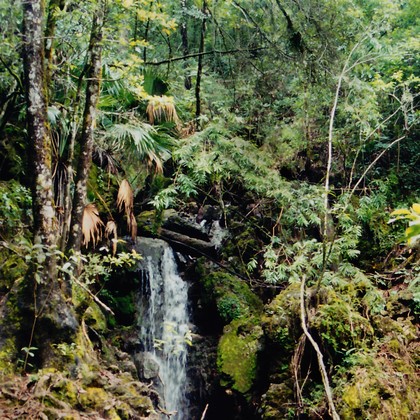
In winter in pine, pine-oak and oak forest and cloud forest in the highlands, also forest edges and open woodland with tall trees; lower down on migration. It catches insects in short sallies from a branch and gleans them from foliage. It does not breed in the guide area.
Where the bird is most at home, classified by the vegetation units of Mexico and Central America.


Range and movements
Breeds in western North America, from Alaska to the mountains of California and New Mexico. Winters from the extreme south-western United States and northern Mexico through the highlands of western and central Mexico to Guatemala, El Salvador and Honduras; in small numbers farther south.
- Winter visitor (c. Oct–Mar)
- dark = core range, pale = thinly spread
How and when to look
From October to March one of the commoner Empidonax flycatchers in the pine-oak forests of the Mexican highlands, often in mixed flocks of small songbirds. The high peek and constant flicking of wings and tail help with identification.
Conservation status
Not threatened. Common in its breeding range and a regular winter visitor to the highlands of Mexico and northern Central America.
Scientific name
Empidonax hammondii | (Xántus, 1858)
Xántus described the species in 1858 as Tyrannula hammondii; because it was later moved to another genus, the author and year stand in brackets. The genus Empidonax was introduced in 1855 by Cabanis. Empidonax is Greek, from empis 'gnat' and anax 'master': 'gnat-king', after its insect hunting. hammondii honours William Alexander Hammond (1828–1900), US Army surgeon and later Surgeon General, who collected birds for Spencer Baird. The specimen the first description was based on came from Fort Tejon, California.