All species › Passerines › Tyrant flycatchers and allies › Western Flycatcher
Position in the tree Birds Aves › Birds with a flexible palate Neognathae › All other modern birds Neoaves › Landbirds Telluraves › Falcons, parrots and passerines Australaves › Falcons and passerines Eufalconimorphae › Parrots and passerines Psittacopasserae
Western Flycatcher | Empidonax difficilis
Oeverfeetiran | Mosquero californiano
The Western Flycatcher is a yellowish Empidonax of shady woodland in western North America and the mountains of Mexico. It includes the forms of the Pacific coast and the Rocky Mountains that were formerly treated as separate species. In the guide area it breeds in the mountains of Mexico, while birds from the north spend the winter in western and southern Mexico.

Voice
The characteristic call of the male is a rising suweet or a two-part pit-peet, depending on the population. The song consists of three high, thin elements, such as pseet-ptsick-seet.
Recording: Cin-Ty Lee — CC BY-NC-SA 4.0 · converted to mono · xeno-canto
Identification
14–15 cm, with a slightly peaked crown. Upperparts brownish olive-green. A conspicuous whitish eye-ring that comes to a point behind the eye (teardrop-shaped). Wings dark with two pale ochre wing bars. Throat yellowish, breast washed brownish olive, belly yellow. Lower mandible bright orange-yellow. Male and female are alike.
Confusion species
Yellowish Flycatcher Empidonax flavescens (south-eastern Mexico and further south) is smaller and more strongly ochre on the breast. Yellow-bellied Flycatcher Empidonax flaviventris (eastern Mexico) is greener, with a round eye-ring and whiter wing bars. Pine Flycatcher Empidonax affinis is greyer olive, with less yellow underparts. Buff-breasted Flycatcher Empidonax fulvifrons is smaller, with a warm ochre-buff breast.
Habitat
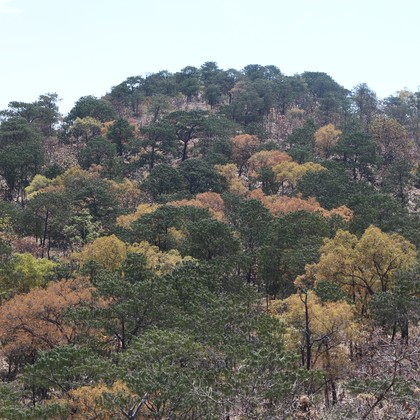
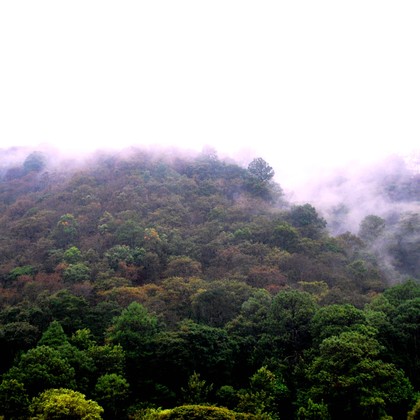
Shady, moist woodland: pine-oak forest, conifer forest and broadleaf woodland in ravines and along streams in the mountains. In winter also in a variety of woodland in the lowlands and hill country, including dry forest and riparian woodland. The nest is placed in a cavity or on a ledge of a rock face, root tangle or building.
Where the bird is most at home, classified by the vegetation units of Mexico and Central America.


Range and movements
Breeds in Baja California and in the mountains of northern and central Mexico. In winter also in the lowlands and hill country of western and southern Mexico. Outside the guide area it breeds in the western United States and Canada and in south-eastern Alaska.
- Resident
- Summer visitor (c. Apr–Sep)
- Winter visitor (c. Oct–Mar)
- Passage (Mar–Apr, Oct–Nov)
- dark = core range, pale = thinly spread
How and when to look
In the mountains of northern Mexico best found in shady ravines with water, where the male gives its rising call.
Conservation status
Not threatened. Common across a large range.
Scientific name
Empidonax difficilis | Baird, 1858
Baird described the species in 1858 and placed it straight away in the genus where it still stands. The genus Empidonax was introduced in 1855 by Cabanis. Empidonax is Greek, from empis 'gnat' and anax 'master': 'gnat-king', after its insect hunting. difficilis is Latin for 'difficult', after how hard this flycatcher is to tell from its relatives. The specimen the first description was based on came from Fort Steilacoom, Washington.