All species › Birds of prey › Kites, Old World vultures, eagles and hawks › American Goshawk
Position in the tree Birds Aves › Birds with a flexible palate Neognathae › All other modern birds Neoaves › Landbirds Telluraves › Raptors, owls, kingfishers and woodpeckers Afroaves › Hawks and owls Hieraves
American Goshawk | Astur atricapillus
Amerikaanse havik | Gavilán azor
The American Goshawk is the largest hawk of North America: a bulky, blue-grey forest raptor with a dark cap and a broad white supercilium. It hunts squirrels, hares and birds up to the size of grouse in the forest. In the guide area it is a scarce resident of high-elevation pine-oak and conifer forests in northwestern Mexico. The species was formerly lumped with the goshawk of Europe and Asia.

Voice
Near the nest a loud, harsh, hoarse kak-kak-kak-kak, especially when disturbed; females and young birds also give a wailing kee-ah. Silent outside the breeding season.
Recording: Katie and Ethan — CC BY-NC 4.0 · converted to mono · iNaturalist
Identification
46–64 cm. Adults are slate grey above, with a blackish crown and eyestripe and a broad white supercilium. The underparts are pale grey with very fine, dense grey barring and dark shaft streaks; the undertail coverts are white and fluffy. The eyes are orange-red to red in adults and yellow in young birds. The tail is long, with faint dark bands. Young birds are brown above and cream below with thick dark streaks down to the undertail coverts, a pale supercilium and an irregularly banded tail. Male and female are alike; the female is clearly larger.
Confusion species
Cooper's Hawk Astur cooperii is smaller, with a dark cap without a white supercilium, orange-red barred underparts in adults and a tail with a broad white tip; young Cooper's Hawks have finer streaks and a white undertail. Young buteos such as the Red-shouldered Hawk Buteo lineatus and Grey Hawk Buteo plagiatus have longer wings and a shorter tail, and soar more.
Habitat
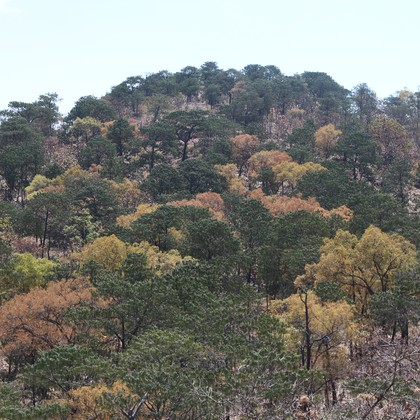
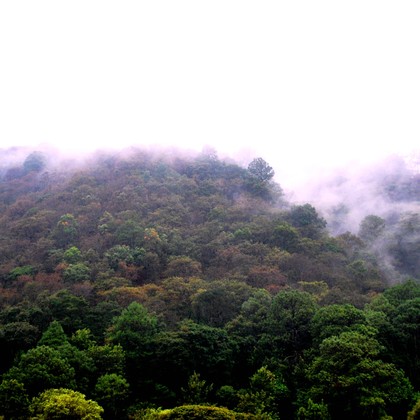
High-elevation pine-oak and conifer forest with old trees, mostly above 2000 m, and locally riparian forest in mountain areas; sometimes lower in winter. It nests in a large stick nest in an old tree. It hunts low below the canopy, from a perch or in a fast chase.
Where the bird is most at home, classified by the vegetation units of Mexico and Central America.


Range and movements
Only in Mexico. Resident in the Sierra Madre Occidental, from Sonora and Chihuahua south through Sinaloa and Durango to Zacatecas and Jalisco; also scarce in the mountains of Coahuila and Nuevo León. In winter a few birds are seen elsewhere in the north. Outside the guide area in the forests of Alaska, Canada and the western and northeastern United States.
- Resident
- Summer visitor (c. Apr–Sep)
- Winter visitor (c. Oct–Mar)
- Passage (Mar–Apr, Oct–Nov)
- dark = core range, pale = thinly spread
How and when to look
The high pine-oak forests of the Sierra Madre Occidental in Chihuahua and Durango offer the best chance. In spring pairs display over the forest with slow, deep wingbeats and spread white undertail coverts.
Conservation status
Not threatened. In Mexico it is sensitive to the logging of old conifer forest in the Sierra Madre Occidental.
Scientific name
Astur atricapillus | (Wilson, 1812) (GBIF: Falco atricapillus)
Wilson described the species in 1812 as Falco atricapillus; because it was later moved to another genus, the author and year stand in brackets. The genus Astur was introduced in 1799 by De Lacépède. Astur is Late Latin for 'hawk'. atricapillus is Latin, from ater 'black' and capillus 'hair', after the blackish crown. The specimen the first description was based on came from Philadelphia, Pennsylvania, USA.