All species › Birds of prey › Kites, Old World vultures, eagles and hawks › Bicolored Hawk
Position in the tree Birds Aves › Birds with a flexible palate Neognathae › All other modern birds Neoaves › Landbirds Telluraves › Raptors, owls, kingfishers and woodpeckers Afroaves › Hawks and owls Hieraves
Bicolored Hawk | Astur bicolor
Tweekleurige havik | Gavilán bicolor
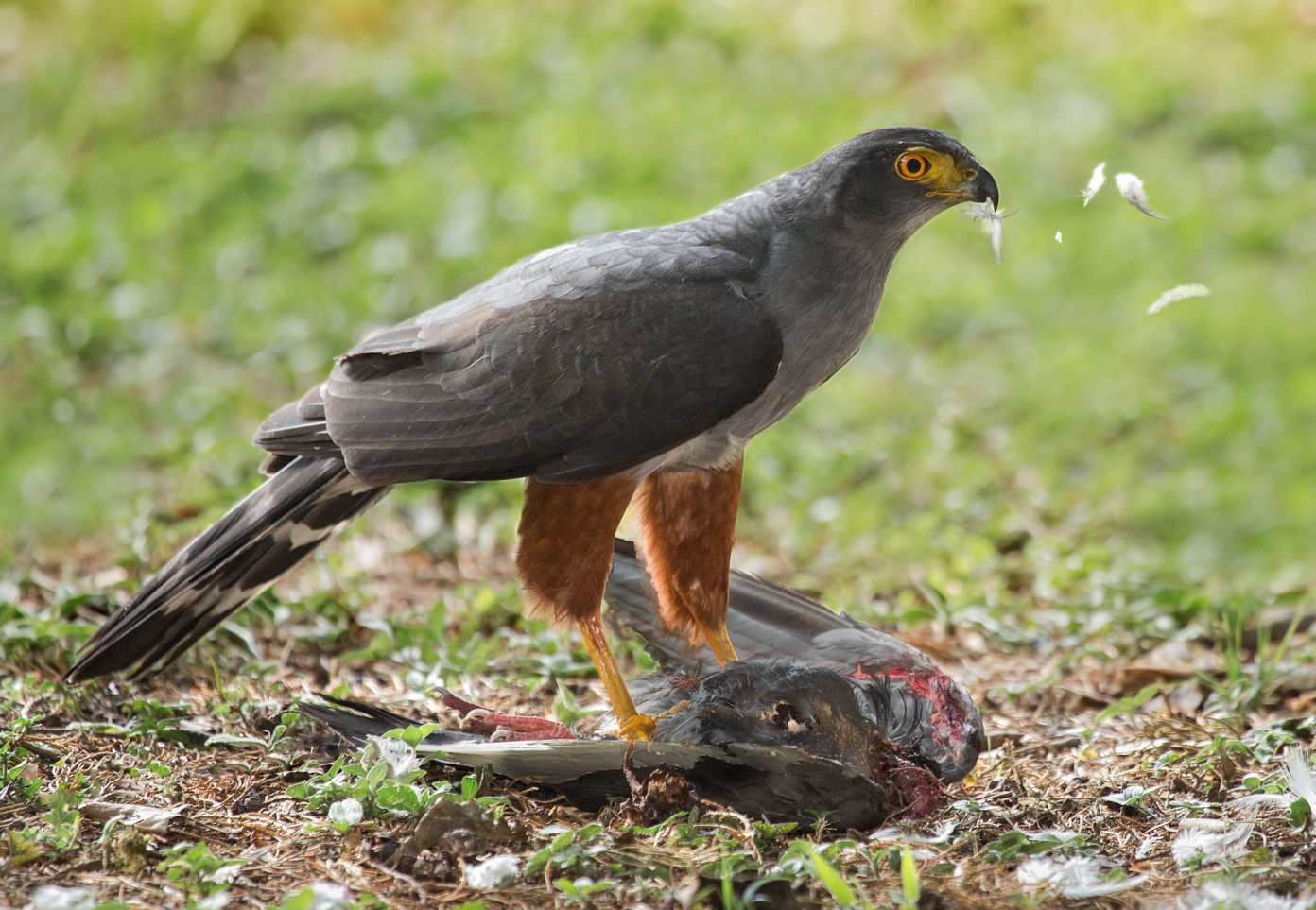
The Bicolored Hawk is a medium-sized, shy forest bird with a dark cap, plain grey underparts and rufous thighs. It hunts from a concealed perch in the forest for birds up to the size of pigeons, and also for lizards and small mammals. In the guide area it is a scarce and seldom-seen resident from eastern and southern Mexico to Panama.
Voice
A repeated, dry, barking kek-kek-kek or kuh-kuh-kuh, mainly near the nest; otherwise seldom heard.
Recording: Jacob Wijpkema — CC BY-NC-SA 4.0 · shortened to the first 60 s, mono · xeno-canto
Identification
33–44 cm. Adults have a blackish crown, slate-grey upperparts and pale grey, unstreaked underparts; the thighs are rufous. The tail is long and rounded, with three or four narrow grey bands and a narrow white tip. The eyes are orange to yellow. Young birds are variable: brown above and cream to rufous below, often with a pale collar and without streaks. Male and female are alike; the female is clearly larger.
Confusion species
Adults are distinctive with their plain grey underparts and rufous thighs. The Collared Forest Falcon Micrastur semitorquatus is larger, has a dark crescent on the cheek, a white or cream collar and a longer tail with narrow white bands; the young Collared Forest Falcon resembles the young Bicolored Hawk but is barred below. Cooper's Hawk Astur cooperii has barred underparts and lives in drier, more open country. The white-bellied form of the Sharp-shinned Hawk Accipiter striatus is smaller and lives in highland forest.
Habitat
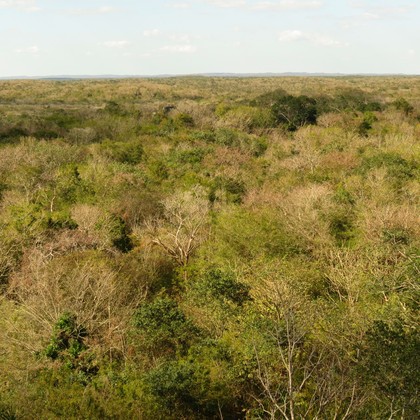
Humid lowland and foothill forest, seasonal forest, gallery forest, forest edges and semi-open country with woodlots, locally also secondary forest and shade coffee; mostly below 1500 m. It sits motionless for long periods in or below the canopy and hunts with short, fast attacks.
Where the bird is most at home, classified by the vegetation units of Mexico and Central America.





Range and movements
Resident, scarce everywhere. In Mexico on the Gulf slope from southern Tamaulipas and San Luis Potosí, south through Veracruz and Oaxaca to Chiapas and the Yucatán Peninsula; further through Belize, Guatemala, Honduras and Nicaragua to Costa Rica and Panama, where it occurs on both slopes. Almost unknown in El Salvador. Outside the guide area in tropical South America to northern Argentina.
- Resident
- dark = core range, pale = thinly spread
How and when to look
The species is usually seen by chance, when a bird flies low across a forest trail or clearing or sits quietly at a forest edge. The chances are best along forest trails in the Caribbean lowlands of Costa Rica and in the forests along the Panama Canal.
Conservation status
Not threatened. The species is scarce everywhere and tolerates some clearance, but is declining locally through deforestation.
Scientific name
Astur bicolor | (Vieillot, 1817)
Vieillot described the species in 1817 as Sparvius bicolor; because it was later moved to another genus, the author and year stand in brackets. The genus Astur was introduced in 1799 by De Lacépède. Astur is Late Latin for 'hawk'. bicolor is Latin for 'two-coloured', after the dark grey upperparts against the paler underparts. The specimen the first description was based on came from Cayenne, French Guiana.