All species › Birds of prey › Kites, Old World vultures, eagles and hawks › Cooper's Hawk
Position in the tree Birds Aves › Birds with a flexible palate Neognathae › All other modern birds Neoaves › Landbirds Telluraves › Raptors, owls, kingfishers and woodpeckers Afroaves › Hawks and owls Hieraves
Cooper's Hawk | Astur cooperii
Coopers sperwer | Gavilán de Cooper
Cooper's Hawk is a medium-sized hawk with short, rounded wings and a long, rounded tail that takes birds up to the size of pigeons, often along forest edges and in urban areas. In the guide area it breeds in northern Mexico, mainly in the Sierra Madre Occidental, and is a winter visitor to much of Mexico from October to April; further south it is rare.

Voice
Near the nest a loud, harsh kek-kek-kek-kek; otherwise mostly silent.
Recording: Jeff Stewart — CC BY-NC-SA 4.0 · converted to mono · xeno-canto
Identification
35–50 cm. Adults are blue-grey above, with a blackish cap contrasting with the paler nape, and finely barred orange-red below. The tail is long and rounded, with dark bands and a broad white tip. The eyes are red in adults and yellow in young birds. Young birds are brown above and white below with fine, sharp brown streaks, mainly on the breast, and a white lower belly. In flight the large head projects clearly beyond the wings. Male and female are alike; the female is clearly larger, almost the size of a crow.
Confusion species
The Sharp-shinned Hawk Accipiter striatus is smaller, with a smaller head, a shorter, square-tipped tail with a narrow white edge and, in adults, a cap that does not contrast with the nape; young birds have coarser, blurrier streaks down to the belly. The American Goshawk Astur atricapillus is larger, with a broad white supercilium and, in adults, finely grey-barred underparts. The Bicolored Hawk Astur bicolor has plain grey underparts and rufous thighs and lives in lowland forest.
Habitat
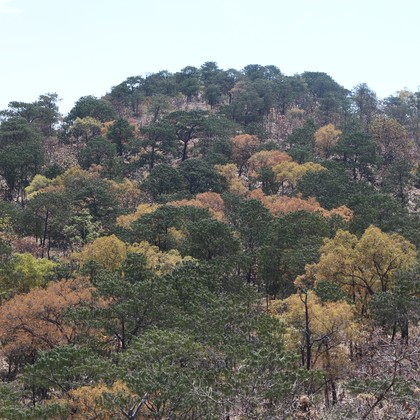
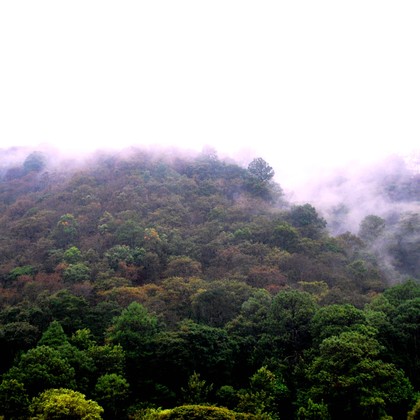
Breeds in pine-oak, oak and riparian forest in northern Mexico. In winter in all kinds of semi-open country with trees: forest edges, riparian forest, dry forest, pasture with trees and urban parks and gardens. It hunts by flying fast and low between trees, often from a concealed perch.
Where the bird is most at home, classified by the vegetation units of Mexico and Central America.




Range and movements
Breeds in northern Baja California and in the mountains of Sonora, Chihuahua and Durango, and locally south to Jalisco and Michoacán. From October to April a winter visitor to almost all of Mexico, commonest in the north and centre; also a passage migrant along the Gulf coast of Veracruz. A scarce winter visitor in Guatemala; rare further south, with a few records as far as Costa Rica. Outside the guide area it breeds in southern Canada and the United States.
- Resident
- Winter visitor (c. Oct–Mar)
- Passage (Mar–Apr, Oct–Nov)
- dark = core range, pale = thinly spread
How and when to look
In winter birds hunt in parks and gardens in Mexican cities, including Mexico City, often taking pigeons. In September and October small numbers pass the raptor migration count sites in Veracruz, together with Sharp-shinned Hawks.
Conservation status
Not threatened. In the United States the species recovered after DDT was banned, and it adapts to urban areas.
Scientific name
Astur cooperii | (Bonaparte, 1828) (GBIF: Ericameria cooperi)
Bonaparte described the species in 1828 as Falco cooperii; because it was later moved to another genus, the author and year stand in brackets. The genus Astur was introduced in 1799 by De Lacépède. Astur is Late Latin for 'hawk'. cooperii honours the American naturalist William Cooper (1798–1864), who collected the type. The specimen the first description was based on came from near Bordentown, New Jersey, USA.