All species › Birds of prey › Kites, Old World vultures, eagles and hawks › Sharp-shinned Hawk
Position in the tree Birds Aves › Birds with a flexible palate Neognathae › All other modern birds Neoaves › Landbirds Telluraves › Raptors, owls, kingfishers and woodpeckers Afroaves › Hawks and owls Hieraves
Sharp-shinned Hawk | Accipiter striatus
Amerikaanse sperwer | Gavilán pecho rufo
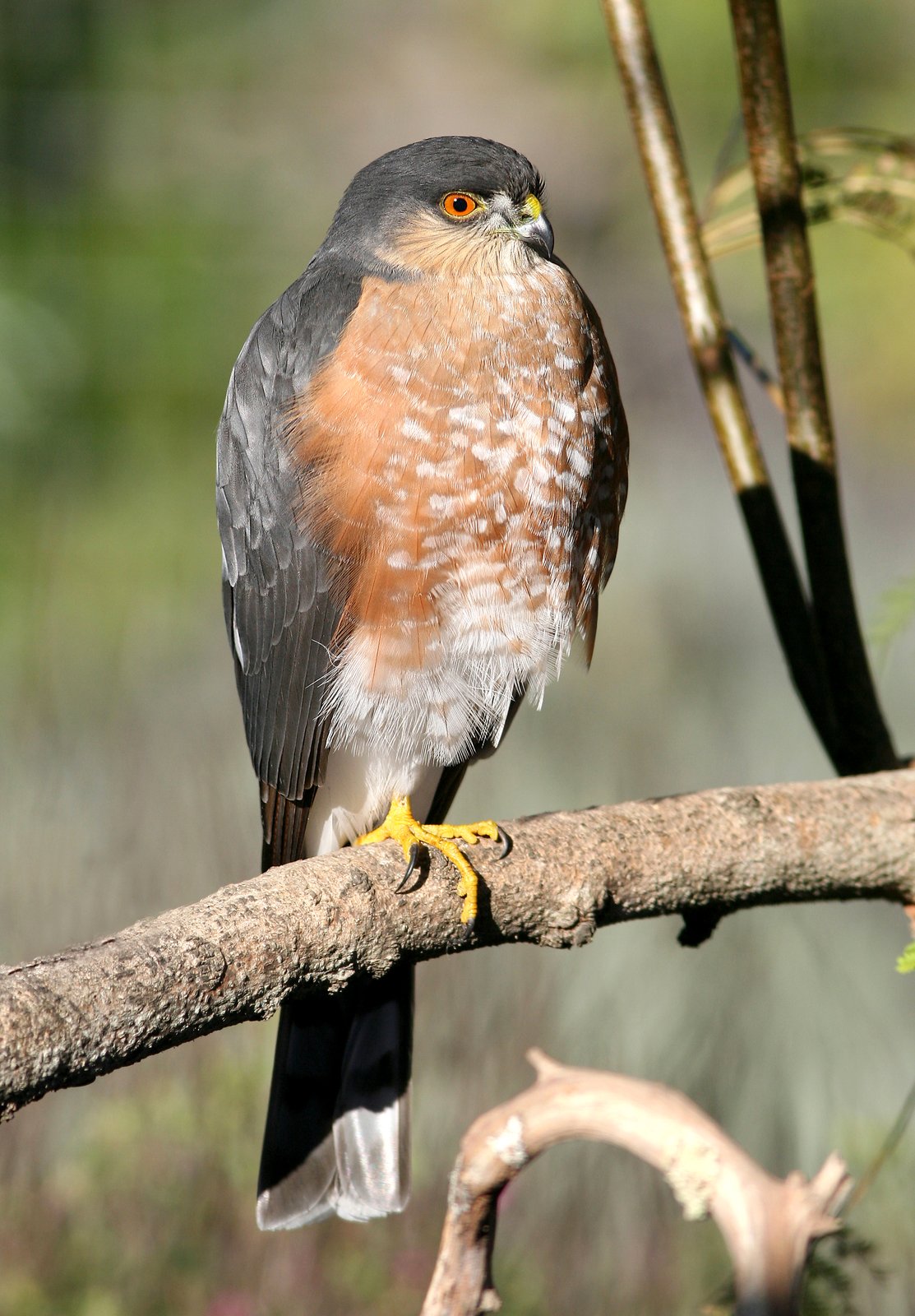
The Sharp-shinned Hawk is a small hawk with short, rounded wings and a long, square-tipped tail that catches mainly small songbirds among trees and shrubs. In the guide area residents live in mountain forests from Mexico to Nicaragua; from October to April they are joined by winter visitors from North America, which spread over almost the whole guide area. The species also includes a form with white underparts in the highlands from Chiapas to Nicaragua, which is sometimes treated as a separate species.
Voice
A high, rapid kee-kee-kee-kee near the nest; otherwise mostly silent.
Recording: Stanislas Wroza — CC BY-NC-SA 4.0 · converted to mono · xeno-canto
Identification
24–34 cm. Adults are blue-grey above with a slightly darker crown; the underparts are finely barred orange-red. The tail is grey with three or four dark bands and a square or slightly notched tip with a narrow white edge. The eyes are red in adults and yellow in young birds. Residents in the Mexican mountains have plain rufous thighs; the form in the highlands from Chiapas to Nicaragua has white to pale cream underparts with little or no barring. Young birds are brown above and white below with broad, blurry brown streaks down to the belly. In flight the small head barely projects beyond the wings. Male and female are alike; the female is clearly larger.
Confusion species
Cooper's Hawk Astur cooperii is larger, with a bigger head that projects further beyond the wings, a longer, rounded tail with a broad white tip and, in adults, a dark cap contrasting with the paler nape; small male Cooper's Hawks and large female Sharp-shinned Hawks cannot always be told apart with certainty. The Tiny Hawk Microspizias superciliosus is smaller, with a shorter tail, and lives in lowland rainforest. The Bicolored Hawk Astur bicolor is larger, with plain grey underparts and rufous thighs. The Merlin Falco columbarius has pointed wings and a fast, direct flight.
Habitat
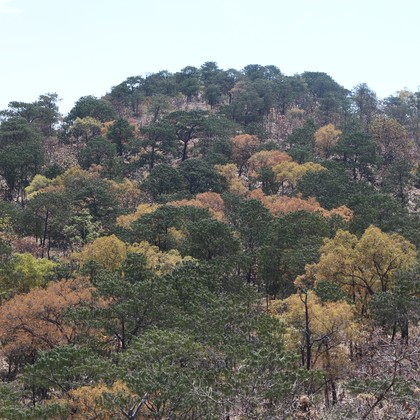
Pine-oak, oak and conifer forest and cloud forest in the mountains, mostly above 1000 m. Winter visitors also in lowland forest, forest edges, scrub, shade coffee and urban parks and gardens. It nests in a dense tree, often a conifer. It hunts by flying fast and low along shrubs and forest edges to surprise birds.
Where the bird is most at home, classified by the vegetation units of Mexico and Central America.






Range and movements
Resident in the mountains of Mexico, from the Sierra Madre Occidental and Sierra Madre Oriental south through the Trans-Mexican Volcanic Belt and the Sierra Madre del Sur to Oaxaca, and in the highlands of Chiapas, Guatemala, El Salvador, Honduras and northern Nicaragua. Winter visitors from Canada and the United States are present from October to April in almost all of Mexico and pass on into Central America; they are scarce in Costa Rica and rare in Panama. On migration in September–October and March–April they pass in numbers along the Gulf coast of Veracruz. Outside the guide area it breeds in Canada, the United States and the Greater Antilles.
- Resident
- Summer visitor (c. Apr–Sep)
- Winter visitor (c. Oct–Mar)
- Passage (Mar–Apr, Oct–Nov)
- dark = core range, pale = thinly spread
How and when to look
In September and October thousands of birds pass the raptor migration count sites at Cardel and Chichicaxtle in Veracruz. In winter birds often hunt in parks and gardens in Mexican cities, darting low between the trees.
Conservation status
Not threatened. The white-bellied form in the highlands from Chiapas to Nicaragua is locally scarce because of the clearance of pine-oak forest and cloud forest.
Scientific name
Accipiter striatus | Vieillot, 1808
Vieillot described the species in 1808 and placed it straight away in the genus where it still stands. The genus Accipiter was introduced in 1760 by Brisson. Accipiter is the Latin word for 'hawk', from accipere, 'to grasp'. striatus is Latin for 'striped', after the streaked and barred underparts. The specimen the first description was based on came from Santo Domingo, Dominican Republic.