All species › Birds of prey › Kites, Old World vultures, eagles and hawks › Crested Eagle
Position in the tree Birds Aves › Birds with a flexible palate Neognathae › All other modern birds Neoaves › Landbirds Telluraves › Raptors, owls, kingfishers and woodpeckers Afroaves › Hawks and owls Hieraves
Crested Eagle | Morphnus guianensis
Wurgarend | Águila crestada
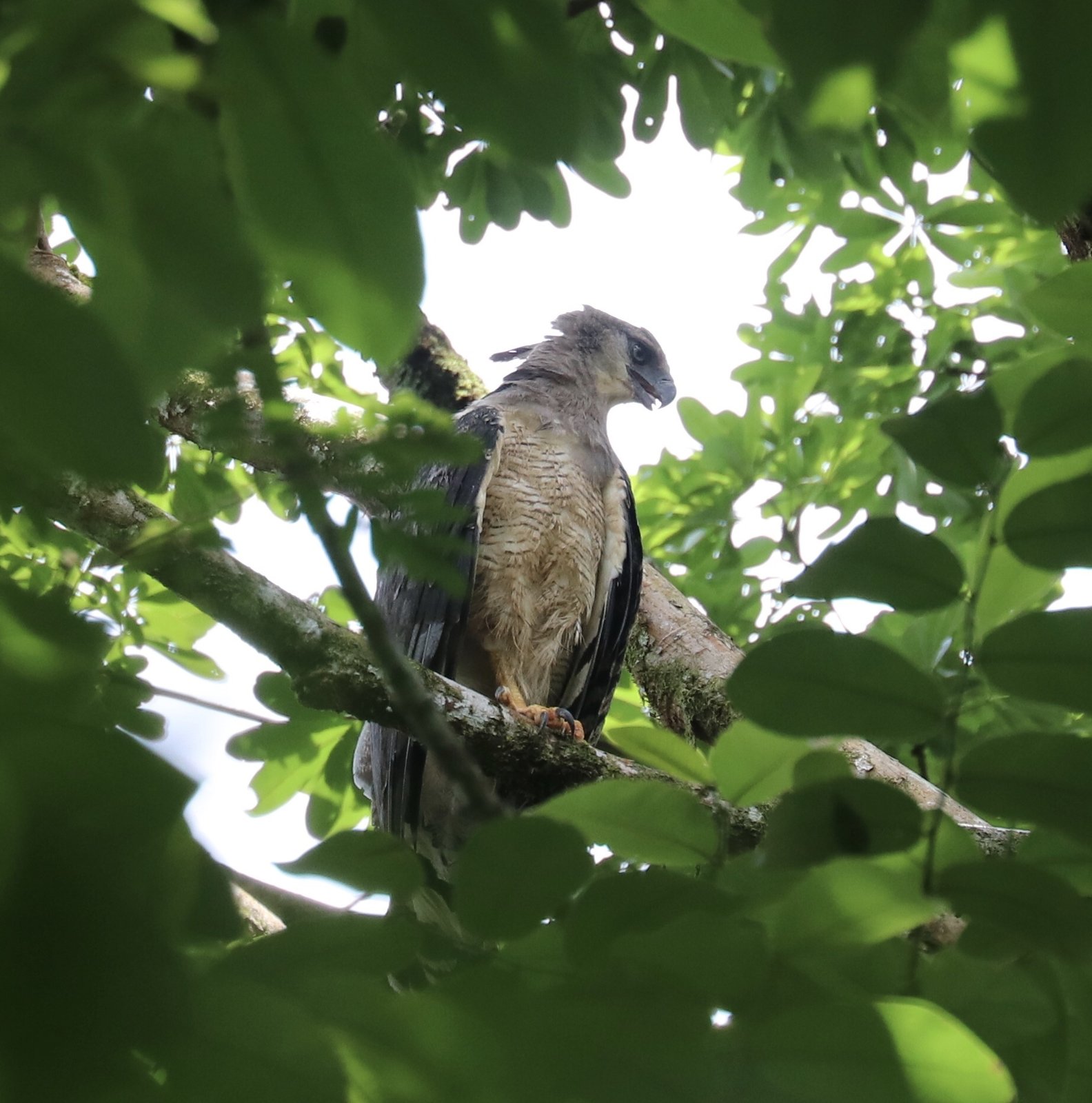
The Crested Eagle is a large, slim forest eagle with a long tail, a short, pointed crest and relatively thin legs. It hunts in the canopy for monkeys, opossums, snakes and large birds. In the guide area it is a rare and poorly known resident of large rainforest, from southern Mexico to Panama; most records come from Panama.
Voice
Rarely heard. A high, whistled wee-wheew or pee-oo, mainly near the nest; young birds beg with a repeated high whistle.
Recording: Fabrice Schmitt — CC BY-NC-SA 4.0 · converted to mono · xeno-canto
Identification
71–89 cm. There are two colour morphs. The pale morph, the commoner one, has a pale grey head and breast, a dark single-pointed crest, white underparts with faint rufous barring and dark brown upperparts. The dark morph has a blackish head and breast and black-and-white barred underparts. The tail is long, with broad dark and grey bands; the wings are broad and rounded, white below with barred flight feathers. The legs are yellow and bare. Young birds have a white head and underparts and pale grey upperparts. Male and female are alike; the female is larger.
Confusion species
The Harpy Eagle Harpia harpyja is larger and bulkier, with very thick legs, a divided crest and, in adults, a black breast band; young Harpy Eagles look very like young Crested Eagles, but have thicker legs and a shorter tail. The young Ornate Hawk-Eagle Spizaetus ornatus and the Black-and-white Hawk-Eagle Spizaetus melanoleucus are smaller, with legs feathered to the toes and a shorter tail. The Grey-headed Kite Leptodon cayanensis resembles the pale morph in flight, but is much smaller and has no crest.
Habitat
Large, continuous humid lowland rainforest and foothill forest, up to about 1200 m, also the Darién rainforest and riverine forest. It nests in a large emergent tree. It hunts from perches in and below the canopy and sometimes circles low over the forest.
Where the bird is most at home, classified by the vegetation units of Mexico and Central America.




Range and movements
Resident, very scarce and scattered, from southern Mexico (mainly Chiapas) through Belize, Guatemala (Petén), Honduras and Nicaragua to Costa Rica, mainly on the Caribbean side, and Panama, where Darién is the main area. Not known from El Salvador. Outside the guide area in tropical South America to northern Argentina.
- Resident
- dark = core range, pale = thinly spread
How and when to look
Darién in Panama offers the best chance. Nests have also been found in the forests of Petén in Guatemala, around Tikal. A bird often sits motionless in the canopy for a long time and is usually seen only when it flies off or circles low over the forest.
Conservation status
Near Threatened. The species depends on large, undisturbed forest and is declining through deforestation and shooting. In the guide area it is rare everywhere and has probably largely disappeared from the north.
Scientific name
Morphnus guianensis | (Daudin, 1800)
Daudin described the species in 1800 as Falco guianensis; because it was later moved to another genus, the author and year stand in brackets. The genus Morphnus was introduced in 1816 by Dumont. Morphnus is Greek: morphnos was the name of a dusky eagle in Homer and Aristotle. guianensis is Latin for 'of Guiana', the region of the Guianas where the type came from. The specimen the first description was based on came from Cayenne, French Guiana.