All species › Passerines › New World warblers › American Yellow Warbler
Position in the tree Birds Aves › Birds with a flexible palate Neognathae › All other modern birds Neoaves › Landbirds Telluraves › Falcons, parrots and passerines Australaves › Falcons and passerines Eufalconimorphae › Parrots and passerines Psittacopasserae
American Yellow Warbler | Setophaga aestiva
Gele zanger | Chipe amarillo norteño
The American Yellow Warbler is a small, almost entirely yellow warbler of scrub and willows near water. It breeds across much of North America and locally in northern and central Mexico, and in winter is one of the commonest warblers in open country from Mexico to Panama. For a long time it was treated as one species with Mangrove Warbler.

Voice
The song is a bright, fast series of whistles that speeds up and often ends with an accent, rendered as sweet sweet sweet I'm so sweet; in the guide area heard mainly in the breeding range and in spring. The call is a loud, full chip, the flight call a buzzy tseep.
Recording: Ray Cooke — CC BY-NC 4.0 · shortened to the first 60 s, mono · xeno-canto
Identification
12–13 cm. Yellow with an olive-green tinge on the upperparts; flight feathers and coverts with broad yellow edges. The tail has yellow spots instead of white, so it looks yellow from below. Large, dark eyes in a plain yellow face, without an eye-stripe. The male has reddish-brown streaks on the breast and flanks; the female is duller with few or no streaks. Young birds in autumn can be quite grey, but usually show yellow wing edges and yellow tail spots.
Confusion species
The male Mangrove Warbler Setophaga petechia, a resident of mangrove forest, has a chestnut head or crown; females of the two species are hardly separable in the field, so habitat and season are the main guide. Wilson's Warbler Cardellina pusilla has plain wings without yellow edges, a longer, dark tail without yellow spots and, in the male, a black cap. Orange-crowned Warbler Leiothlypis celata is greener and drabber, with a dark eye-stripe and faint breast streaks.
Habitat
Breeds in willows, cottonwoods and scrub along rivers, streams and marshes. In winter in all kinds of semi-open country with scrub: riparian growth, forest edges, pastures with trees and hedges, gardens, parks and the edges of mangroves, mostly below 1500 m. It searches shrubs and low trees for insects.
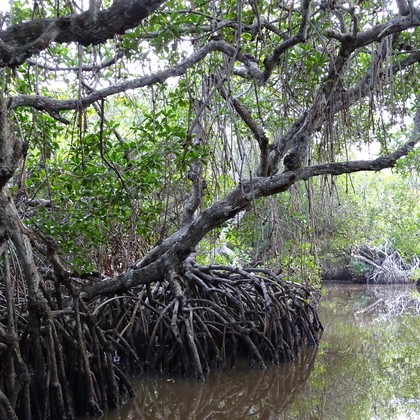
Where the bird is most at home, classified by the vegetation units of Mexico and Central America.






Range and movements
Breeds from Alaska and Canada through the United States to northern Mexico, mainly in Baja California, Sonora and Chihuahua; also locally in the highlands of central Mexico. Winters from western and southern Mexico through Central America to northern South America. On migration throughout the guide area.
- Resident
- Summer visitor (c. Apr–Sep)
- Winter visitor (c. Oct–Mar)
- Passage (Mar–Apr, Oct–Nov)
- dark = core range, pale = thinly spread
How and when to look
In winter common in gardens, waterside scrub and open, wooded pastures; often first noticed by its loud call.
Conservation status
Not threatened (LC). The assessment covers Yellow Warbler in the broad sense, including Mangrove Warbler. Common and widespread; locally declining through loss of riparian vegetation and through brood parasitism by Brown-headed Cowbird Molothrus ater.
Scientific name
Setophaga aestiva | (Gmelin, 1789)
Gmelin described the species in 1789 as Motacilla aestiva; because it was later moved to another genus, the author and year stand in brackets. The genus Setophaga was introduced in 1827 by Swainson. Setophaga is Greek, from sēs, sētos 'moth' and -phagos '-eating': 'moth-eater'. aestiva is Latin, from aestivus 'summery', after the bird as a summer visitor in the north. The specimen the first description was based on came from Quebec City, Canada.