All species › Passerines › New World warblers › Chestnut-sided Warbler
Position in the tree Birds Aves › Birds with a flexible palate Neognathae › All other modern birds Neoaves › Landbirds Telluraves › Falcons, parrots and passerines Australaves › Falcons and passerines Eufalconimorphae › Parrots and passerines Psittacopasserae
Chestnut-sided Warbler | Setophaga pensylvanica
Roestflankzanger | Chipe flancos castaños
The Chestnut-sided Warbler breeds in young deciduous woods and scrub in eastern North America and winters in Central America. In the guide area it is one of the commonest winter visitors in humid forest from southern Mexico to Panama. The winter plumage, bright green above and greyish white below, differs greatly from the breeding plumage.

Voice
The song is a clear, whistled series ending with an emphatic, falling final note, often rendered as pleased pleased pleased to MEET you; in the guide area heard mainly from March. In winter mainly a sharp chip and a softer, nasal chep.
Recording: Mario Reyes Jr — CC BY-NC-SA 4.0 · converted to mono · xeno-canto
Identification
11–13 cm. The breeding male has a yellow crown, a black eye-stripe and malar stripe on a white cheek, a green-and-black streaked back, yellow wing bars and white underparts with a broad chestnut stripe along the flanks; the female has less black and chestnut. In winter plumage, as usually seen in the guide area: bright yellowish-green crown and upperparts, a grey face with a white eye-ring, two yellowish wing bars and greyish-white underparts; adults often with some chestnut on the flanks. It often holds the tail cocked and the wings slightly drooped.
Confusion species
Bay-breasted Warbler Setophaga castanea in winter plumage has an olive-green, faintly streaked back, white wing bars and buffy underparts, without a white eye-ring on a grey face. Breeding male Bay-breasted Warblers have a chestnut throat and crown, whereas Chestnut-sided Warbler has a white throat and yellow crown.
Habitat
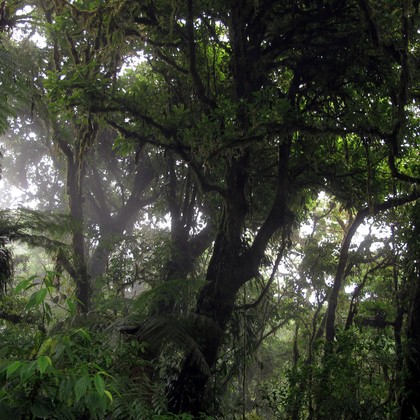
In winter humid lowland and foothill forest, especially forest edges, clearings, secondary forest and shade coffee; mostly below 1500 m, less often in montane forest. It forages at mid-level under the leaves for insects and also eats berries. It often winters at a fixed site and joins mixed flocks there; in winter it sometimes defends its own territory.
Where the bird is most at home, classified by the vegetation units of Mexico and Central America.





Range and movements
Breeds in south-eastern Canada and the north-eastern and east-central United States, south along the Appalachians. Winters from southern Mexico (from Veracruz and Oaxaca) through Central America to Panama, mainly on the Caribbean slope; scarce into north-western Colombia. On migration also elsewhere in eastern Mexico and on the Yucatán Peninsula.
- Winter visitor (c. Oct–Mar)
- dark = core range, pale = thinly spread
How and when to look
In winter regularly seen in mixed flocks at forest edges and in gardens in the Caribbean lowlands, including La Selva in Costa Rica and along Pipeline Road (Camino del Oleoducto) in Panama.
Conservation status
Not threatened (LC). The species has benefited from the growth of young woodland and scrub after logging in North America; since the 1960s numbers have gradually declined.
Scientific name
Setophaga pensylvanica | (Linnaeus, 1766)
Linnaeus described the species in 1766 as Motacilla pensylvanica; because it was later moved to another genus, the author and year stand in brackets. The genus Setophaga was introduced in 1827 by Swainson. Setophaga is Greek, from sēs, sētos 'moth' and -phagos '-eating': 'moth-eater'. pensylvanica refers to Pennsylvania, where the type locality lies. The specimen the first description was based on came from near Philadelphia, Pennsylvania, United States.