All species › Passerines › New World warblers › Mangrove Warbler
Position in the tree Birds Aves › Birds with a flexible palate Neognathae › All other modern birds Neoaves › Landbirds Telluraves › Falcons, parrots and passerines Australaves › Falcons and passerines Eufalconimorphae › Parrots and passerines Psittacopasserae
Mangrove Warbler | Setophaga petechia
Mangrovezanger | Reinita de manglar
The Mangrove Warbler is a yellow warbler of coastal mangrove forest; the male has a chestnut head or crown. It is a resident along both coasts of Mexico and Central America and on islands in the Caribbean. Until recently it was treated as part of Yellow Warbler; it is now generally regarded as a separate species.

Voice
The song is a bright series of whistles, similar to that of American Yellow Warbler, but often more varied and less regular. The call is a loud, full chip.
Recording: Bobby Wilcox — CC BY-NC-SA 4.0 · converted to mono · xeno-canto
Identification
12–14 cm. Structure and plumage like those of American Yellow Warbler: yellow with olive-green upperparts, yellow edges to the wing feathers and yellow tail spots. The male has reddish-brown streaks on the breast and, depending on the form, an entirely chestnut head and throat or only a chestnut crown; the form on Cozumel has a rufous crown on an otherwise yellow head. The female is duller, sometimes with a tinge of rufous on the head, and young birds are greyish.
Confusion species
American Yellow Warbler Setophaga aestiva, common in winter in the same area and also at mangrove edges, lacks the chestnut head in the male. Females and young birds of the two species are hardly separable in the field; birds in mangroves from May to July are almost certainly Mangrove Warblers.
Habitat
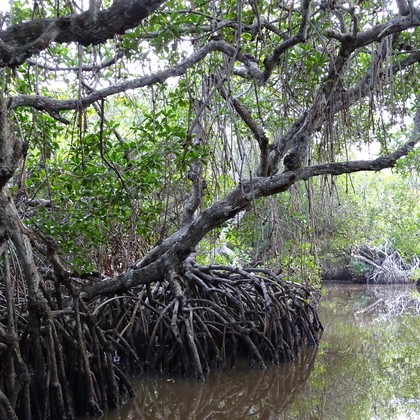
Mangrove forest along sea coasts, lagoons and estuaries; locally also swamp forest, scrub along saline lagoons and, on some islands, coastal vegetation and gardens. It searches the mangrove canopy for insects.
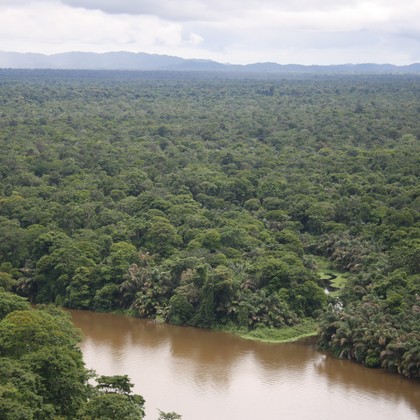
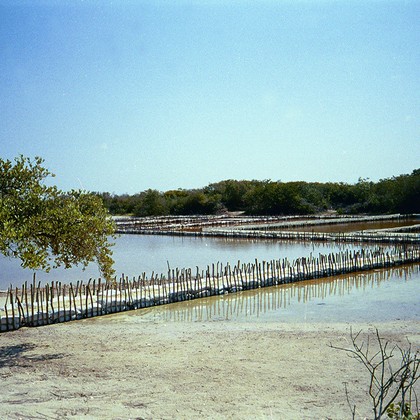
Where the bird is most at home, classified by the vegetation units of Mexico and Central America.

Range and movements
Along the Pacific coast from southern Baja California and Sonora to Panama, and along the Atlantic coast from Tamaulipas around the Yucatán Peninsula to Panama, including offshore islands such as Cozumel and the Bay Islands. Outside the guide area in the Caribbean, on the Galápagos Islands and along the coasts of northern South America to Peru.
- Resident
- Summer visitor (c. Apr–Sep)
- Winter visitor (c. Oct–Mar)
- Passage (Mar–Apr, Oct–Nov)
- dark = core range, pale = thinly spread
How and when to look
Best found by walking or boating along the edge of a mangrove forest, for example at Celestún and Río Lagartos in Yucatán or on Cozumel; the males often sing from the outermost branches.
Conservation status
Not threatened (LC). The IUCN assesses Yellow Warbler in the broad sense, which includes Mangrove Warbler. The species depends on mangroves and declines locally where mangroves are cleared for shrimp farms, tourism and coastal development.
Scientific name
Setophaga petechia | (Linnaeus, 1766)
Linnaeus described the species in 1766 as Motacilla petechia; because it was later moved to another genus, the author and year stand in brackets. The genus Setophaga was introduced in 1827 by Swainson. Setophaga is Greek, from sēs, sētos 'moth' and -phagos '-eating': 'moth-eater'. petechia comes from Italian petecchia 'small red spot on the skin', after the rusty-red breast streaks. The specimen the first description was based on came from Barbados.