All species › Falcons › Falcons and caracaras › Barred Forest Falcon
Position in the tree Birds Aves › Birds with a flexible palate Neognathae › All other modern birds Neoaves › Landbirds Telluraves › Falcons, parrots and passerines Australaves › Falcons and passerines Eufalconimorphae
Barred Forest Falcon | Micrastur ruficollis
Gestreepte bosvalk | Halcón montés barreteado
The Barred Forest Falcon is the smallest forest falcon in the guide area, a slender raptor with short, rounded wings, a long tail and finely barred underparts. It sits quietly in the lower levels of the forest and catches lizards, small birds and large insects; it sometimes follows army-ant swarms to take flushed prey. In the guide area it is a resident from southeastern Mexico to Panama, heard more often than seen.

Voice
A sharp, barking ahrk or kek, repeated at intervals of a few seconds, especially before and at dawn. Sometimes a faster series of rising notes.
Recording: Jacob Wijpkema — CC BY-NC-SA 4.0 · converted to mono · xeno-canto
Identification
31–38 cm. Head and upperparts slate grey, the breast grey; the rest of the underparts white with dense, fine black barring. Bare skin round the eye, cere and legs yellow to orange. The tail is long and black, with three or four narrow white bars and a white tip. Eyes dark to yellowish brown. Juveniles are brown above, buff to white below with coarser barring, and often have a pale collar. Male and female are alike.
Confusion species
The Slaty-backed Forest Falcon Micrastur mirandollei is larger and has plain white underparts. The Tiny Hawk Microspizias superciliosus is smaller, with a shorter tail, red eyes and a browner back. The Sharp-shinned Hawk Accipiter striatus has rufous-barred underparts, longer wings and a square tail. Juveniles resemble the juvenile Collared Forest Falcon Micrastur semitorquatus, which is much larger and longer-tailed.
Habitat
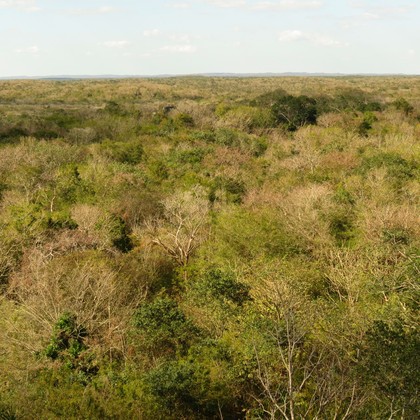
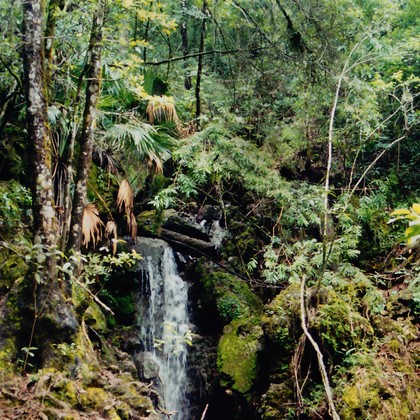
Interior of humid lowland, foothill and montane forest up into cloud forest, also semi-evergreen seasonal forest and tall secondary forest; mainly from the lowlands to about 1800 m. It usually stays low in the undergrowth and the middle storey of the forest.
Where the bird is most at home, classified by the vegetation units of Mexico and Central America.





Range and movements
Resident. In Mexico from southern Veracruz and northern Oaxaca south to Tabasco, Chiapas and the southern Yucatán Peninsula. Further through Belize, Guatemala, Honduras, Nicaragua and Costa Rica to Panama, on both slopes; rare in El Salvador. Outside the guide area in tropical South America to northern Argentina.
- Resident
- dark = core range, pale = thinly spread
How and when to look
At dawn the repeated barking call is heard in the forests of Tikal, in the Caribbean foothills of Costa Rica and along the Pipeline Road (Camino del Oleoducto) in Panama. At army-ant swarms the bird sometimes sits low and in full view.
Conservation status
Not threatened. Fairly common in continuous forest, but sensitive to fragmentation.
Scientific name
Micrastur ruficollis | (Vieillot, 1817)
Vieillot described the species in 1817 as Sparvius ruficollis; because it was later moved to another genus, the author and year stand in brackets. The genus Micrastur was introduced in 1841 by Gray. Micrastur combines Greek mikros 'small' with the genus Astur 'goshawk': 'small hawk'. ruficollis is Latin, from rufus 'rufous' and collum 'neck', after the rufous neck of some forms. The specimen the first description was based on came from Rio de Janeiro, Brazil (restricted later; originally South America).