All species › Falcons › Falcons and caracaras › Slaty-backed Forest Falcon
Position in the tree Birds Aves › Birds with a flexible palate Neognathae › All other modern birds Neoaves › Landbirds Telluraves › Falcons, parrots and passerines Australaves › Falcons and passerines Eufalconimorphae
Slaty-backed Forest Falcon | Micrastur mirandollei
Mirandolles bosvalk | Halcón montés dorsigrís
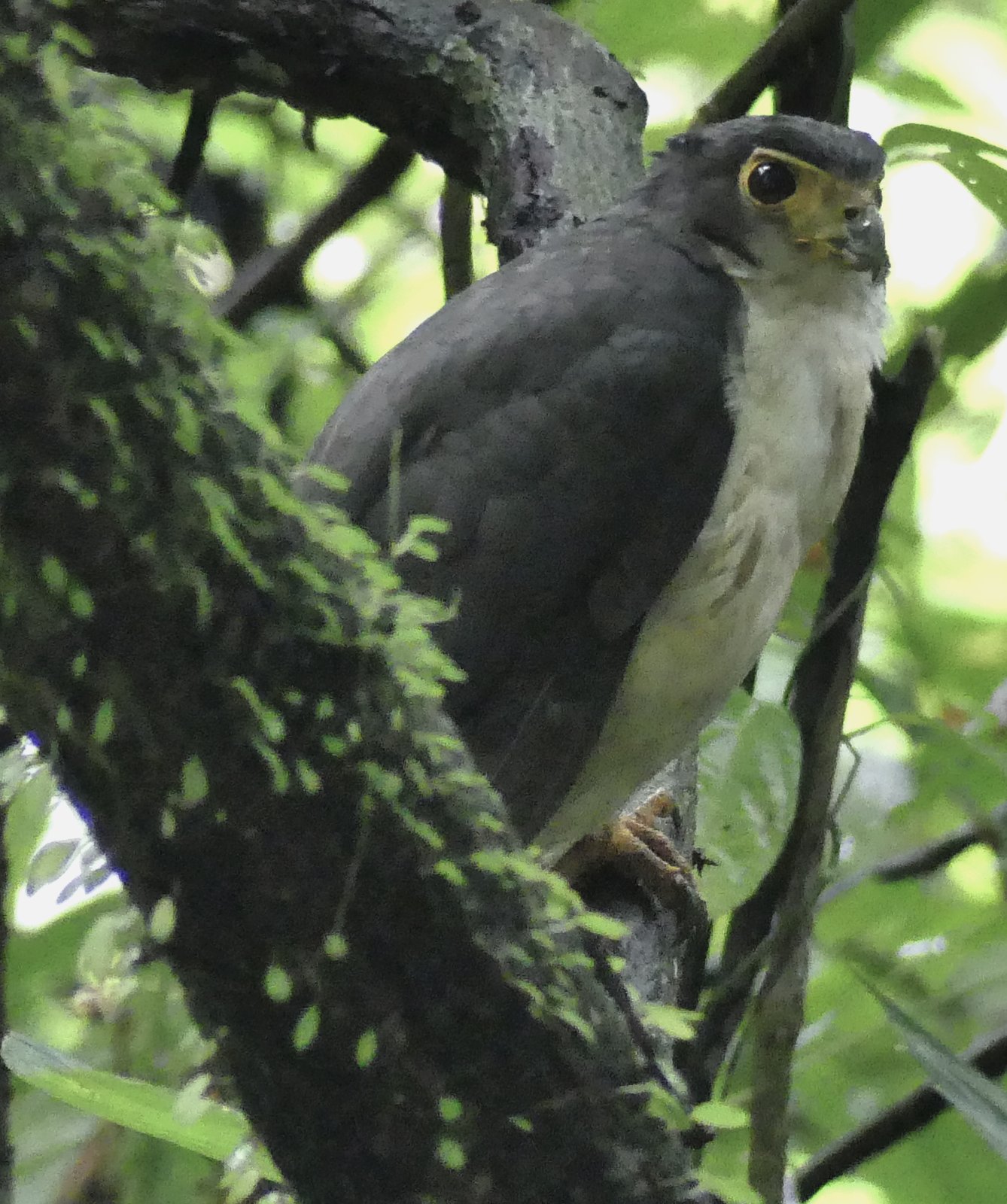
The Slaty-backed Forest Falcon is a medium-sized forest falcon with slate-grey upperparts, plain white underparts and a yellow-orange face. It lives hidden in the canopy of undisturbed humid lowland forest and hunts birds, lizards and snakes from a perch. In the guide area it is a rare resident of southeastern Nicaragua, Costa Rica and Panama, at the northern edge of a large range in South America.
Voice
A series of ten to twenty nasal notes, ah-ah-ah-ah-ah, that first swells slightly and then fades, mainly at dawn. Also single, plaintive kah calls.
Recording: Fernando Igor de Godoy — CC BY-NC-SA 4.0 · converted to mono · xeno-canto
Identification
40–46 cm. Head and upperparts plain dark slate grey, without a collar or cheek markings. Underparts white to pale greyish white, unbarred. Bare skin round the eye, cere and legs yellow to orange. The tail is medium-long and blackish, with three narrow greyish-white bars and a white tip; the wings are short and rounded. Eyes dark. Juveniles have a buff wash and fine dark scaling on the breast. Male and female are alike.
Confusion species
The Collared Forest Falcon Micrastur semitorquatus is larger and longer-tailed, with a black crescent on the cheek and a white collar. The Barred Forest Falcon Micrastur ruficollis is smaller and has finely barred underparts. The Semiplumbeous Hawk Leucopternis semiplumbeus is very similar but smaller and stockier, with a shorter tail with a single broad white band and orange eyes. The Plumbeous Hawk Cryptoleucopteryx plumbea is grey below as well.
Habitat
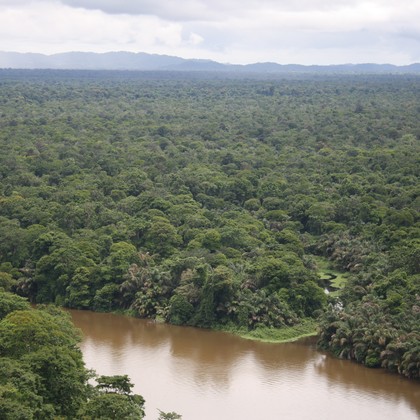
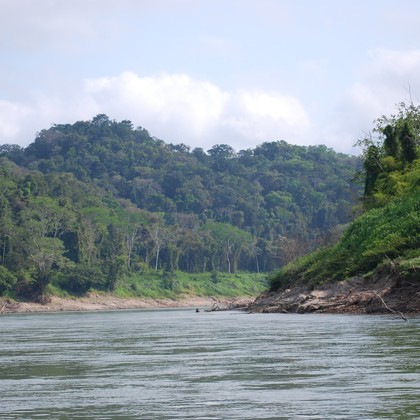
Interior and edges of tall humid lowland and foothill forest, also swamp forest and riverine forest; mostly below 600 m. It avoids heavily logged forest and open country.
Where the bird is most at home, classified by the vegetation units of Mexico and Central America.



Range and movements
Resident, rare and local everywhere. Caribbean lowlands of southeastern Nicaragua (especially along the Río San Juan) and Costa Rica; in Panama in humid lowland forest on both slopes, mainly in the centre and east of the country and in Darién. There is a single report from eastern Honduras. Outside the guide area in Colombia, Venezuela, the Guianas and Amazonia to Bolivia and Brazil.
- Resident
- dark = core range, pale = thinly spread
How and when to look
The best chance is in Soberanía National Park along the Panama Canal, where it is regularly heard along the Pipeline Road (Camino del Oleoducto), and in the lowland forests of Darién. In Costa Rica it is a rare find in the Caribbean lowlands.
Conservation status
Not threatened. Rare in the guide area and sensitive to clearance of lowland forest.
Scientific name
Micrastur mirandollei | (Schlegel, 1862)
Schlegel described the species in 1862 as Astur mirandollei; because it was later moved to another genus, the author and year stand in brackets. The genus Micrastur was introduced in 1841 by Gray. Micrastur combines Greek mikros 'small' with the genus Astur 'goshawk': 'small hawk'. mirandollei honours the Dutch lawyer and politician Charles Jean François Mirandolle (1827–1884), born in Suriname. The specimen the first description was based on came from Suriname.