All species › Falcons › Falcons and caracaras › Crested Caracara
Position in the tree Birds Aves › Birds with a flexible palate Neognathae › All other modern birds Neoaves › Landbirds Telluraves › Falcons, parrots and passerines Australaves › Falcons and passerines Eufalconimorphae
Crested Caracara | Caracara plancus
Kuifcaracara | Caracara quebrantahuesos
The Crested Caracara is a large, long-legged falcon with a black cap, a bare red to orange face and a heavy pale blue bill, which walks on the ground more than it hunts. It eats carrion, roadkill, insects, small animals and refuse, and readily follows ploughs and fire fronts. In the guide area it is a common resident of open country, from Baja California and Sonora to Panama. Birds in the guide area belong to the northern form cheriway, sometimes treated as a separate species.

Voice
Usually silent. When excited a dry, rattling krrrak-krrrak, given while throwing the head back onto the back. Also a creaking cackle.
Recording: Franco Vushurovich — CC BY-NC-SA 4.0 · converted to mono · xeno-canto
Identification
49–63 cm. Black crown with a short, flat crest; cheeks, throat and neck white to cream. Bare face red to orange-yellow, changing colour with the bird's mood. Bill large and pale blue to grey. Breast and upper back white with dense black barring, the rest of the body and wings blackish-brown. The tail is white with fine dark barring and a broad black terminal band. Legs long and yellow. In flight a large white patch in the outer wing and a white tail and neck. Juveniles are browner, with a streaked breast and a pink to greyish face. Male and female are alike.
Confusion species
In flight it can be confused with the Black Vulture Coragyps atratus, which also has white wingtips but a black head, a short black tail and no white neck. The Red-throated Caracara Ibycter americanus is glossy black with a white belly, lacks a white neck or tail and lives in forest. Juveniles can resemble the Yellow-headed Caracara Daptrius chimachima (Costa Rica and Panama), which is smaller and lacks a black cap.
Habitat
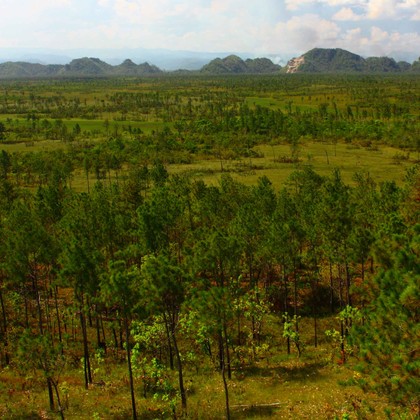
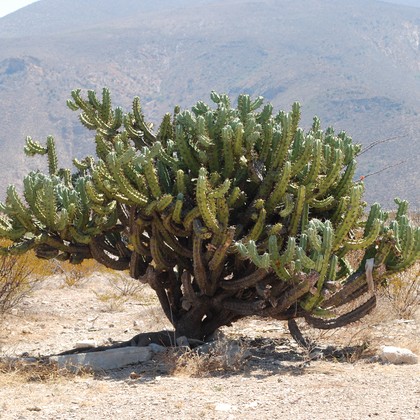
Savanna, pine savanna, pasture, farmland, dry forest and thorn scrub, semi-desert and desert, and open coastal plains; from sea level to about 2000 m, sometimes higher. It perches on posts, bare trees and cacti and walks a lot on the ground. Also along roads and at rubbish dumps.
Where the bird is most at home, classified by the vegetation units of Mexico and Central America.




Range and movements
Resident. In Mexico almost everywhere in open country, from the southern part of Baja California and Sonora to Tamaulipas, the Yucatán Peninsula and Chiapas; absent from dense forest and high mountains. In Central America mainly on the Pacific side and in the pine savannas of Belize, Honduras and Nicaragua; in Costa Rica it has spread from Guanacaste to the Central Valley and the Caribbean side, in Panama mainly in the Pacific lowlands. Outside the guide area in the southern United States, Cuba and South America to Tierra del Fuego. On Isla Guadalupe off Baja California lived the Guadalupe Caracara Caracara lutosa, which became extinct around 1900.
- Resident
- dark = core range, pale = thinly spread
How and when to look
Easy to see along roads in Guanacaste in Costa Rica, in the Pacific lowlands of Panama and in much of lowland Mexico, often on a post or on the ground by the roadside.
Conservation status
Not threatened. Increasing in Central America as forest gives way to pasture and farmland.
Scientific name
Caracara plancus | (Miller, 1777)
Miller described the species in 1777 as Falco Plancus; because it was later moved to another genus, the author and year stand in brackets. The genus Caracara was introduced in 1826 by Merrem. Caracara comes from an onomatopoeic Tupi-Guaraní name, via Marcgrave (1648), after the harsh call. plancus is Latin for 'flat-footed'; in Pliny the name of a kind of eagle. The specimen the first description was based on came from Tierra del Fuego.