All species › Jacamars and puffbirds › Puffbirds › Black-breasted Puffbird
Position in the tree Birds Aves › Birds with a flexible palate Neognathae › All other modern birds Neoaves › Landbirds Telluraves › Raptors, owls, kingfishers and woodpeckers Afroaves › Mousebirds, rollers and woodpeckers Coraciimorphae › Trogons and cavity nesters Cavitaves › Hornbills, kingfishers and woodpeckers Picocoraciae › Kingfishers, bee-eaters and woodpeckers Picodynastornithes
Black-breasted Puffbird | Notharchus pectoralis
Zwartborstbaardkoekoek | Buco pechinegro
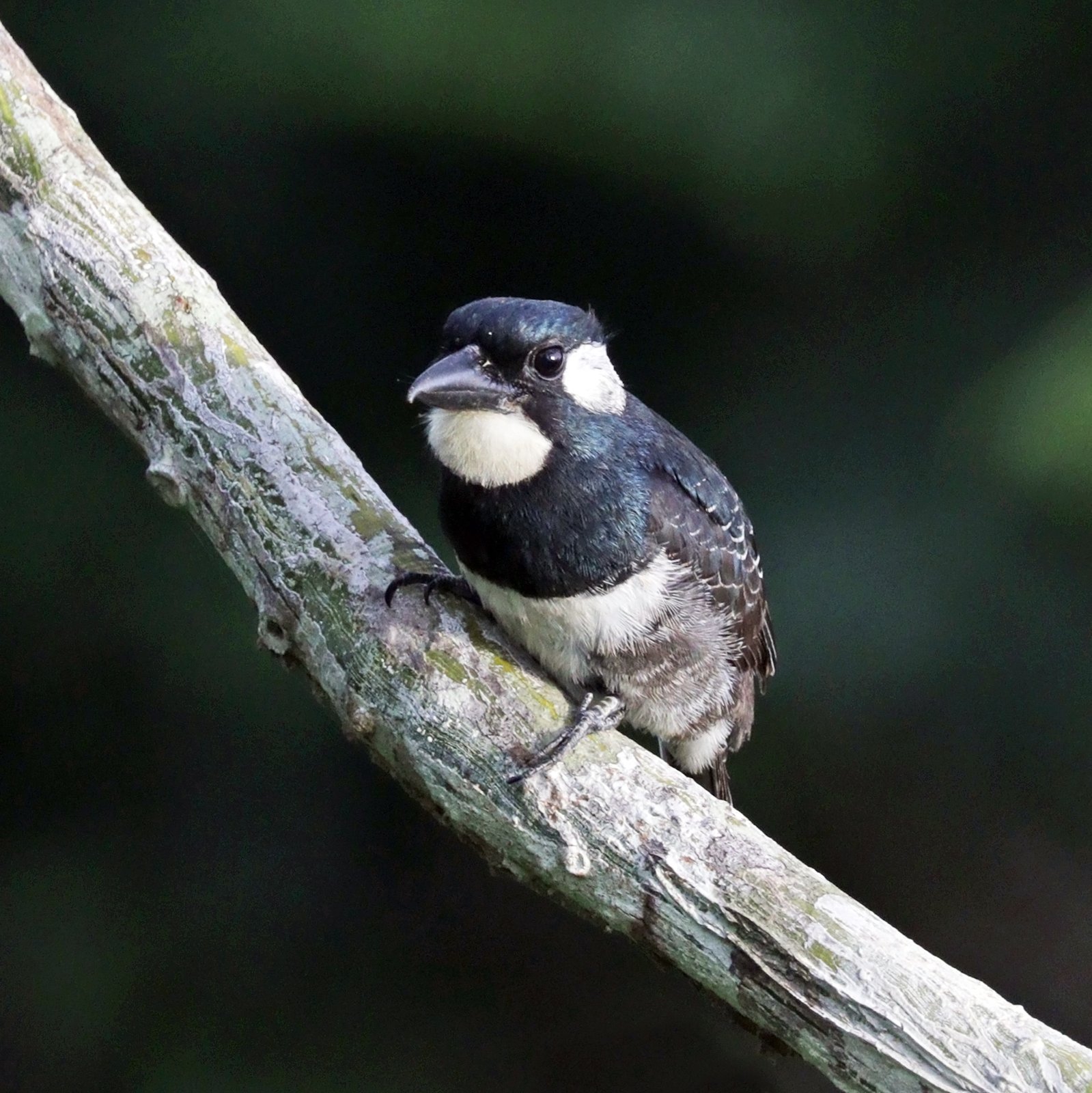
The Black-breasted Puffbird is a black-and-white puffbird with a white ear patch and a broad black breast band. It sits quietly in the canopy for long periods but often gives a long, loud whistled series. In the guide area it lives only in central and eastern Panama.
Voice
A long, loud series of clear whistles, kwee-kwee-kwee-kwee, rising at first and then changing into falling two-syllable notes, kwee-yoo kwee-yoo. It carries far through the forest.
Recording: Marcos Melo — CC BY-NC-SA 4.0 · converted to mono · xeno-canto
Identification
19–21 cm. Crown, back and wings glossy blue-black; the black crown extends to the bill. A large white ear patch continues as a narrow white band across the hindneck. Throat white, breast with a broad black band, belly white with a buff wash and black-barred flanks. The bill is heavy and black, with a small hook at the tip. Sexes alike.
Confusion species
White-necked Puffbird Notharchus hyperrhynchus is larger, with a broad white forehead band, a white nape band and a white belly without a buff wash. Pied Puffbird Notharchus tectus is much smaller, with a narrow white eyebrow and a white stripe on the shoulder.
Habitat
Canopy and edges of humid lowland and foothill forest up to about 1000 m, also tall secondary forest and tall isolated trees in clearings. It perches high on a branch and sallies to large insects and lizards. It nests in a cavity the pair excavates in an arboreal termite nest.
Where the bird is most at home, classified by the vegetation units of Mexico and Central America.




Range and movements
Within the guide area only in central and eastern Panama, from the canal area (Colón, Panamá and Panamá Oeste) east to Guna Yala and Darién. Outside the guide area in north-western Colombia and extreme north-western Ecuador.
- Resident
- dark = core range, pale = thinly spread
How and when to look
The whistled series is regularly heard along Pipeline Road (Camino del Oleoducto), on the Achiote Road and in Parque Natural Metropolitano in Panama. Following the sound often leads to the bird on a tall bare branch at the forest edge.
Conservation status
Not threatened. Common in central and eastern Panama as long as forest and tall isolated trees remain.
Scientific name
Notharchus pectoralis | (Gray, 1846)
Gray described the species in 1846 as Bucco pectoralis; because it was later moved to another genus, the author and year stand in brackets. The genus Notharchus was introduced in 1863 by Cabanis & Heine. Notharchus is Greek, from nōthēs 'sluggish' and arkhos 'leader': 'sluggish chief', after the lethargic behaviour of puffbirds. pectoralis is Latin, from pectus 'breast', after the broad black breast band. The specimen the first description was based on came from not stated.