All species › Jacamars and puffbirds › Puffbirds › White-necked Puffbird
Position in the tree Birds Aves › Birds with a flexible palate Neognathae › All other modern birds Neoaves › Landbirds Telluraves › Raptors, owls, kingfishers and woodpeckers Afroaves › Mousebirds, rollers and woodpeckers Coraciimorphae › Trogons and cavity nesters Cavitaves › Hornbills, kingfishers and woodpeckers Picocoraciae › Kingfishers, bee-eaters and woodpeckers Picodynastornithes
White-necked Puffbird | Notharchus hyperrhynchus
Witnekbaardkoekoek | Buco cuelliblanco
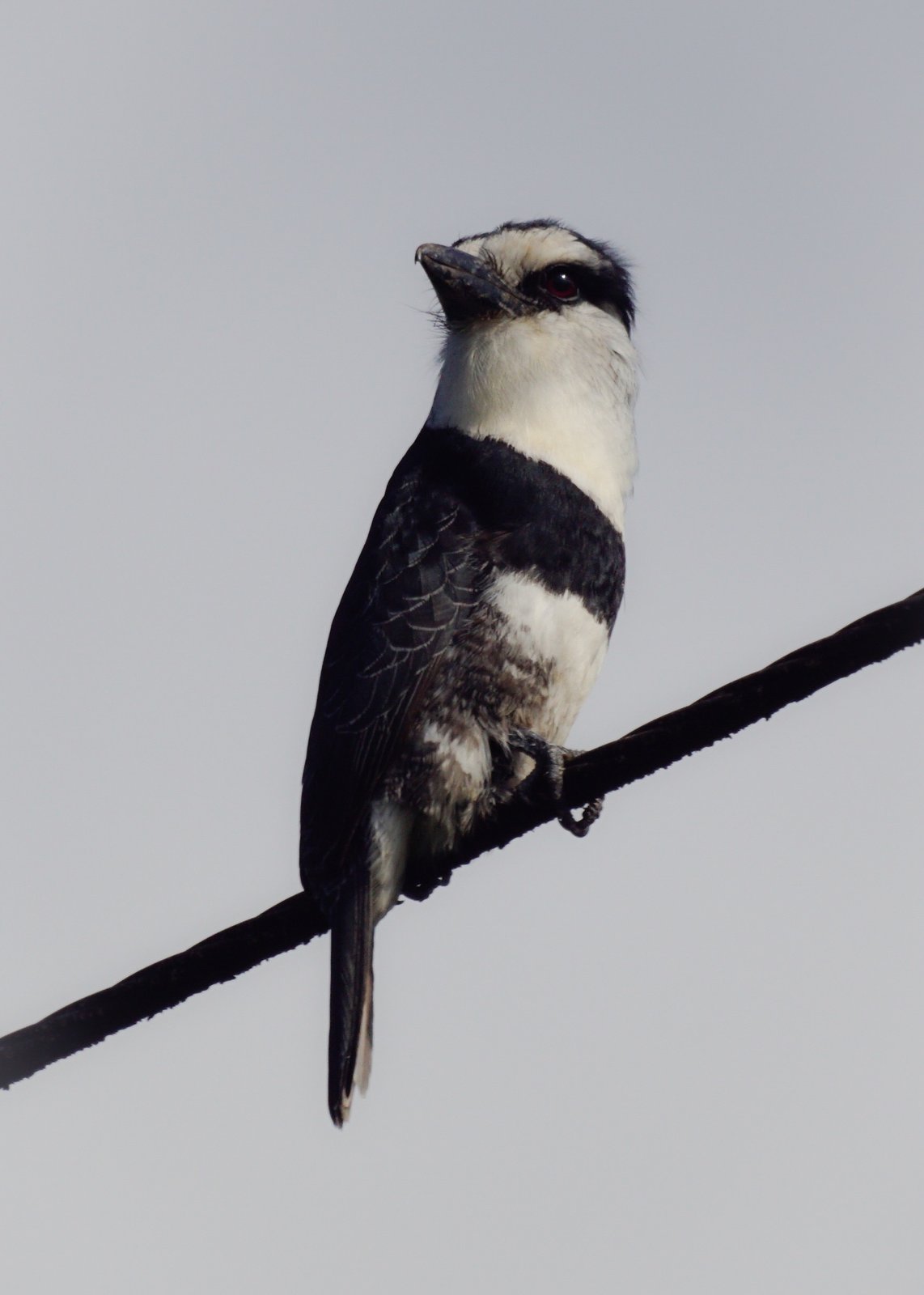
The White-necked Puffbird is the largest puffbird in the guide area, a black-and-white bird with a big head and a heavy bill. It often sits motionless for long periods on a bare branch high in or above the forest. In the guide area it lives from southern Mexico to Panama.
Voice
Mostly silent. The song is a long series of soft, trilled whistles lasting several seconds; also a soft, low twittering.
Recording: JAYRSON ARAUJO DE OLIVEIRA — CC BY-NC-SA 4.0 · converted to mono · xeno-canto
Identification
24–26 cm. Upperparts glossy black. A broad white forehead band and a white band across the nape separate the black crown from the back. Throat, cheeks and underparts white, with a broad black breast band; the flanks are barred black. The bill is long, heavy and black, with a small hook at the tip. The eye is dark. Sexes alike.
Confusion species
Black-breasted Puffbird Notharchus pectoralis (central and eastern Panama) is smaller, with a black crown reaching the bill and no white forehead, a white ear patch and a buff wash on the belly. Pied Puffbird Notharchus tectus is much smaller, with a narrow white eyebrow, a white stripe on the shoulder and small white spots in the tail.
Habitat
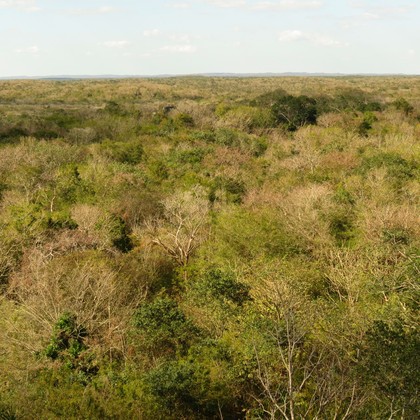
Canopy and edges of humid and semi-humid lowland forest, also seasonal forest, gallery forest, clearings with tall scattered trees and wooded pasture, mainly below 600 m and locally higher. It perches high on a bare branch and sallies to large insects, lizards and sometimes small frogs in the foliage. It nests in a cavity the pair excavates in an arboreal termite nest.
Where the bird is most at home, classified by the vegetation units of Mexico and Central America.





Range and movements
From southern Mexico (southern Veracruz and Oaxaca, Tabasco, Chiapas, Campeche and Quintana Roo) through Belize, Guatemala, Honduras and Nicaragua to Costa Rica and Panama, on both the Caribbean and Pacific sides; in El Salvador only a few records. Outside the guide area in northern South America and Amazonia, south to Bolivia and Brazil.
- Resident
- dark = core range, pale = thinly spread
How and when to look
Best found by scanning bare branches above the forest from a canopy tower or a clearing, for example at Lamanai and Crooked Tree in Belize, at La Selva and Carara in Costa Rica and along Pipeline Road (Camino del Oleoducto) in Panama.
Conservation status
Not threatened. Widespread and tolerates semi-open country with tall trees, but fairly scarce everywhere.
Scientific name
Notharchus hyperrhynchus | (Sclater, 1856)
Sclater described the species in 1856 as Bucco hyperrhynchus; because it was later moved to another genus, the author and year stand in brackets. The genus Notharchus was introduced in 1863 by Cabanis & Heine. Notharchus is Greek, from nōthēs 'sluggish' and arkhos 'leader': 'sluggish chief', after the lethargic behaviour of puffbirds. hyperrhynchus is Greek, from huper 'beyond measure' and rhunkhos 'bill', after the very heavy bill. The specimen the first description was based on came from upper Amazon (not specified further).