All species › Passerines › New World warblers › Black-eared Warbler
Position in the tree Birds Aves › Birds with a flexible palate Neognathae › All other modern birds Neoaves › Landbirds Telluraves › Falcons, parrots and passerines Australaves › Falcons and passerines Eufalconimorphae › Parrots and passerines Psittacopasserae
Black-eared Warbler | Basileuterus melanotis
Costaricaanse zanger | Reinita costarricense
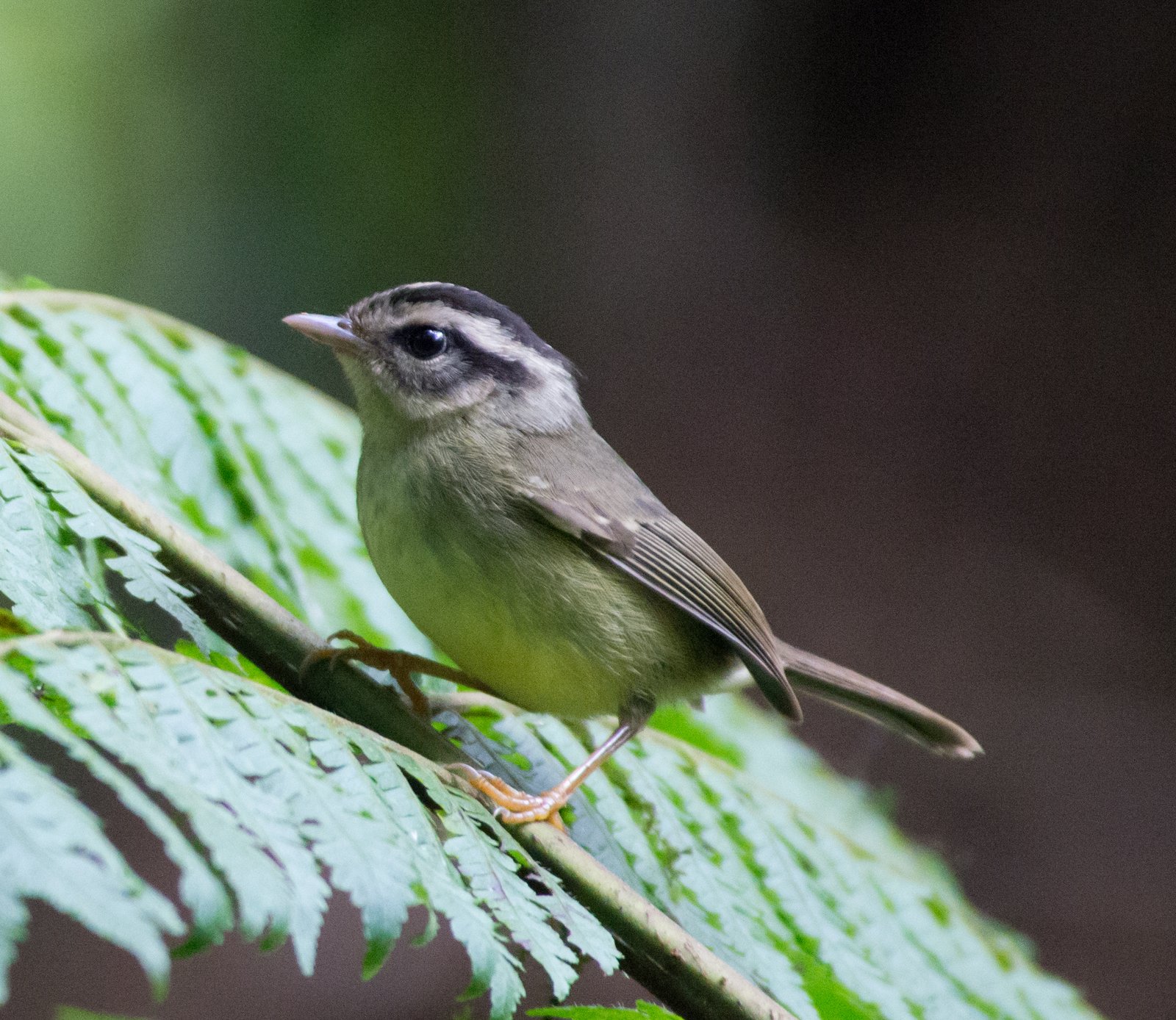
The Black-eared Warbler is a warbler of the montane forests of Costa Rica and western Panama, with a black-and-white striped head and a black ear patch. It lives in noisy groups in the understorey of cloud forest. Until recently it was included, together with the Tacarcuna Warbler, in the South American Three-striped Warbler.
Voice
The song is a fast, high and shrill chatter of thin notes, often by several birds of a group at once. The call is a high tsit or chip, given constantly by groups.
Recording: GABRIEL LEITE — CC BY-NC-SA 4.0 · converted to mono · xeno-canto
Identification
13 cm. Head striped: a broad black stripe on each side of the crown, a pale ochre central stripe, a pale yellowish to dull white eyebrow and a large black patch across lores and ear coverts. Throat pale ochre-yellow. Upperparts olive-green, without wing bars. Rest of underparts dull yellow with an olive wash on breast and flanks. Male and female are alike.
Confusion species
Golden-crowned Warbler Basileuterus culicivorus also has black crown stripes, but a yellow to orange central stripe, no black ear patch and bright yellow underparts; it usually lives lower. Black-cheeked Warbler Basileuterus melanogenys has a rufous crown, a white eyebrow and greyish-white underparts and lives higher. Tacarcuna Warbler Basileuterus tacarcunae is very similar, but occurs only in eastern Panama.
Habitat
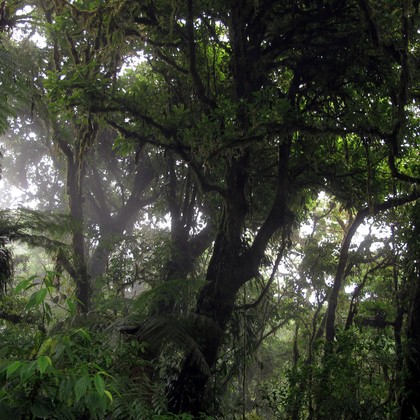
Understorey and lower tree layer of cloud forest and humid montane forest, also older secondary forest and forest edges; mostly between about 1200 and 2500 m. It lives in groups of three to eight birds and often forms the core of mixed flocks in the understorey.
Where the bird is most at home, classified by the vegetation units of Mexico and Central America.

Range and movements
Mountains of Costa Rica (Cordillera de Tilarán, Cordillera Central and Cordillera de Talamanca) and western Panama (Chiriquí, Bocas del Toro and Veraguas). Resident.
- Resident
- dark = core range, pale = thinly spread
How and when to look
Regular in the understorey of the cloud forests of Monteverde and the forests of the Talamanca; a group announces itself with a stream of high calls and moves quickly through the vegetation.
Conservation status
Not threatened (LC). Common in montane forest within a small range, much of which is protected.
Scientific name
Basileuterus melanotis | Lawrence, 1868
Lawrence described the species in 1868 and placed it straight away in the genus where it still stands. The genus Basileuterus was introduced in 1848 by Cabanis. Basileuterus is Greek, from basileuteros 'more kingly', after the coloured crown stripe recalling a little crown. melanotis is Greek, from melas 'black' and ous, ōtos 'ear', after the black ear-coverts. The specimen the first description was based on came from Cervantes, Costa Rica.