All species › Passerines › New World warblers › Golden-crowned Warbler
Position in the tree Birds Aves › Birds with a flexible palate Neognathae › All other modern birds Neoaves › Landbirds Telluraves › Falcons, parrots and passerines Australaves › Falcons and passerines Eufalconimorphae › Parrots and passerines Psittacopasserae
Golden-crowned Warbler | Basileuterus culicivorus
Goudhaanzanger | Chipe corona dorada
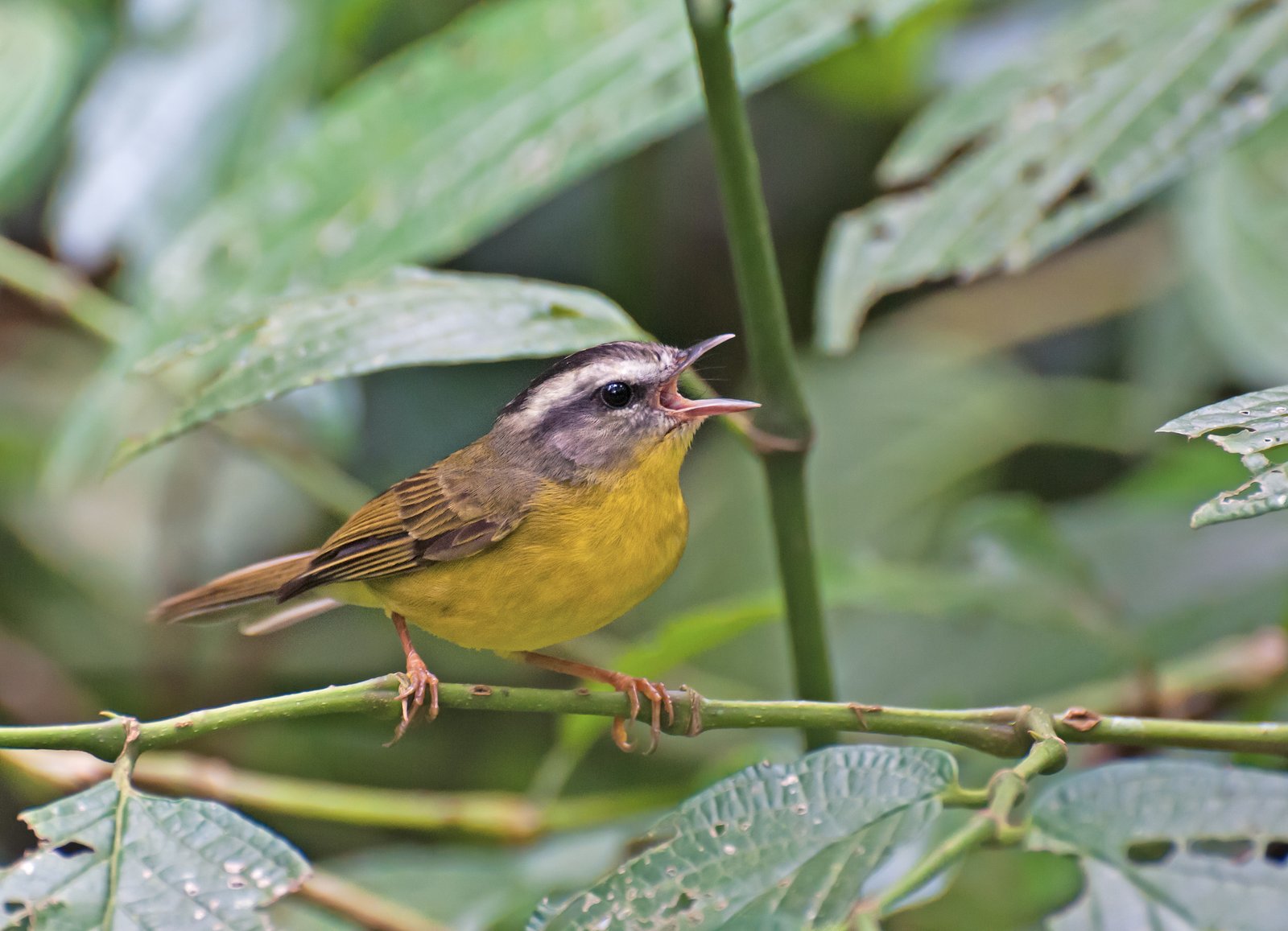
The Golden-crowned Warbler is a small warbler with a striped head: black stripes along the crown with a yellow to orange central stripe between them. It is a common resident of the understorey of humid forest, from eastern Mexico to western Panama, and moves about in pairs or small groups with mixed flocks.
Voice
The song is a clear series of whistled notes that rise and end with a distinctly rising final note, roughly wee wee wee chee-chee-weet. The call is a dry tchek, often repeated into a rattling chatter.
Recording: Marcos E. Sosa — CC BY-NC-SA 4.0 · converted to mono · xeno-canto
Identification
12–13 cm. Head grey to olive-grey, with a broad black stripe on each side of the crown and a yellow to orange-yellow central stripe, which is raised by excited birds. Pale, greyish eyebrow and a dark eye-stripe. Upperparts olive-grey to olive-green, without wing bars. Underparts bright yellow. Male and female are alike; young birds are browner, with faint head stripes.
Confusion species
Black-eared Warbler Basileuterus melanotis also has a striped head, but a black ear patch, a pale central stripe and dull yellow underparts; it lives higher in the mountains. Rufous-capped Warbler Basileuterus rufifrons and Chestnut-capped Warbler Basileuterus delattrii have a rufous crown and cheek and a white eyebrow. Golden-browed Warbler Basileuterus belli has a rufous crown and cheek with a golden-yellow eyebrow and lives higher.
Habitat
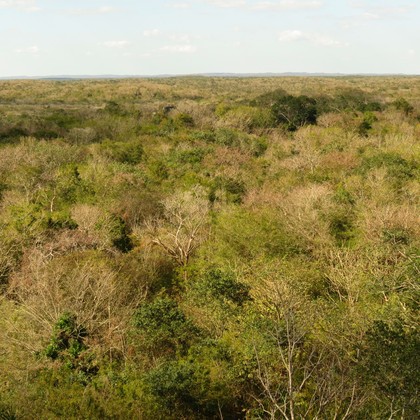
Understorey and lower tree layer of humid and semi-humid forest, both old-growth and secondary, riparian forest and the edge of cloud forest, also shade coffee; from sea level to about 1800 m, most numerous on the slopes between 500 and 1500 m. It moves quickly through the vegetation, often flicking its wings, and joins mixed flocks.
Where the bird is most at home, classified by the vegetation units of Mexico and Central America.






Range and movements
From Nuevo León and Tamaulipas in north-eastern Mexico south along the Caribbean slopes and through Chiapas to Guatemala, Belize, Honduras, El Salvador, Nicaragua and Costa Rica to western Panama; on the Pacific side mainly in the foothills. Resident; an occasional vagrant reaches southern Texas.
- Resident
- dark = core range, pale = thinly spread
How and when to look
In humid forest on the Caribbean slopes of Mexico and Central America one of the first warblers to appear in a mixed flock; the dry call and rising song are often heard before the bird is seen.
Conservation status
Not threatened (LC). Common and widespread, also in secondary forest and shade coffee, and little affected by partial deforestation.
Scientific name
Basileuterus culicivorus | (Deppe, 1830)
Deppe described the species in 1830 as Sylvia culicivora; because it was later moved to another genus, the author and year stand in brackets. The genus Basileuterus was introduced in 1848 by Cabanis. Basileuterus is Greek, from basileuteros 'more kingly', after the coloured crown stripe recalling a little crown. culicivorus is Latin, from culex, culicis 'gnat' and -vorus '-eating': 'gnat-eater'. The specimen the first description was based on came from Xalapa, Veracruz (Mexico).