All species › Passerines › New World warblers › Golden-browed Warbler
Position in the tree Birds Aves › Birds with a flexible palate Neognathae › All other modern birds Neoaves › Landbirds Telluraves › Falcons, parrots and passerines Australaves › Falcons and passerines Eufalconimorphae › Parrots and passerines Psittacopasserae
Golden-browed Warbler | Basileuterus belli
Goudbrauwzanger | Chipe ceja dorada
The Golden-browed Warbler is a warbler of the montane forests of Mexico and northern Central America, with a rufous crown and cheeks and a broad golden-yellow eyebrow. It lives in pairs low in the understorey of humid pine-oak forest and cloud forest.

Voice
The song is a series of high, thin whistled notes that speed up and end in a short, rising phrase. The call is a dry chik or tsit.
Recording: Matthew L. Brady — CC BY-NC-SA 4.0 · converted to mono · xeno-canto
Identification
12–13 cm. Crown and cheek rufous; between them a broad golden-yellow eyebrow, edged above by a narrow black line. Lores dark. Upperparts olive-green, without wing bars. Underparts bright yellow, washed olive on breast and flanks. Male and female are alike; young birds are browner, with less distinct head markings.
Confusion species
Rufous-capped Warbler Basileuterus rufifrons also has a rufous crown and cheek, but a white eyebrow, often a white belly and a longer tail, often cocked; it lives lower, in drier scrub and forest edges. Golden-crowned Warbler Basileuterus culicivorus has a grey head with black crown stripes and a yellow or orange central stripe, no rufous cheek, and usually lives lower. Wilson's Warbler Cardellina pusilla has a plain yellow face without stripes.
Habitat
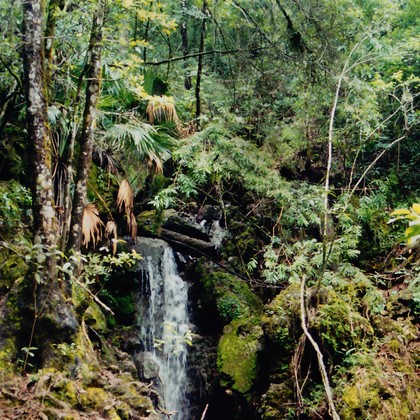
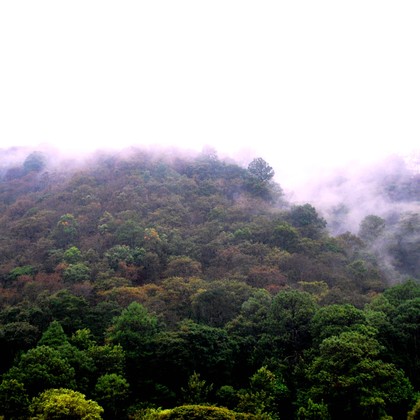
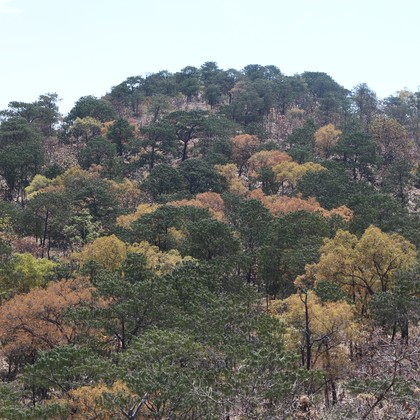
Understorey of humid pine-oak forest, oak forest, cloud forest and high-elevation conifer forest, often in ravines and along streams; mostly between about 1500 and 3500 m. It searches for insects close to the ground, in pairs or in mixed flocks.
Where the bird is most at home, classified by the vegetation units of Mexico and Central America.

Range and movements
Highlands of Mexico, from the Sierra Madre Occidental (Sinaloa and Durango) and the Sierra Madre Oriental (Tamaulipas) south through the Trans-Mexican Volcanic Belt, the Sierra Madre del Sur and Chiapas to Guatemala, El Salvador and Honduras. Resident.
- Resident
- dark = core range, pale = thinly spread
How and when to look
Regularly seen in the mountains around San Cristóbal de las Casas in Chiapas, in the forests above Oaxaca and in the highlands of Guatemala, usually in pairs low in the understorey, where the dry call reveals its presence.
Conservation status
Not threatened (LC). Common in humid montane forest within a large range; declining locally through logging and conversion of montane forest to farmland.
Scientific name
Basileuterus belli | (Giraud, 1841)
Giraud described the species in 1841 as Muscicapa belli; because it was later moved to another genus, the author and year stand in brackets. The genus Basileuterus was introduced in 1848 by Cabanis. Basileuterus is Greek, from basileuteros 'more kingly', after the coloured crown stripe recalling a little crown. belli honours the American taxidermist and collector John Graham Bell (1812–1889). The specimen the first description was based on came from Pico de Orizaba, Veracruz, Mexico (originally given wrongly as 'Texas').