All species › Passerines › New World warblers › Tacarcuna Warbler
Position in the tree Birds Aves › Birds with a flexible palate Neognathae › All other modern birds Neoaves › Landbirds Telluraves › Falcons, parrots and passerines Australaves › Falcons and passerines Eufalconimorphae › Parrots and passerines Psittacopasserae
Tacarcuna Warbler | Basileuterus tacarcunae
Tacarcunazanger | Reinita de Tacarcuna
The Tacarcuna Warbler is a warbler with a striped head and a black ear patch that occurs only in the mountains of eastern Panama and adjacent north-western Colombia. Until recently it was included, together with the Black-eared Warbler, in the South American Three-striped Warbler.
No photograph of a living wild bird of this species with a suitable Creative Commons licence exists. Do you have one that meets the rules? Send it in.
Voice
Little described; probably similar to that of Black-eared Warbler: a fast, high chatter of thin notes, often by several birds at once. The call is a high tsit.
Recording: William Adsett — CC BY-NC-SA 3.0 · converted to mono · xeno-canto
Identification
13–14 cm. Head striped: a broad black stripe on each side of the crown, an ochre central stripe, a pale eyebrow and a black patch across lores and ear coverts. Upperparts olive-green, without wing bars. Underparts yellow with an olive wash on breast and flanks, on average somewhat yellower than in Black-eared Warbler. Male and female are alike.
Confusion species
Pirre Warbler Basileuterus ignotus, on the highest summits of the same mountains, has a rufous crown without a pale central stripe. Black-eared Warbler Basileuterus melanotis is very similar, but occurs only in Costa Rica and western Panama; the ranges do not meet. Golden-crowned Warbler Basileuterus culicivorus does not occur in eastern Panama.
Habitat
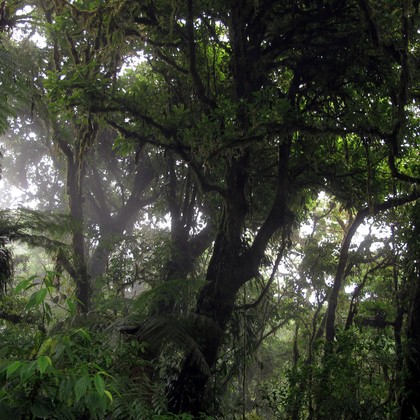
Understorey of humid montane forest and cloud forest on the middle slopes, roughly between 800 and 1800 m. It lives in small groups and joins mixed flocks in the understorey.
Where the bird is most at home, classified by the vegetation units of Mexico and Central America.

Range and movements
Mountains of eastern Panama in Darién, including the Tacarcuna massif and Cerro Pirre, and adjacent north-western Colombia. Resident.
How and when to look
Seen only on treks of several days into the mountains of Darién National Park, such as to Cerro Pirre from the former Cana field station; such trips are organised only with guides and depending on the security situation.
Conservation status
Not threatened (LC). The range within the guide area is small and remote, but the forest is largely intact and lies mostly within Darién National Park.
Scientific name
Basileuterus tacarcunae | Chapman, 1924
Chapman described the species in 1924 and placed it straight away in the genus where it still stands. The genus Basileuterus was introduced in 1848 by Cabanis. Basileuterus is Greek, from basileuteros 'more kingly', after the coloured crown stripe recalling a little crown. tacarcunae refers to Cerro Tacarcuna in Darién (Panama), where the species was discovered. The specimen the first description was based on came from Cerro Tacarcuna, Darién, Panama.