All species › Tubenoses › Petrels, shearwaters and diving petrels › Black-vented Shearwater
Position in the tree Birds Aves › Birds with a flexible palate Neognathae › All other modern birds Neoaves › Birds of the elements Elementaves › Tropicbirds and waterbirds Phaethoquornithes › Core waterbirds Aequornithes
Black-vented Shearwater | Puffinus opisthomelas
Zwartbuikpijlstormvogel | Pardela mexicana
The Black-vented Shearwater breeds almost only on a few islands off the west coast of Baja California, making it a species of Mexico. Most of the world population breeds on tiny Isla Natividad. Unlike most shearwaters it stays close inshore, so it is often visible from land, sometimes in long lines or large flocks.

Voice
Silent at sea. In the colonies at night hoarse, moaning and rasping calls, from the burrows and in the air.
Recording: Justyn Stahl — CC BY-NC-SA 4.0 · converted to mono · xeno-canto
Identification
32–37 cm. A medium-sized shearwater with fairly short, narrow wings. Upperparts, tail and head dark greyish brown, without a sharp border to the dingy white throat; the neck side is often mottled or washed grey. Underparts white, with dark flanks and dark undertail coverts. The underwing is white with broad, diffuse dark margins and often greyish coverts. Bill slender and dark, legs pink with a dark outer side. Flies low over the water with series of quick, stiff beats and short glides. Sexes alike.
Confusion species
Townsend's Shearwater Puffinus auricularis is blacker above, with a sharp border between black head and white throat and a white flank patch reaching onto the side of the rump. Galapagos Shearwater Puffinus subalaris is smaller, with darker upperparts and a quicker, fluttering flight, and occurs mainly further south. Manx Shearwater Puffinus puffinus, very rare on this coast, is black and bright white, with white undertail coverts. Pink-footed Shearwater Ardenna creatopus is much larger, with a pink, dark-tipped bill and a slower flight.
Habitat
Coastal water over the continental shelf, often within a few kilometres of the shore and in bays; less often far out at sea. Eats small schooling fish such as anchovies and sardines, and squid, caught at the surface or by diving. Breeds in burrows and rock crevices on bare or sparsely vegetated islands.
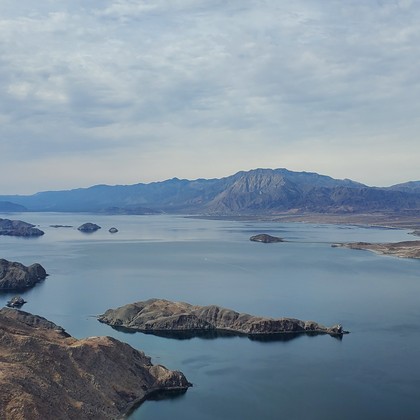
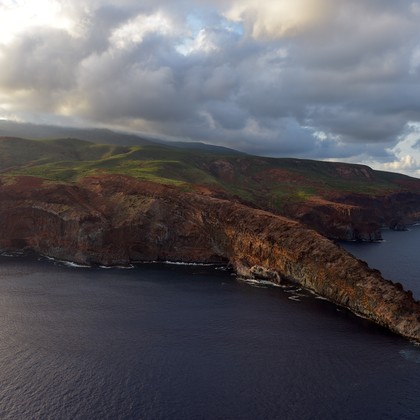
Where the bird is most at home, classified by the vegetation units of Mexico and Central America.


Range and movements
Breeds on islands off the west coast of Baja California: mainly on Isla Natividad, and further on the San Benito Islands and Isla Guadalupe. Present all year off the Pacific coast of Baja California, and in autumn and winter also numerous in the Gulf of California. Outside the breeding season some move south along the west coast of Mexico to Oaxaca, Guatemala and El Salvador; further south there are only a few reports, to Costa Rica. Outside the guide area the species appears mainly in autumn and winter off the coast of California, in some years north to Monterey.
- Resident
- Summer visitor (c. Apr–Sep)
- Winter visitor (c. Oct–Mar)
- Passage (Mar–Apr, Oct–Nov)
- dark = core range, pale = thinly spread
How and when to look
From the coast of Baja California, such as at Ensenada and in the bays on the Pacific side, and from ferries in the Gulf of California, flocks are often visible from land. The brownish tone, dingy head and dark undertail separate it from the black-and-white Townsend's Shearwater.
Conservation status
Near Threatened. Because almost the entire world population breeds on a few islands, the species is vulnerable to disturbance there. Introduced cats and goats have been removed from the breeding islands, but burrow collapse caused by trampling, fishing settlements on the islands, bycatch in nets and oil pollution remain threats.
Scientific name
Puffinus opisthomelas | Coues, 1864
Coues described the species in 1864 and placed it straight away in the genus where it still stands. The genus Puffinus was introduced in 1760 by Brisson. Puffinus comes from English puffin and its variants, the name for the cured nestling of the shearwater, once a delicacy. opisthomelas is Greek, from opisthe 'behind' and melas 'black': 'black-backed', after the dark upperparts. The specimen the first description was based on came from Cabo San Lucas, Baja California Sur, Mexico.