All species › Tubenoses › Petrels, shearwaters and diving petrels › Townsend's Shearwater
Position in the tree Birds Aves › Birds with a flexible palate Neognathae › All other modern birds Neoaves › Birds of the elements Elementaves › Tropicbirds and waterbirds Phaethoquornithes › Core waterbirds Aequornithes
Townsend's Shearwater | Puffinus auricularis
Townsends pijlstormvogel | Pardela de Revillagigedo
Townsend's Shearwater is a small black-and-white shearwater that breeds only in the Revillagigedo Islands far off the west coast of Mexico, and today only on Isla Socorro. This makes it one of the rarest seabirds of the guide area. The related Newell's Shearwater of Hawaii was formerly included in the same species.

Voice
Silent at sea. In the colony at night rhythmic, hoarse and rasping calls, from the burrows and in the air.
Recording: Alán Palacios — CC BY-NC-SA 4.0 · converted to mono · xeno-canto
Identification
31–35 cm. A small, slender shearwater with fairly short wings and a short tail. Upperparts, head to below the eye and tail black, sharply demarcated from the white throat and underparts. A white flank patch reaches onto the side of the rump and is often obvious in flight. The undertail coverts are black. The underwing is white with broad black margins and a dark patch at the axilla. Bill slender and dark, legs pink with a dark outer side. Flies low over the water with series of quick, stiff beats and short glides. Sexes alike.
Confusion species
Black-vented Shearwater Puffinus opisthomelas is slightly larger and browner, with a dingy head merging gradually into the throat, greyer underwing coverts and no white patch on the side of the rump. Galapagos Shearwater Puffinus subalaris is smaller and browner, without a white flank patch, and occurs mainly further south. The light morph of Wedge-tailed Shearwater Ardenna pacifica, which also breeds in the Revillagigedo Islands, is much larger and browner, with a long, wedge-shaped tail and a relaxed, floating flight.
Habitat
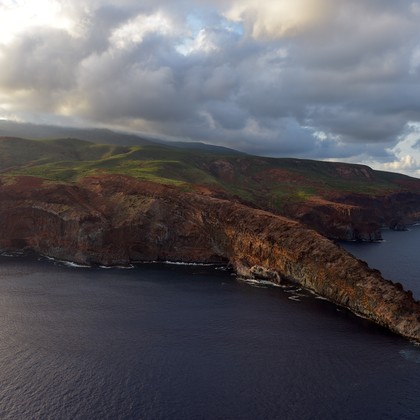
Open, warm ocean around the islands and further offshore; sometimes also over the continental shelf off the mainland. Eats small fish and squid, often in mixed flocks over schools of predatory fish. Breeds in burrows on wooded or vegetated mountain slopes of Isla Socorro, away from the coast.
Where the bird is most at home, classified by the vegetation units of Mexico and Central America.

Range and movements
Breeds only on Isla Socorro in the Revillagigedo Islands. Formerly also on Isla Clarión, where the species has disappeared, and on San Benedicto, where the colony was destroyed by a volcanic eruption in 1952. At sea mainly around the islands and between the islands and the mainland, with records off the coast of Nayarit, Jalisco, Colima and Michoacán and south to off Guerrero and Oaxaca. Because little observation is done at sea, its distribution away from the islands is poorly known.
- Winter visitor (c. Oct–Mar)
- dark = core range, pale = thinly spread
How and when to look
Boat trips to the Revillagigedo Islands and pelagic trips off Jalisco and Colima offer the best chance. Look for the crisp black-and-white pattern, the white flank patch reaching onto the side of the rump and the black undertail.
Conservation status
Critically Endangered. The population is small and confined to a single island. On Isla Socorro feral cats kill breeding birds, and past grazing by sheep degraded the breeding habitat; the sheep have since been removed and a control programme against the cats is under way.
Scientific name
Puffinus auricularis | Townsend, 1890
Townsend described the species in 1890 and placed it straight away in the genus where it still stands. The genus Puffinus was introduced in 1760 by Brisson. Puffinus comes from English puffin and its variants, the name for the cured nestling of the shearwater, once a delicacy. auricularis is Medieval Latin for 'eared', from auricula 'little ear', after the dark ear-coverts reaching below the eye. The specimen the first description was based on came from Clarión Island, Revillagigedo Islands, Mexico.